



Consumer trust drives success in today’s global marketplace, but for Muslim beauty enthusiasts, trust encompasses far more than product efficacy or ingredient transparency. The halal cosmetics revolution represents a fundamental shift from niche religious accommodation to mainstream quality assurance, yet this transformation has revealed a critical misunderstanding that affects the spiritual practice of millions of Muslims worldwide.
The assumption that “halal certified” automatically means “wudu-friendly” has become one of the most significant misconceptions in Islamic beauty standards. This distinction isn’t merely academic—it directly impacts the validity of Muslim worship and the spiritual integrity of daily religious practices.
The Divine Standard: Why Cosmetic Purity Matters
Islam establishes clear requirements for ritual purity that extend beyond internal cleanliness to encompass external barriers that might prevent proper ablution. The Quran commands: “O you who believe! When you prepare for prayer, wash your faces and your hands up to the elbows, rub your heads, and wash your feet up to the ankles” (Quran 5:6).
This divine instruction requires water to reach every part of the skin during wudu (ablution). The Prophet Muhammad (peace be upon him) emphasized the critical importance of complete water contact: “A man performed ablution and left a small part on his foot equal to the size of a nail unwashed. The Prophet saw that and said: ‘Go back and perform your ablution properly.'”
This prophetic guidance demonstrates that even the smallest barrier can invalidate ablution and prayer. For Muslim consumers, this creates a dual requirement: cosmetics must be both halal (religiously permissible) and wudu-friendly (allowing proper ablution).
The Critical Distinction: Halal vs. Wudu-Friendly
Understanding Islamic cosmetic requirements involves recognizing three distinct categories:
- Halal (Permissible) Products free from prohibited ingredients such as pork derivatives, alcohol, and other haram substances. Manufacturing processes must comply with Islamic law, but halal certification alone doesn’t address whether products create barriers to proper ablution.
- Wudu-Friendly (Ablution-Compatible) Products that allow water penetration during ablution, ensuring worship validity. This requires breathable formulations that don’t create impermeable films. A product can be halal yet still problematic for wudu if it prevents water from reaching the skin.
- Toxic/Harmful (Potentially Haram) Products containing harmful substances may be considered haram regardless of ingredient source. Islamic law prohibits anything causing bodily harm, as the Quran states: “And do not throw yourselves into destruction” (Quran 2:195).
The Wudu Challenge: When Beauty Meets Worship
Modern cosmetic formulations often create impermeable barriers through polymers, silicones, and film-forming agents designed for long-lasting wear and water resistance. While serving cosmetic purposes, they can conflict with Islamic worship requirements.
Common Problematic Ingredients:
- Acrylates and film-forming polymers creating waterproof barriers
- Silicones that repel water and create occlusive layers
- Long-wear formulations specifically designed to resist water penetration
- Traditional nail polish creating complete barrier films
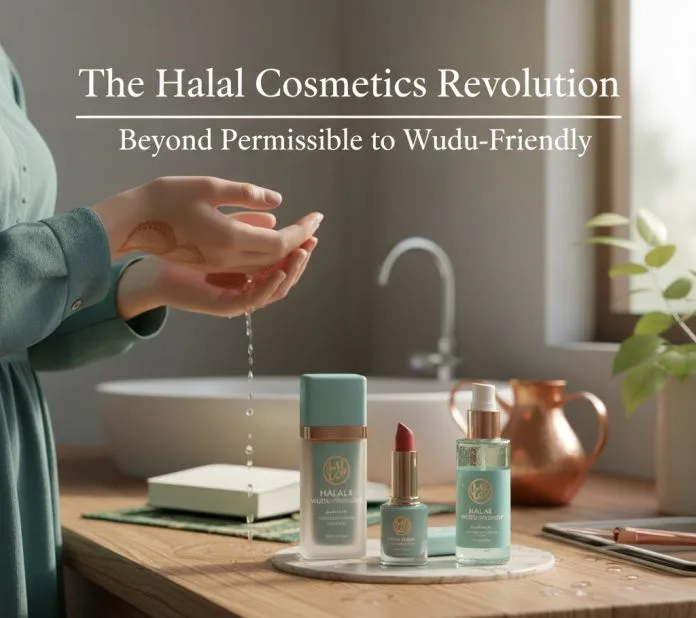
Nail polish presents the clearest example of this challenge. Traditional formulations create impermeable films preventing water from reaching the nail bed during ablution. Despite potential halal ingredient certification, these products remain incompatible with proper wudu performance.
Global Market Transformation
The halal cosmetics market has experienced unprecedented growth, projected to reach $52 billion by 2025, driven by both Muslim consumers and broader clean beauty movements. Major brands including Unilever, L’Oréal, and Procter & Gamble have introduced halal-certified lines, while specialized brands like Wardah and Iba Cosmetics have established significant market presence.
However, this rapid expansion has sometimes prioritized marketing over the nuanced requirements of Islamic cosmetic compliance.
Health and Harm Considerations
Islamic jurisprudence extends beyond ingredient permissibility to consider health impacts. Substances causing harm may be considered haram regardless of source or manufacturing process.
Potentially Harmful Ingredients Under Islamic Review:
- Heavy metals (lead, mercury, chromium) accumulating in body tissues
- Endocrine disruptors interfering with hormonal systems
- Carcinogenic colorants linked to cancer risks
- Harsh preservatives causing allergic reactions
- Toxic solvents affecting respiratory or neurological health
Halal Watch World: Setting the Gold Standard
Recognizing the complexity of Islamic cosmetic requirements, Halal Watch World has established comprehensive certification protocols addressing both halal compliance and wudu compatibility through religious law expertise and advanced product testing.
Our Comprehensive Approach:
- Ingredient Analysis: Complete evaluation for halal compliance
- Manufacturing Audits: Verification of production processes
- Wudu-Friendly Testing: Laboratory analysis of water penetration
- Health Impact Assessment: Evaluation of ingredients for potential harm
- Supply Chain Verification: Ensuring ethical sourcing throughout production
The Nail Polish Challenge: A Critical Case Study
Nail polish represents the most complex category in halal cosmetics. To date, Halal Watch World has not certified any nail polish brand as wudu-friendly after rigorous testing. Laboratory analysis consistently demonstrates that conventional formulations prevent adequate water penetration required for valid ablution.
Current Challenges:
- Base formulations create impermeable films regardless of ingredient source
- “Breathable” claims often lack scientific verification
- Marketing terminology may mislead consumers about water penetration
- Removal requirements between prayers create practical limitations
Innovation and Future Directions
The industry continues evolving toward formulations satisfying both beauty aspirations and religious requirements. Promising developments include water-permeable base formulations, natural wax alternatives, breathable foundation technologies, and temporary cosmetic solutions designed for easy removal.
However, technological promises must be verified through rigorous testing rather than marketing claims alone.
Consumer Guidance: Making Informed Choices
Muslim consumers should prioritize verified certification over marketing claims. Understanding the distinction between halal and wudu-friendly enables informed decision-making honoring both beauty preferences and spiritual obligations.
Practical Guidelines:
- Seek comprehensive certification addressing both halal and wudu-compatibility
- Understand which product categories typically create barriers
- Verify testing claims for “breathable” or “wudu-friendly” products
- Consider usage timing around prayer schedules
- Prioritize spiritual requirements over cosmetic preferences
Conclusion: Trust Through Comprehensive Compliance
The halal cosmetics revolution has achieved remarkable growth yet revealed critical gaps between marketing claims and religious reality. True service to Muslim consumers requires understanding that beauty products must facilitate rather than hinder religious practice.
Halal Watch World’s comprehensive certification approach—addressing ingredient compliance, manufacturing standards, health considerations, and wudu compatibility—provides the complete assurance Muslim consumers deserve. The future of Islamic cosmetics lies in developing products that honor both beauty aspirations and spiritual requirements through rigorous certification, scientific testing, and religious expertise.
In a world where cosmetic choices affect spiritual practice, comprehensive certification becomes essential. Trust in beauty, but verify through knowledge. Trust in Halal Watch World for complete Islamic compliance that honors both your beauty goals and spiritual obligations.