


Shading—The Hidden Threat in a Skyrocketing Solar Market
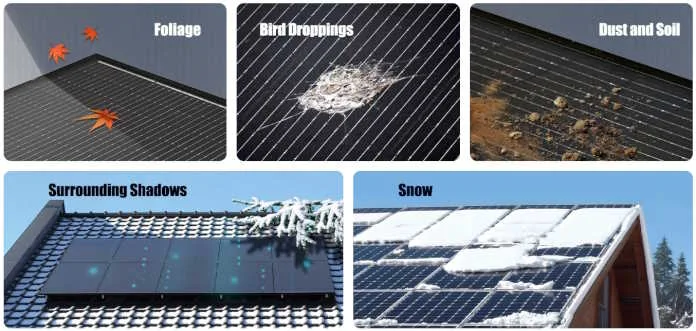
In 2025, with over 2,000 GW of global solar capacity installed, adoption is expanding fast—especially in balconies, RVs, and off-grid setups. But with that growth comes a persistent challenge: shading.
Even light obstruction from a tree or railing can drastically cut output and trigger hotspot effects, reducing system life and safety. Traditional panels aren’t built for these everyday realities.
That’s why Sungold developed Cell-Level Shadow Management Technology —a smarter way to keep solar panels efficient, even under partial shade.
What Causes Energy Loss in Partially Shaded Solar Panels?
Shading doesn’t just lower energy yield—it disrupts the internal flow of current in a solar module. In conventional designs, when one cell is shaded, the increased resistance can cause the entire row to underperform or even shut down. Over time, this imbalance causes heat to build up in specific areas—commonly known as hotspots—which can lead to:
- Delamination
- Burnt backsheets
- Fire risks
- Reduced lifespan
- Energy losses up to 100% in affected areas
Given the unpredictability of real-world conditions—clouds, nearby objects, or time-of-day effects—solar panels need smarter, more resilient ways to adapt.
How Does Cell-Level Shadow Management Work?
Sungold’s Cell-Level Shadow Management Technology addresses this head-on by integrating smart current routing elements directly within the panel. When a cell is shaded, this technology automatically redirects the current around it, maintaining the overall energy output and preventing heat accumulation.
This intelligent circuitry allows each cell to respond independently to varying light levels. Unlike conventional panels where a single shaded cell can pull down the performance of its neighbors, Sungold panels localize and isolate the issue, ensuring that the rest of the module continues performing optimally.
This marks a shift in the solar industry: rather than managing shading losses downstream at the inverter level, we bring shade resilience directly into the panel architecture.
Real-World Test Results: Sungold vs Traditional Panels
We put our anti-shadow panels to the test in real-world shading conditions, comparing them directly with traditional models. Here’s what we found:
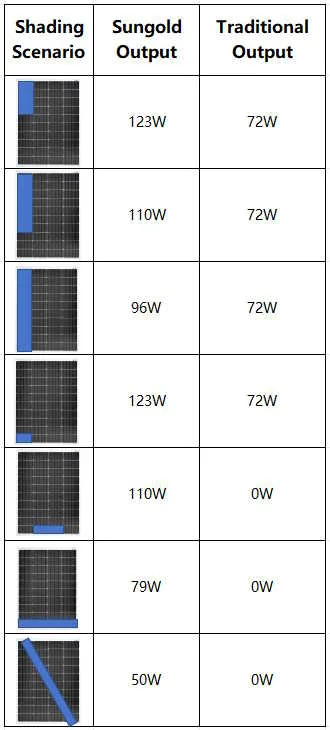
Under full sunlight and no shading, the traditional panel delivered a rated output of 150W, while the Sungold’s panel produced 140W—a comparable baseline.But across a range of real-world shading scenarios, Sungold panels retained between 36% and 88% of their rated output, depending on shading position. In contrast, traditional panels frequently dropped to 0W, failing entirely under moderate to critical shading.
Flexible and Ready: PA219 in Real-World Applications
To bring its shadow-resistant technology into real-world environments, Sungold developed the PA219 flexible solar panel —a lightweight, durable, and highly adaptable solution for scenarios where space is limited and shading is unavoidable.
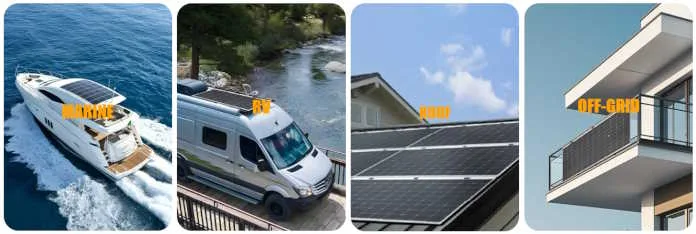
Whether it’s a curved RV roof, a yacht deck, or an urban balcony partially covered by railings, PA219 combines mechanical flexibility with stable power delivery under partial shade, making it an ideal fit for mobile and off-grid solar setups.
Final Thoughts
Shading is inevitable—but energy loss doesn’t have to be. With Sungold’s Cell-Level Shadow Management Technology, your solar investment stays strong, even in less-than-perfect conditions.