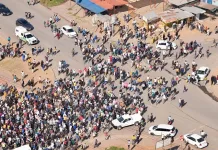




PRETORIA, GAUTENG — Amidst escalating South Africa immigration protests targeting undocumented foreign nationals, African National Congress (ANC) National Executive Committee member Dakota Legoete has addressed the ongoing unrest. Speaking on the widespread demonstrations, Legoete outlined the ruling party’s position on border control, the legal rights of citizens, and the urgent need to enforce immigration laws while condemning violent civil disobedience.
The ANC’s Stance on Protests and Violence
The nationwide protests, organized by citizens demanding government action against undocumented migrants, have seen march organizers vow to sustain their demonstrations until their demands are met. In response, Legoete expressed the ANC’s sympathy toward the challenges South Africans face regarding migration. While affirming the constitutional right to peaceful protest, he drew a strict line against violence, looting, vigilantism, and civil disobedience, warning that such actions disrespect the rule of law and threaten national security.
International Treaties and Sovereignty
A central pillar of Legoete’s address was the enforcement of international and regional frameworks. He emphasized that undocumented individuals must respect the 1967 Organization of African Unity (OAU) protocols and the 1949 Geneva Convention, specifically the 12 treaties defining the legal distinctions between refugees, asylum seekers, and economic migrants. He referenced the 1884 Berlin Conference, noting that colonial-era borders require documentation for cross-border movement. He argued that South Africa’s territorial integrity is being disrespected, claiming the nation is being blackmailed into silence by individuals entering without documentation. Furthermore, he pushed back against foreigners acting as “bogus kings” within a nation governed by its own traditional leaders.
Constitutional Rights and Diplomatic Engagement
Referencing Section 21 of the Bill of Rights, subsections 3 and 4, Legoete highlighted that the right of residence is reserved for documented citizens and that all citizens must be documented. He called on the government to establish a permanent interministerial committee to manage immigration comprehensively. Furthermore, he urged the Department of International Relations and Cooperation (DIRCO) to engage with foreign diplomats, the African Union, and the UN Commission on Refugees. Addressing concerns about South Africa’s image—especially after an economist suggested the country is becoming a “pariah state” on the continent due to travel alerts and citizen repatriations by neighboring countries—Legoete agreed the issue must be confronted. He proposed that the Presidency issue convoys to clearly communicate South Africa’s case regarding its own struggles with poverty and hunger.
Unrest in Mpumalanga and Security Concerns
The interview also touched upon the volatile situation on the ground, specifically in the Mashishing area of Mpumalanga, where residents have blockaded roads with burning tires. Locals expressed deep frustration over a surge in drug peddling and abuse, which they attribute to foreign nationals. As the chair of the portfolio committee on defense, Legoete noted the deployment of the South African National Defence Force (SANDF) in areas like Hillbrow, Gauteng. Describing South Africa as an “activist country” with over 300 years of battle, he warned that citizens will not allow others to do as they please. However, he stressed that citizens with grievances should report issues to the police rather than resorting to vigilantism.
Corruption and the Call for Consequence Management
Legoete did not shy away from criticizing the state’s own failures, blaming “dishonest officials” within the police, Home Affairs, defense, and intelligence sectors for enabling corruption. He alleged that citizenship has been sold at borders, leading to severe security lapses. He demanded strict consequence management for these corrupt perpetrators. Highlighting the severity of the crime crisis, he noted that over 29,000 people are killed by criminal elements annually, and police dockets remain unfinished because many suspects are not captured in the Home Affairs system.
Socio-Economic Pressures
Addressing the root causes of the public’s anger, Legoete pointed to the severe socio-economic pressures facing the country. He noted that while 18 million people receive SASSA social grants, an estimated 32 million go to bed hungry daily, and over 12 million are unemployed. He argued that the influx of undocumented economic migrants—fleeing no civil wars in their home countries—exacerbates the competition for scarce jobs. He concluded by urging a decisive government response to address these legitimate grievances and restore peace, warning that unchecked civil disobedience is a slippery road that could lead to severe national instability or even civil war.