



Yoojin Park’s team reframes micro-housing as a starting point for social reconnection and a response to generational housing challenges
Buildner, in collaboration with Kingspan, has announced the winners of the seventh annual MICROHOME architecture competition—an international platform that invited architects and designers from 115 countries to envision the future of small-scale, off-grid living. Among the awarded projects is Home Coming Home, a concept by Yoojin Park, Sanghyo Kim, and Ju Sang Lee that expands the definition of compact living to include not just spatial efficiency, but also social meaning.
Conceived as a modular residence for a hypothetical young professional couple, the project responds to a complex matrix of urgent issues: declining birth rates, growing economic precarity, and a worldwide housing shortage. “This project began with a question,” says team leader Yoojin Park. “What kind of home could actually make it possible for a young couple to start their life together in today’s world?”
In many countries—particularly Park’s native South Korea—the declining birth rate reflects a broader societal shift. Younger generations are reevaluating traditional paths like marriage and parenting, often deterred by the economic and emotional weight of securing a stable domestic life. The rising cost of real estate has made home ownership a distant dream for many, turning the basic idea of “starting a family” into a major life hurdle.
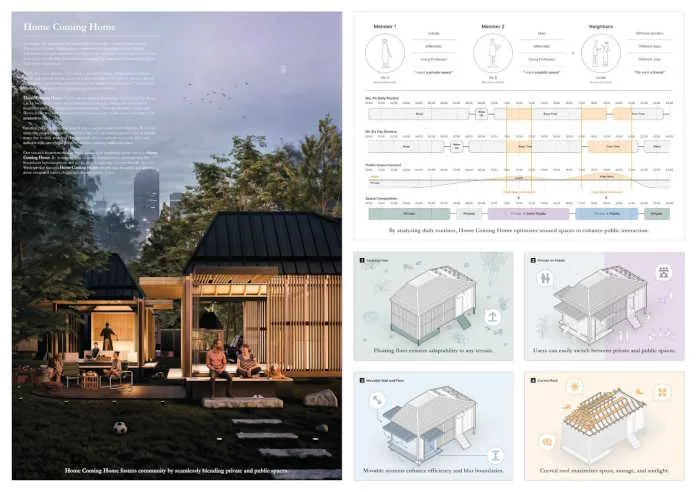
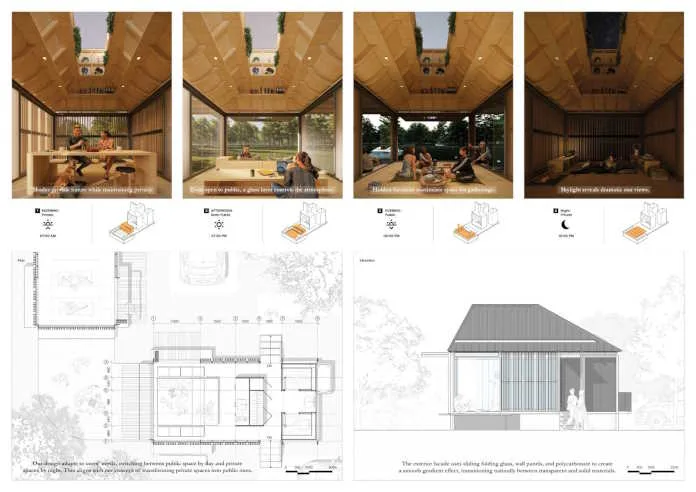
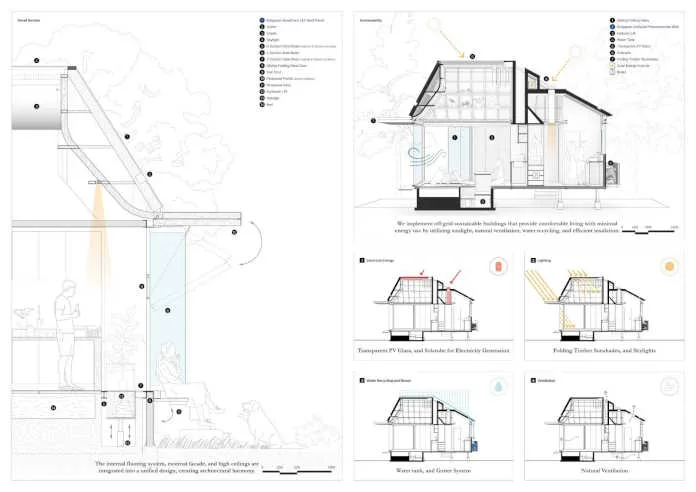
Home Coming Home is an architectural response to this shifting landscape. Rather than treat the young couple as a generic user profile, the team took them as a real subject shaped by contemporary pressures—two working individuals navigating limited space, time, and resources. The resulting design offers a flexible micro-home with transformable interiors that respond to daily rhythms, allowing rooms to shift between private use and public engagement.
At its core, the proposal reclaims the social function of housing. Through movable façades and modular flooring, spaces evolve over time, enabling residents to activate unused areas during off-hours—for example, transforming living quarters into co-working zones during the day. The concept doesn’t just stretch square meters; it stretches time, use, and purpose.
Beyond spatial adaptability, the design also introduces a selectively shared infrastructure between neighboring units. In recognition of today’s emphasis on community and shared values, the project imagines a new typology in which private homes can momentarily open into collective zones—redefining micro-living not as isolation, but as invitation.
“‘Home Coming Home’ is about restoring housing as a social connector,” says Park. “We wanted to show that even within the tight parameters of micro-living, architecture can foster reconnection—not just practically, but symbolically as well.”
In aligning personal needs with collective aspirations, Home Coming Home stands out as more than a spatial exercise. It is a conceptual framework rooted in empathy, aimed at lowering the threshold—both economic and psychological—for starting a home, and by extension, a future.
The design resonates with the MICROHOME competition’s broader objectives: to promote sustainable, affordable, and community-forward solutions. By treating architecture as a medium for social inquiry as much as spatial invention, Park and his team offer a model for how design can actively engage with the urgencies of our time.
Project Team
- Yoojin Park – Team Leader
- Sanghyo Kim – Team Member
- Ju Sang Lee – Team Member
About MICROHOME
MICROHOME is an annual competition organized by Buildner in partnership with Kingspan and other industry leaders. Focused on off-grid, modular living, it challenges designers to develop innovative, replicable housing solutions that address pressing global issues—from sustainability and affordability to social cohesion and urban adaptability.