
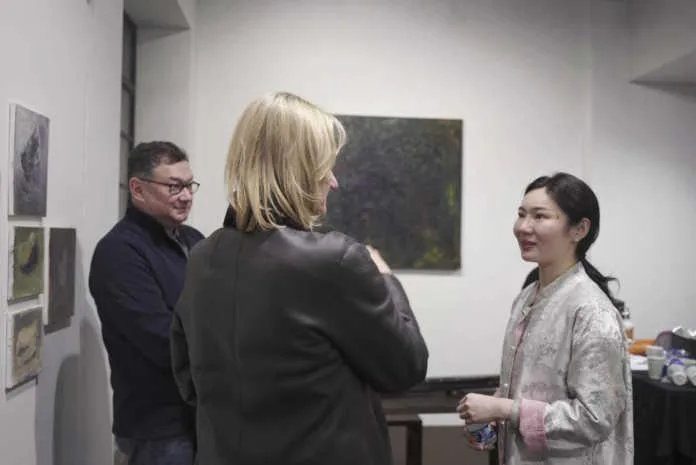
From January 23 to 30, 2025, ArtsWestchester in White Plains, New York, hosted Relations and Being, the Duo Exhibition exploring themes of human connection, identity, and the essence of existence. Among the exhibiting artists was painter and musician Yiting Liu, whose two featured works, Tian Wen and Universe Earth Man II, offered a contemplative and resonant exploration of existence and interconnection.
Liu’s work, rooted in traditional Chinese aesthetics and philosophy, exists at the intersection of sound, image, and spirit. With brushwork that evokes rhythm and compositions that reflect on nature and selfhood, she invites audiences to consider what it means to exist.
We spoke with Liu about the meaning behind her works and the personal and philosophical undercurrents that shape her practice.
Q: What inspired your Tian Wen series, and what would you like audiences to feel when standing in front of it?
A: The series began during a long period of creative doubt, when I felt disconnected from my own voice. That was when I encountered Tian Wen—a poem by Qu Yuan, a Chinese poet and statesman from the 3rd century BCE. He composed it after suffering political exile and national collapse, asking hundreds of questions to the heavens about the origin of the universe, myths, and ultimately his own fate.
I was struck by how he responded to despair by seeking meaning in the cosmos. That act became a kind of blueprint for me. In my paintings, I use stone and water as metaphors: stone as a marker of time and being; water as the silent, fluid echo of universal consciousness. I want viewers to feel that even in uncertainty, there is value in asking. As I see it, you don’t need to become someone else; your honest existence is already precious.

Q: Many of your works use oil, charcoal, and ink. What do these materials help you express?
A: The medium I use is never neutral—it carries its own meaning. Oil, with its weight and depth, holds layers like sediment. It’s ideal for conveying the passage of time, memory, and the grounded quality of existence. Charcoal, on the other hand, feels volatile and immediate. It allows me to express movement, emotional intensity, and fleeting sensations. Ink and water introduce another dimension: fluidity, unpredictability, and impermanence. I often let water flow and stain freely, because life itself resists control. The way I choose and use materials reflects how I see the universe: at once structured and chaotic, solid and constantly shifting.
Q: You have a background in Guqin music. How does that influence your painting?
A: Deeply. The Guqin’s sound follows the rhythm of breath—it relies on silence as much as tone. That rhythm finds its way into my visual work. In Tian Wen, for instance, I used thick, grounded shapes contrasted with flowing, brushy layers to mimic Guqin tones: “pressed,” “floating,” and “plucked.” Some strokes feel like a pulse, others like an echo.
I performed live Guqin during the exhibition. One visitor, unfamiliar with meditation, told me the experience helped her find inner quiet. That meant a lot to me. I hope viewers can “hear” the rhythm behind the images, even if only intuitively.
Q: What themes or directions are you exploring next?
A: I’ll continue working around the question of existence—especially through the lens of time, rhythm, and personal history. One direction is to collaborate with sound artists and explore multimedia installations that create immersive, sensory environments. I’m also developing a more intimate body of work about female bodily awareness: how memory and emotion are held in the body, how cycles shape our lives.
Through brush, breath, and silence, Yiting Liu continues to explore what it means to exist. In Relations and Being, her paintings offered a form of quiet defiance—a way to hold space for uncertainty, rather than escape it. What matters most in her work isn’t resolution, but the willingness to keep searching, even when the answer remains uncertain.