


The problem behind inconsistent P&L
Most active traders don’t lose because they can’t read a chart. They lose because two silent forces chip away at every edge: overtrading and a fee drag. Overtrading happens when decisions are made all day, everywhere, with no rules about when to act. Fee drag compounds the damage — taker/maker fees, spreads, and small slippage stack up over dozens of clicks. The result is familiar: plenty of motion, not enough progress. I’m talking about short-term traders, not the guys who tend to hold their trades forever.
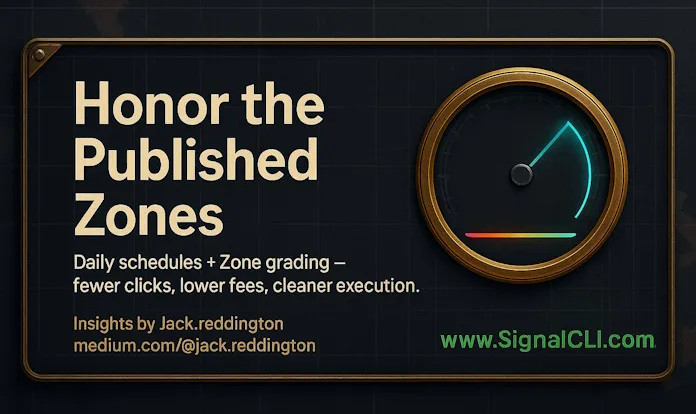
The good news: two operating constraints can break the cycle — a daily schedule and Zone grading. The schedule limits when you engage. Zone grading limits which moments deserve attention. Used together, they reduce the number of low‑quality decisions you can even attempt and lower the percentage of gross P&L that disappears into frictions.
What a daily schedule actually does
A daily schedule is a signal’s provider‑published list of Zones (time periods) for the current day. Each Zone has a Zone grade attached to it (Green, Yellow, or Red) based on live and historical outcomes. Your job isn’t to invent windows; it’s to choose which published Zones you’ll engage and which you’ll skip.
Schedules do four things well:
- Calibrate attention. When the schedule is off‑Zone, you’re off. No doom‑scrolling between Zones.
- Force selectivity. Acting only inside designated Zones shrinks the number of low‑quality decisions you can even attempt.
- Sync with participation. Zones tend to align with recurring liquidity/volatility cycles—not random minutes.
- Enable auditing. Because Zones are predefined, you can review performance by Zone and grade across days/weeks.
What Zone grading is — and isn’t
Zone grading is the label attached to each published Zone (time period) in the daily schedule. A Zone is context, not a signal; it answers “is this Zone worth my attention?” before you even look at a chart.
Plain‑English rule: Green = best time to trade, Yellow = approach with caution, Red = stay away.
Zones are computed from continuous monitoring of trade outcomes and refreshed at least daily. A time period isn’t labeled at random: if 14:00–15:00 UTC appears as Yellow, it’s because recent results sit below the Green threshold defined from historical data. The grade reflects measured performance, not guesswork.
How Gradients refine timing inside a Zone
Gradients are a Zone‑level weighting applied to a Zone. Not every Green Zone behaves the same. Gradients score the Zone using historical performance: if this Green Zone has consistently behaved well, it will be presented as Green 100%. If it has occasionally underperformed, you may see Green 90/10 (a hint of Yellow mixed in): which doesn’t mean it’s no good and should be stayed away from; it just means – caution advised.
Use the Gradient to set participation and size. Green 100% — run your full playbook. Green 90/10 — still trade, but keep size around ~80% and have a recovery plan ready. If the Gradient tilts the other way (e.g., Yellow with a Green component), treat it as workable with caution or skip entirely, depending on your rules. Gradients don’t replace the Zone grade; they refine it so expectations and risk are aligned.
Why schedules + Zones cut overtrading
Overtrading loves unlimited time and unlimited discretion. Schedules kill the first; Zones constrain the second. The combination removes most of the moments that typically lure traders into fatigue clicks — late entries, chase entries, and boredom trades. What remains are fewer, higher‑quality decisions inside Zones that historically behave better.
There’s also the emotional benefit: a schedule and Zone plan clarify when not to trade. Knowing “outside scheduled Zones I do nothing” is the single fastest way to avoid revenge clicks after a loss and FOMO clicks after a win.
Where fee drag actually hides (and how the combo lowers it)
Fees are marketed as tiny, yet they bite into results. A clear example: MEXC. The website advertises a 0.04% taker fee, but the real round‑trip cost lands around 30% on a small $10 trade when traders use leverage. You won’t see that number plainly in the UI; but you can infer it: check the realized PnL field at entry, then double it — that gets you close to the effective fee hit. Marketing highlights the headline rate; the effective cost is what matters.
Zones and Gradients help you manage those exchange realities. Green Zones typically deliver moves large enough to clear costs, reduce unnecessary clicks by concentrating activity into cleaner windows, and often resolve faster — cutting exposure to news, whales, and other shocks you can’t predict. This does not mean you close CryptoPanic or ignore calendars; it means conditions are better defined, so confidence rises and errors fall.
A simple operating framework
Found a solid signals provider? Good. But that does not replace your strategy. A credible provider acts as a trading assistant, not a strategy substitute. What is expected from a trading assistant is: unified indicator, direction‑only read so you can check other market conditions quickly and make a decision on the spot. Price specified will sort of give you an idea what’s going on: but you might as well ignore it – due to price differences between assets on various exchanges. A fantastic example is crypto.com vs. MEXC; $700-$1000 difference on BTC futures price is quite normal; yet renders “price-related” guidance for short term traders – practically unusable. Price movements, charts – that’s a different story. Those do tend to rhyme across exchanges; therefore your primary focus should be directed at two parameters: when and which way.
Layer your judgment on top. Start with the trend (higher‑timeframe and daily). Going against the trend can work too, but it’s riskier. Stay aware of news and scheduled events; no indicator watches headlines for you, so use an aggregator like CryptoPanic. Keep one or two fast checks you trust (for example: structure, momentum, or a simple volatility tell) and keep them simple.
If the signal lines up with your read, no material news is pending, and tape looks clean — execute. If it conflicts, pause and resolve the mismatch. Give setups a moment to mature when appropriate: if the signal points up but a quick pullback is likely, wait for the dip to print and then act. Patience for that first corrective move often improves entries and lowers stress.
Align with the published Zones
Treat the daily schedule as your operating framework. You don’t set ad‑hoc windows; you select the published Zones you intend to work with and refrain from anything else. Choose one Zone and make it your sole focus for a defined period. Set a clear start and stop aligned to that Zone. When the Zone ends, step away — no “just ten more minutes.” Because Zones are predefined, you can review outcomes in the exact context you worked with: Zone, grade, and the Gradient shown at the time. This eliminates most boredom and chase entries and makes your P&L auditable: same hours, same context, cleaner comparisons across days. If a given Zone deteriorates — for example, a Green weakens or liquidity thins — reduce size or pause until conditions improve.
Size by grade and gradient
Position sizing is a policy, not a mood. Define a base size for Green Zones with a strong Gradient. When the Gradient turns neutral, reduce size; if it weakens, treat the Zone as optional or stand aside. Yellow Zones can be tradable when the Gradient is favorable, but use smaller size and tighter risk controls; without that Gradient, skip. In Red Zones, do not trade. This hierarchy keeps you aligned with conditions without over‑engineering. Keep leverage high enough that a clean move matters and margin generous so normal volatility doesn’t create stress. Simple rule of thumb: could you double the position up to five times and still be comfortable? Yes = appropriate. No = adjust size or leverage. Skipping trades is fine. On average, a reliable provider surfaces ~10–16 signals per hour (or ~4–6 if you stick to a single mode). With average trade time around 10 minutes, there is always another signal — no chasing required.
Instead of conclusion
The bottom line is, the more information you have – the better off you are. Having a verified schedule with preferred times to trade – will help you to boost your trading overall. Getting signals – that are ultimately – unified indicators – will save your time on running analysis on your own. Operating in green zones – will give you an edge against exchange algorithms, whose objective (let’s be honest here) isn’t to protect your interest, but to ensure exchange is profitable. Gradients – will help you to further refine your strategy. Your work will come down to checking news, overall trend, whale activity, and maybe a couple of indicators that you do enjoy using – and that’s it. The goal isn’t bigger trades — it’s better filters. Schedules, Zones, and Gradients reduce avoidable risk and keep fees from swallowing the month.
About SignalCLI
SignalCLI is a crypto futures signals provider focused on clarity, precision, and informed decision-making. Using a combination of established technical indicators, Smart Money Concepts, and advanced AI analysis, SignalCLI delivers structured, data-driven insights to help traders identify high-probability setups in fast-moving markets. The service is designed for those who value disciplined execution, risk awareness, and timing over speculation. For deeper insights and practical examples, visit www.signalcli.com and explore Jack Reddington’s Medium for trading strategies, market breakdowns, and educational articles.