




- A growing interest among wildlife traffickers’ interest in golden lion tamarins threatens one of Brazil’s iconic endangered animals.
- Seizures in Togo, Suriname and in the Brazilian Amazon reveal sophisticated criminal networks that control international routes, sometimes using forged documents.
- Behind one of these criminal organizations is a man with multiple forged passports that subjected 20 tamarins to a 40-day voyage across the Atlantic.
- Some tamarins are smuggled; traffickers also use loopholes in wildlife trade rules to launder wild-caught animals within captive-bred shipments.
Smuggled in cars, aboard airplanes, or on sailboats crossing the Atlantic Ocean, tiny golden-furred monkeys are being wrenched from their Brazilian forest homes and trafficked overseas by sophisticated criminal networks.
These golden lion tamarins (Leontopithecus rosalia) are moved through Latin America and Africa, with strong indications that they are bound for the Asian black market. Collectors are willing to pay as much as $100,000 for this friendly animal, which is one of Brazil’s conservation symbols. Some of the tamarins die before reaching their destination. Those that survive may end their journey emaciated, sick and sometimes, mutilated.
“It is frightening in the sense that [tamarin trafficking] is a threat we believed was relatively under control,” said Luis Paulo Ferraz, executive secretary of the Golden Lion Tamarin Association (AMLD), which has led an international effort to preserve the species since the 1990s.
In recent years, his team has increasingly encountered people venturing deep into the forests of Rio de Janeiro state to capture these animals. “Our field team started coming face to face with these guys, to the point that I became deeply concerned about having my staff working in areas where criminals were operating.”
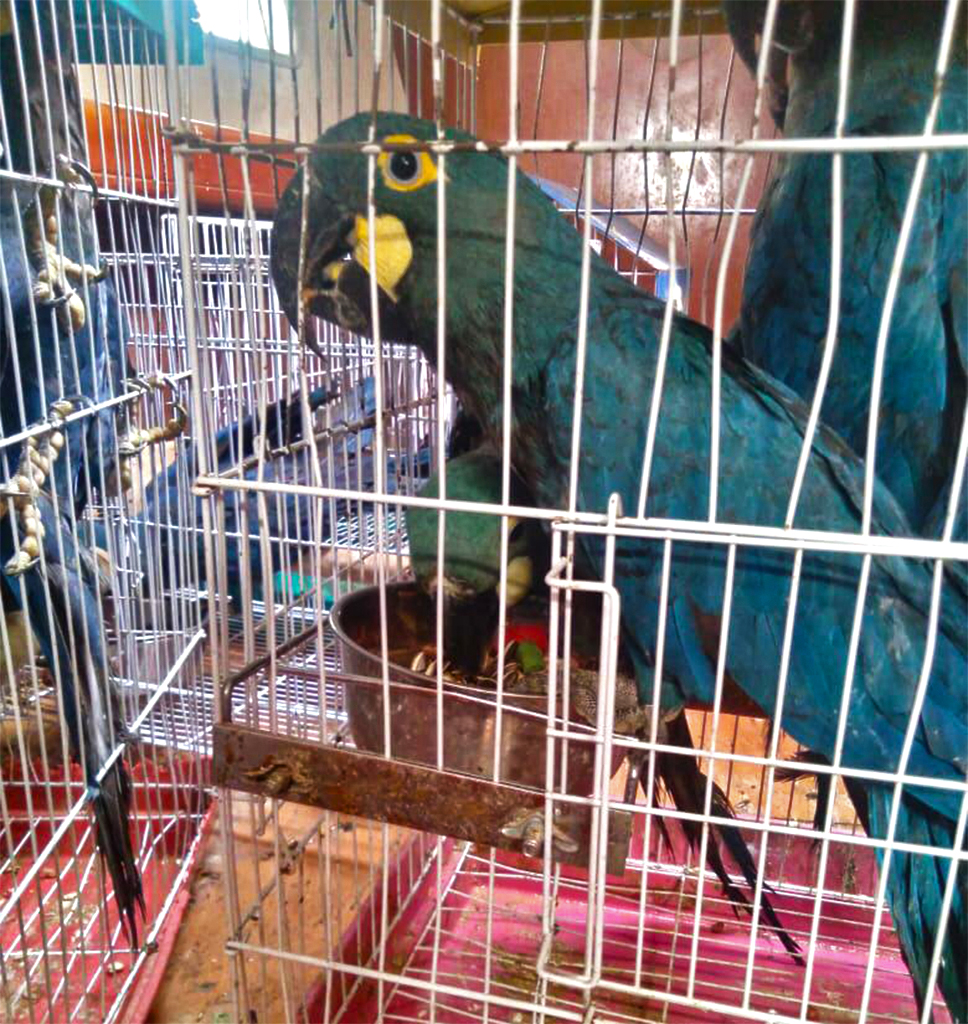
The golden lion tamarin, featured on Brazil’s 20-real banknote, drew the attention of the Brazilian Federal Police in 2023 after seven of these monkeys and 29 Lear’s macaws (Anodorhynchus leari), another species native to Brazil, were seized at a captive facility in neighboring Suriname.
In February 2024, authorities in Togo were startled to find the same two species — 20 tamarins and 12 macaws — aboard a sailboat that had broken down while navigating along the West African coast.
A few months later, a driver traveling along a highway in the Brazilian Amazon, the BR-364 in Rondônia state, was stopped by the Federal Highway Police. While searching his vehicle, they discovered that he had eight golden lion tamarins and three black-tufted marmosets (Callithrix penicillata) in cages in the back seat.
In testimony, the driver said he’d been paid 25,000 reals (about $4,500) to pick up the animals in the southeastern state of Minas Gerais, and transport them to the city of Pacaraima, on the border with Venezuela. He said that he had recently transported another six golden lion tamarins along the same route.
The Federal Police concluded that the case was yet another link in the intricate global wildlife trafficking network. “Pacaraima is a well-known exit point for wild animals leaving the country, a route for international trafficking,” Raphael Goncalves da Silva, a federal police official who worked on the case, wrote in the indictment order against the driver.
In 2023, the golden lion tamarin population was estimated at about 4,800 individuals. It’s endangered, with limited habitat, confined to a handful of preserved areas in the coastal lowlands of the São João River Basin, in the Atlantic Forest.
Coveted for their striking color, these monkeys have been pulled from the wild as far back as the 19th century, when they were displayed as exotic pets by the European aristocracy.
These captures, combined with the progressive destruction of the Atlantic Forest, nearly wiped out the population. By the 1960s and 1970s, fewer than 200 remained in the wild. An international effort enabled the species’ recovery, which included transferring tamarins from zoos around the world back to Brazil. But this tiny monkey is once again falling prey to international wildlife trafficking.
“It seems to me that, for some time now, something has reignited interest in these animals,” said Juliana Machado Ferreira, executive director of the wildlife trafficking watchdog Freeland Brasil, which was directly involved in the Togo and Suriname investigations.
Forty days of horror
It was an ordinary Saturday in Lomé, the capital of Togo, when residents of a coastal community noticed unusual activity at sea. Two men had abandoned a sailboat and were headed ashore in a lifeboat, carrying cages containing small golden monkeys.
As soon as they reached the beach, one of the men loaded the animals into a taxi and then climbed onto a motorcycle taxi himself. The two vehicles sped away, leaving behind the other man and the rest of the sailboat’s crew, who were dealing with the vessel’s mechanical problems.
“They were making a big mess out of it,” said Ofir Drori, who took part in the rescue operation and is the founding director of the EAGLE network (Eco Activists for Governance and Law Enforcement). “They just arrived on a normal beach with villages and tried to get out of there, but they were attracting a lot of attention,” said Drori, who said his organization has helped secure the arrest of more than 3,000 wildlife traffickers.
Alerted by residents, Togo’s Coast Guard came to the beach and arrested those remaining in the boat, bringing to an end a 40-day journey that had begun on the other side of the Atlantic, in the Brazilian city of Salvador, Brazil. Onboard the vessel, authorities found 12 Lear’s macaws.

The crew of this vessel, the Bella Vita, illustrates the multinational nature of the operation. According to information from Brazil’s Federal Police, Julio Ricardo Gonzalez Polonioli, the sailboat’s owner and captain, was a Uruguayan resident of Salvador. Under his command was Brazilian national Silvier de Almeida da Silva, a sailor and owner of a Brazilian boat maintenance and repair company in São Paulo state. The crew also included Surinamese national Iwan Brigadirie, who was responsible for caring for the animals on board.
Those onboard were arrested. Meanwhile, a man of unconfirmed nationality named by Brazil’s Federal Police as the group’s leader, Alexander Levin, was attempting to cross the border into Ghana, taking the golden lion tamarins with him. He was detained before he could reach the neighboring country, and 17 animals were recovered. Another three monkeys died during the journey.
Those that survived were in terrible condition: emaciated, soaked in seawater, and missing large amounts of fur. They stared in apparent terror through the bars of their cages, and were in extremely bad shape, according to Drori. “We were really fearing for them to die fast.” According to IBAMA, they also had colds and were suffering from mange.
The animals were rescued by Brazil’s then-ambassador to Togo, Nei Bitencourt, who died in 2024. He sheltered them in an improvised hospital set up in his own home.
In February 2024, the tamarins and the macaws were brought back to Brazil to go through a recovery process.
Mongabay reached out to sailboat owner and captain Polonioli and crewmember Brigadirie for comment, but received no response.
Brazilian national Silvier de Almeida da Silva spent nine months in jail in Togo before being brought back to Brazil with support from the Foreign Ministry. In a message to Mongabay, da Silva’s attorney, Telêmaco Marrace, said his client only wanted to gain sailing experience and did not know he was doing anything illegal.
“He had no idea, because documentation for these animals was presented to him. Perhaps the documents were false and he was deceived,” the lawyer said in a WhatsApp audio message to Mongabay. According to Marrace, his client is currently responding to criminal charges in Brazil related to the case.

A master of forged passports
The plan to venture into the open sea aboard a sailboat loaded with rare animals went wrong. However, had it not been for the vessel’s mechanical problems, Levin likely would have reached his destination unnoticed, crossing borders far from the scrutiny of ports and airports.
“His plan was brilliant,” Drori told Mongabay. “If it wasn’t for this malfunctioning, all these golden tamarins would have found themselves already with collectors around the world.”
Levin, whom the Federal Police described as the “individual responsible for the acquisition and subsequent commercialization of the trafficked animals,” ultimately escaped from Togolese authorities, under unclear circumstances.
Nearly everything about him is shrouded in mystery, beginning with his nationality. Levin is thought to be 59 years old, but where he’s from is less clear-cut. He was carrying five forged passports when he was detained in Togo: one from Israel, one from Kazakhstan, one from Russia and two from Belarus. The Brazilian Federal Police refer to him as an “Israeli,” but Levin has described himself on social media as “a Russian of Jewish blood.” Court documents from Canada, meanwhile, state that Levin was born in Ukraine and emigrated to Canada in 1982. US authorities, on the other hand, described him as a Canadian citizen.

In 2014, he was sentenced to 15 months in prison in Canada for kidnapping his 2-year-old daughter, whom he had with a Brazilian woman. Levin abducted the child during a family trip to Ukraine and boarded a flight with her to the Philippines, where he left her in the care of a stranger. Upon confessing to the crime, described as “barbaric” by the Canadian courts, he claimed he wanted to punish his partner for an alleged affair. After nearly four months, the girl was rescued and returned to her mother in Brazil.
Levin had already accumulated convictions for lesser crimes, including theft, use of forged documents and unauthorized possession of a firearm.
In 2017, he again made headlines after being detained with a forged Israeli passport while attempting to enter the U.S. from Mexico. In his luggage, authorities found additional fake passports and equipment used to forge documents.
Levin’s current whereabouts remain unknown, but the Togo case led to a Brazilian Federal Police operation that resulted in the arrest of 10 people on March 12, 2026. Most of them had previous wildlife trafficking offenses and operated in Bahia state, where Lear’s macaws are found. Some of them were later released, but remain under investigation.
According to the Federal Police, the suspects played different roles within the criminal organization. Some captured the animals; others transported them or acted as intermediaries with buyers inside and outside Brazil.
Documents submitted as evidence in the ongoing court case outlined the international scope of this network. “The investigation attributes transnational operations to the group, with branches abroad, mobility, access to resources and the potential use of forged documents and multiple identities, citing the international escape of a foreign leader following the seizure in Togo.”

Traffickers exploited regulatory loopholes
Levin and his associates were carrying CITES permits issued by the government of Guyana “which were identified by that country’s competent authority as inauthentic,” according to the lawsuit currently before Brazilian courts.
As a species at risk of extinction, the golden lion tamarin is subject to CITES strictest rules. The treaty, signed in 1973 to establish standards protecting wildlife from unsustainable trade, currently includes 183 countries and the European Union. Togo, Guyana and Brazil are all signatories.
Animals listed under the most protective category, Appendix I, cannot be exported for commercial purposes, but only for scientific and conservation objectives. The golden lion tamarin is listed on Appendix I.
CITES, however, provides exceptions for commercial breeding facilities that are registered with the convention’s secretariat. Appendix I animals from those breeders may be sold — provided they are accompanied by a favorable finding issued by environmental authorities in the country of origin.
However, there are no facilities registered with CITES for the commercial trade of golden lion tamarins.
CITES provides an additional exception for animals born in noncommercial facilities, which is the case for most accredited zoos. In such cases, a document certifying that the animal was born in captivity is sufficient for a permit. Although the rule was designed for animals bred for noncommercial purposes, such as conservation, education or training, CITES itself created a loophole by allowing the provision to apply to the eventual sale of animals by these institutions.
This latter exception is especially problematic, said Taylor Tench, a senior wildlife policy analyst at the Environmental Investigation Agency in the US (EIA US). “It is confusing — largely up to the interpretation of the exporting country,” said Tench, whose organization investigates and campaigns against environmental crime. “It’s been a longstanding issue at CITES, unfortunately.”
The convention’s loopholes create opportunities for traffickers, who trade animals poached from the wild, move them across borders and sell them as captive bred. According to Ferreira from Freeland Brasil, many of these schemes involve registered breeders who use legitimate documents to “launder” and traffic illegally acquired wildlife.
Endangered animals are sometimes exported using documents issued for another, less protected animal, since customs officials often can’t easily distinguish between species. Smugglers may also mix protected wildlife into a legal shipment. “And then nobody checks which animals are actually there — or you pay [the inspector] not to check,” Ferreira said.
Crossing Amazon borders
Some countries are especially attractive to traffickers as hubs where they can launder and redistribute animals, either because of weak environmental laws or the ease of corrupting public officials. In South America, Guyana and Suriname serve as exit points for animals captured in Brazil, according to a report from USAID, IUCN and the wildlife trade watchdog TRAFFIC.
To reach these neighboring countries, smugglers coming from Brazil cross borders in the Amazon aboard boats and small aircraft, often sharing routes with those trafficking drugs or illegally mined gold.

Suriname came into the spotlight with the 2023 rescue of golden lion tamarins and Lear’s macaws in the capital, Paramaribo. “With this case, it became evident that Suriname is becoming a route for wildlife trafficking,” an official connected to wildlife trafficking investigations in the country, who requested anonymity, told Mongabay.
Brazil repatriated the seven golden lion tamarins and five of the Lear’s macaws. The rest of the macaws — there were 29 in total — were stolen from a garage of Suriname’s National Forestry Service (LBB) hours before the arrival of the Brazilian repatriation team.
Mongabay sent emails asking for more details from the Surinamese Public Ministery (Openbaar Ministerie),the environmental authority (Nationale Milieu Autoriteit) and the Ministry of Land Policy and Forestry (GBB), but received no response.
Another incident involving golden lion tamarins occurred about a year later. This time, a man driving along a highway in southern Suriname claimed he had bought a pair of tamarins from two Indigenous people who were selling them by the roadside. When environmental authorities learned of this, they investigated the area where the animals were allegedly sold. There, they found illegal airstrips — possibly used by drug traffickers. “So our theory is that wildlife could also be coming in the same route,” the anonymous source told Mongabay.
Golden lion tamarins that are fortunate enough to be rescued go through a long rehabilitation process before they can return to the forest — if that’s possible. Some of the animals brought back from Togo and Suriname have already been released into the forests of Rio de Janeiro after receiving care from the Golden Lion Tamarin Association team.
“They have a remarkable capacity for resilience,” said Ferraz from the Golden Lion Tamarin Association. “These animals are heroes of conservation — they are survivors.”
Some of them, however, will have to spend the rest of their lives in captivity. That’s the case for a tamarin that lost one of its hands during the journey aboard the sailboat.
The Thailand-India connection
Once they leave South America, animals often pass through multiple countries before reaching their final destination, whether into the hands of collectors or commercial facilities. Increasingly, Thailand has emerged as one of these hubs, especially as a gateway to the Indian market.
A survey by TRAFFIC recorded the seizure of 7,272 animals hidden in the luggage of passengers traveling between the two countries between January 2022 and May 2025. According to the organization, the data reveal “the massive scale and global reach of wildlife trafficking via air between India and Thailand.”

Four golden lion tamarins rescued in Togo and Suriname were released in August 2025 in a forest in Rio de Janeiro. Image courtesy of Ricardo Peng/ICMBio.
Freeland also monitors commercial flights between the two countries. In just six months, from May to October 2025, the organization identified 11 seizures involving more than 600 animals on flights between Bangkok, Thailand’s capital, and the Indian city of Mumbai.
“Trafficking has been increasing in India over the past three or four years, with animals coming through Thailand, Indonesia and Myanmar,” said primatologist Dilip Chetry, who works with the conservation NGO Aaranyak in the Indian state of Assam. Primates make up to most of the seizures in northeastern India, he said.
Threatened species like the golden lion tamarin likely end up in the hands of Asian collectors who are willing to pay thousands of dollars for this rare animal, according to specialists from Brazil’s federal environmental agency, IBAMA, and organizations that combat wildlife trafficking.
An operation carried out by the Brazilian Federal Police suggested that part of the sudden interest in the species may also be linked to the emergence of the private Indian mega-zoo Vantara. On May 1, 2026, federal agents seized cell phones and a computer from renowned bird expert Tony Silva, a U.S. citizen, at São Paulo’s Guarulhos International Airport.
Silva was convicted of bird trafficking in the United States in the 1990s and spent nearly seven years in prison. This time around, he was allegedly brokering the purchase of animals illegally captured in Brazil for Vantara, according to an anonymous source who spoke to Mongabay. Among the main targets were golden lion tamarins and Lear’s macaws — one of the rarest birds in the world. That investigation is ongoing.
The zoo opened in March 2025 in Jamnagar, in India’s Gujarat state, founded by billionaire Anant Ambani, the son of India’s richest man, who runs the business conglomerate Reliance Industries. The Vantara complex sprawls across 14 square kilometers (5.4 square miles) and purportedly houses more than 150,000 animals from 2,000 species.
When Mongabay reported on the arrest, a Vantara spokesperson denied the allegations in an email. They said Tony Silva had been involved with the organization as “an independent contractor for limited consultancy.”
When Mongabay contacted Vantara for comments on this report, a representative said Vantara has no connection to the acquisition of illegal animals, and that such allegations have been examined by various authorities that found no irregularities.
“Needless to say, any suggestion that the seizure of Tony Silva’s equipment at GuarulhosAirport indicates that the increase in the trafficking of golden lion tamarins may be related to Vantara’s ongoing acquisition of animals is entirely false and baseless,” the spokesperson wrote in an email. (See the full response below).
Vantara’s full response:
Thank you for reaching out and for giving us the opportunity to respond. We confirm receipt of your email.
We would like to begin by extending a sincere and open invitation please visit Vantara and see for yourself how we operate. We welcome journalists, researchers, and conservationists to witness firsthand our facilities, our processes, and our commitment to animal welfare. We believe that transparency is the best answer to any question, and our doors are open to you.
We would also like to respectfully clarify that Vantara has no connection to the acquisition of illegal animals, and any suggestion to the contrary is incorrect. All such allegations have been thoroughly examined by various authorities, including the apex court, namely the Hon’ble Supreme Court of India, and no irregularities have been found.
Needless to say, any suggestion that the seizure of Tony Silva’s equipment at Guarulhos
Airport indicates that the increase in the trafficking of golden lion tamarins may be related to
Vantara’s ongoing acquisition of animals is entirely false and baseless.
Please do not hesitate to reach out to arrange a visit. We look forward to hearing from you.
Best wishes,
Team Vantara
Banner image: Twenty golden-lion-tamarins were found aboard a sailboat on the coast of Togo in 2024; three died. Image courtesy of EAGLE Network.
Brazil police seize devices from bird expert in trafficking probe linked to Vantara zoo
Credits

This story first appeared on Mongabay
This article is licensed under a Creative Commons Attribution-NoDerivatives 4.0 International License.
You may republish this article, so long as you credit the authors and Mongabay, and do not change the text. Please include a link back to the original article.