24 November 2026: Women living in communities surrounding the uThukela Marine Protected Area (MPA) in northern KwaZulu-Natal, South Africa, are turning traditional knowledge, sustainable farming, and climate-smart solutions into opportunities to improve livelihoods and build greater resilience – for both nature and people.
Women’s empowerment is taking centre stage in communities surrounding the uThukela MPA. Through community activities initiated and driven by the environmental NGO, WILDTRUST, uThukela MPA and Ecosystem-based Adaptation (EbA) Project, community members have received training, resources, and support to develop and maintain climate-smart enterprises and sustainable livelihood opportunities.
The initiative, funded by the Blue Action Fund, forms part of the project’s broader efforts to promote climate resilience by supporting communities in responding to environmental challenges and creating opportunities for improved food security and income generation.
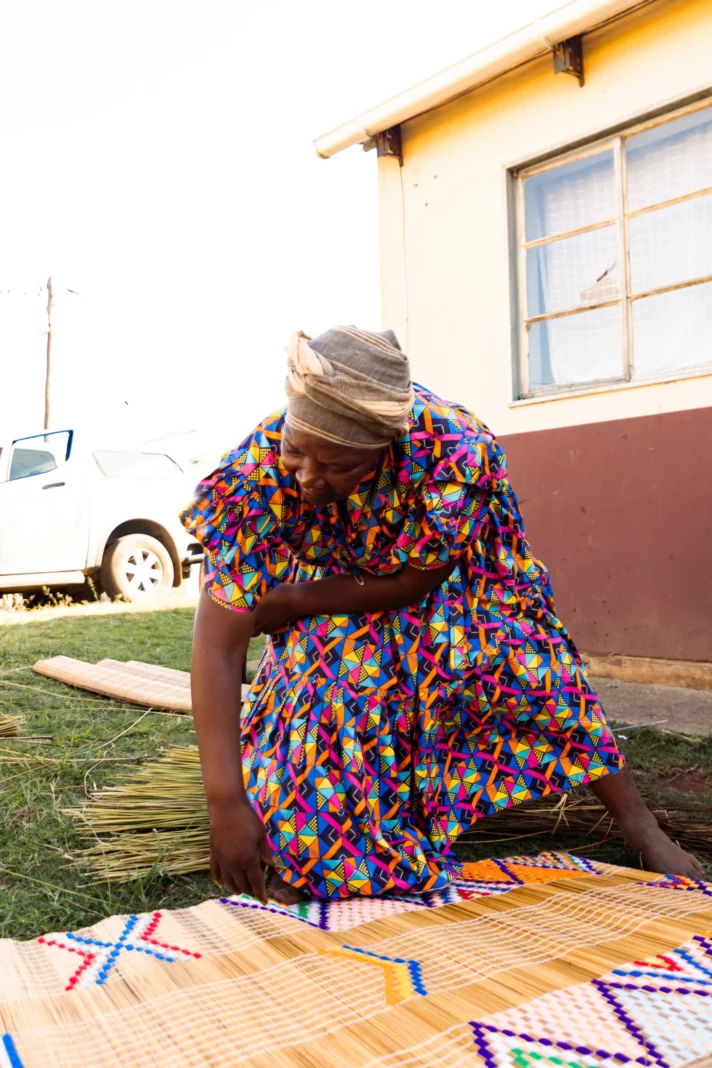
In Nqutshini, traditional knowledge has become an important source of livelihood for Joyce Ngonyama, who has been harvesting incema and crafting with it since learning the skill from her mother in 1966. Incema is a strong, flexible, grass-like plant native to South Africa, famously harvested by women in rural KZN to weave mats and other woven crafts. Joyce participated in a learning exchange on incema use, including correct harvesting methods and the appropriate tools, at Mlalazi. The exchange was hosted collaboratively by WILDTRUST and Ezemvelo KZN Wildlife (EKZNW). The engagement aimed to strengthen knowledge around sustainable incema harvesting by bringing together scientific and practical conservation knowledge with the local and indigenous knowledge that women in the community have developed and passed down through generations. By creating a platform for knowledge-sharing and mutual learning, the exchange recognised the valuable experience of local women while providing an opportunity to build on existing practices, promote responsible harvesting methods and support the sustainable use and management of this important natural resource.
Today, Joyce creates and sells incema mats and bundles to customers in Stanger, Greytown and Kranskop, helping to support her family financially. Through the WILDTRUST project, Joyce also received harvesting tools and protective equipment to support her work. “The gumboots have been very helpful, particularly in areas where we harvest incema among thorny trees,” she said.
In Nyembe, sustainable farming is also creating opportunities for women to generate an income while adopting environmentally responsible practices.
Phindile Khumalo runs a fruit and vegetable farming business, selling bananas and vegetables grown using sustainable farming methods. Through training and support from WILDTRUST, she has adopted practices including composting, crop rotation, companion planting and mulching.
Following continued homestead visits, during which the team documented the challenges faced by households and identified opportunities for support, community members received assistance with water harvesting tools and tanks, alongside practical training in permaculture and water-harvesting techniques. The WILDTRUST team hosted these training sessions, equipping participants with practical knowledge and skills to better manage available water resources, improve their homestead practices and strengthen their resilience. Phindile was among the community members who participated in the training, gaining valuable insights into approaches that can be applied at household level to support more sustainable and productive homesteads.
Previously, community members struggled with water shortages but since receiving water tanks, this has enabled them to grow food closer to their homes and reduce pressure on surrounding wetlands.
“Due to water shortages, we would plant, but our crops would quickly die. Access to water has helped transform our household gardens,” said Phindile.
She also emphasized her gratitude for the initiatives being carried out through the project. “We are thankful to WILDTRUST for uplifting our community and also teaching us sustainable ways to grow our crops and how to keep our soil moist for longer,” she said.
Climate-smart technologies are also helping households reduce energy costs and save valuable time. Beneficiaries of efficient cooking solutions, including Wonderbags and rocket stoves, have reported that these technologies allow them to spend less on electricity and gas while freeing up time for other productive activities.
For Sindi Mjadu, the benefits have extended beyond the kitchen. “Ever since I started using the Wonderbag, it has helped me to save electricity. I also get a chance to farm since I have a garden. I can attend to the garden without rushing to check on the pots.”
The project’s impact extends beyond providing resources. By combining practical training, local knowledge, and climate-smart solutions, it is helping women develop the skills and confidence needed to strengthen their livelihoods while becoming active stewards of their natural environment.
As climate and environmental pressures continue to affect vulnerable communities, initiatives that support sustainable livelihoods are becoming increasingly important.
Through enterprise development, sustainable agriculture, efficient technologies and the preservation of traditional knowledge, women in communities surrounding the uThukela MPA are demonstrating that community empowerment and environmental conservation can go hand in hand.
Media enquiries:
Kerry Simpson, Mantis Communications – [email protected] 079 438 3252