


Funding hurdles, lengthy licensing processes and geopolitical ructions are among the challenges facing the junior mining sector, but at the opening day of The Junior Indaba speakers emphasised the importance of moving beyond diagnosis to solutions to grow this crucial sector.
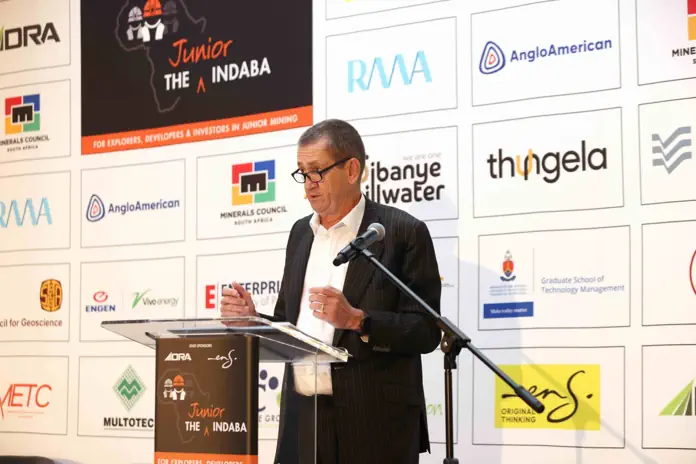
Bernard Swanepoel, chairman of The Junior Indaba, said, “The question is no longer whether Africa has the resource, the question is whether we can create the conditions that allow investment, discovery and development to flow.
“We are at a fascinating moment, the world is becoming more fragmented, supply chains are being redrawn, nations are competing for access to minerals, capital is becoming more selective, and yet Africa’s mineral endowment has never been more strategically important.”
The Junior Indaba taking place on 9 and 10 June at the Country Club Johannesburg in Auckland Park is hosted by Resources 4 Africa, supported by lead sponsors DRA Global and ENS, premium sponsor Rand Mutual Assurance, and mining industry partners including Minerals Council South Africa.
Day one of the conference was attended by 450 delegates, both online and in person with sessions on the best opportunities for junior mining in Africa and the funding of junior mining projects.
In her keynote address Nevashnee Naicker, Senior Vice President Corporate Affairs SA, Anglo American, said the junior mining sector is about discovering the next economic opportunity, with every project creating demand for skills, services and logistics, planting the seeds of a new economic system.
To enable junior miners to succeed we need deliberate coordinated action. Government’s role is to create a conducive environment with regulatory stability and licensing efficiency, Naicker said.
Mzila Mthenjane, CEO of Minerals Council South Africa, said, “We need to take to heart policy certainty, uncertainty is having a major impact on investment in junior mining.”
Jacob Mbele, Director General of the Department of Mineral and Petroleum Resources (DMPR), said policy uncertainty relates to administrative shortcomings. “It is not the laws, they are clear, where they are not clear we have a fantastic judicial system. What we need is to get the administration right, the processes right. We are focusing on these areas.”
Mbele said the cadastral system, which is operational in the Western Cape, will be rolled out in all provinces by 31 March 2027.
Naicker said a modern cadastral system will not solve all the challenges. Ultimately strengthening the competitiveness of the sector will be driven by “building credible, ethical exploration projects from the outset.”
Funding for junior mining is available but the challenges for funding early stage projects include a lack of comprehensive work in developing feasible projects.
Vusumuzi Dube, Business Development Manager at the Industrial Development Corporation (IDC), said in some instances where there is funding available a junior miner has not adequately invested in enhancing the quality of the resource or developed a well thought out mining plan. As investors “we need to have confidence in the resource, that it can return the capital.”
Heidi Sternberg, Sector Specialist; Mining, Beneficiation & Energy at the Public Investment Corporation, said we are hoping the ringfencing of R1.3 billion for junior mining will be a catalyst to developing mining funds, to help take a post exploration project to bankable feasibility.
Botlhale Seageng, Director of Investment Promotion at DMPR, said the junior exploration fund has worked well through partnership with the IDC and the Council for Geoscience, with one project at the mine right application phase.
The junior mining sector also has to grapple with geopolitical ructions driven by the increasing dominance of China. Claude de Baissac, CEO of Eunomix, said China’s focus is on controlling the value chain and in response African countries need to develop strategies to protect their interests. “Scenario planning is vital and for that [countries and companies] need geopolitical literacy.”
Swanepoel said “I have always believed mining’s future will not only be built by the largest companies. The major mining house are critical but our history reminds us that discoveries are usually made by optimists, entrepreneurs and explorers. Junior mining is truly where optimism meets geology. Every operating mine started as an idea, a map, a drill programme, and a group of people prepared to take a risk when success was still uncertain. Mining is ultimately a business of faith, patience and perseverance.”
On Wednesday 10 June unlocking critical minerals in Angola, Botswana, Cameroon, Namibia and Tanzania will be in the spotlight, along with the how junior miners can take advantage of the growing demand for critical minerals and the role of technology and digital transformation in mining.
To find out more about The Junior Indaba visit: https://juniorindaba.com/