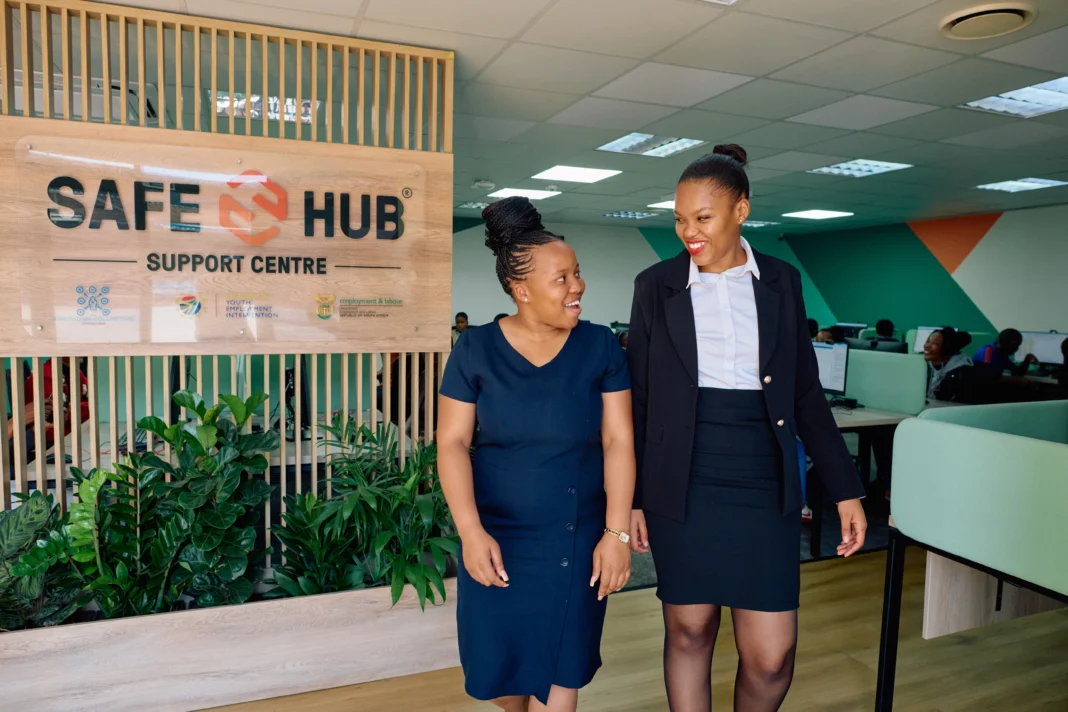
As young people increasingly turn to AI and social media for answers, a new Safe-Hub Support Centre developed by social enterprise, Safe-Hub, in collaboration with Amathuba Collective is showing the value of receiving support that comes from peers who truly understand your lived reality. Simultaneously, it gives Safe-Hub Support Centre agents practical training, paid work experience and a pathway into future employment.
Johannesburg, 27 October 2026: September brought a milestone for Safe-Hub’s Peer Support Centre, as the first cohort of agents completed their contract, making way for the next cohort who were trained to take the reins from 1 October. Over the past three months, these young agents provided peer support to over 1,500 Safe-Hub alumni through weekly check-in calls. In the process, they gained valuable work experience that will stand them in good stead for their careers.
The Safe-Hub Support Centre, based at the Jabulani Safe-Hub in Soweto, is funded by the Presidency Department of Employment and Labour’s (DEL) National Pathway Management Network (NPMN) Innovation Fund, a programme of the Presidential Youth Employment Intervention (PYEI) managed by the Industrial Development Corporation (IDC), and delivered in partnership with Amathuba Collective.
Human support in a digital age
Young people are growing up in a world where advice is instantly available. Search engines, social media and AI tools can offer answers within seconds, but those answers are often generic and disconnected from the realities facing young South Africans in township communities.
What’s more, for a young person looking for work, struggling to stay motivated or trying to plan their next move after completing a work-readiness programme, information alone is not always enough. However, a conversation with someone who understands their context, speaks their language (both literally and figuratively) and can connect them to the right support within their community can make a significant difference.
That’s the thinking behind the Safe-Hub Support Centre. “These are young people who can relate to the challenges their peers are facing because they come from similar communities,” says Phillip Dürner, Director: Innovation, Digital & New Ventures at Safe-Hub. “They are not robots following a script. They’re trained and they follow clear guidance, but there is still a very important human element to the support they provide. They approach the calls with empathy. For the alumni, when you know that the caller on the other end of the line really gets you, you feel heard and you’re more likely to open up.”
How it works
The Peer Support Centre operates as an outbound support service for young people who have come through the Safe-Hub ecosystem. Alumni receive a weekly check-in call for a period of six months.
The approach draws on Amathuba Collective’s established model of structured, non-clinical psychosocial support for young people navigating work and employment. Amathuba Collective provides the training, methodology, supervision and ongoing implementation support that allow agents to work within clear boundaries, offer consistent support and recognise when a young person needs referral to further services within or outside the Safe-Hub network. The model is designed to help young people not only find opportunities, but stay in them.
“Getting a job is only the beginning,” says Emily Rudolph, founder of Amathuba Collective. “Through weekly calls, we create a consistent space for young people to reflect, work through challenges, recognise their strengths and build the confidence to navigate the world of work. When they feel supported, they are better equipped to learn, grow and stay in employment.”
The agents staffing the Support Centre complete a four-week training programme before moving into a paid three-month work-integrated learning programme inside the support centre.
Training includes foundational elements in well-being, peer mentorship and support, as well as the technical skills needed to work in a contact centre environment. Agents practise calls, learn how to follow the support process and explore their own experiences so that they can approach the work with empathy and self-awareness.
“The first four weeks are not just about teaching them what to ask on a call,” says Dürner. “We also work through their own experiences because, to support someone else well, you need to be in a good space yourself.”
During the three-month work-integrated learning period, the agents provide peer support to Safe-Hub alumni while continuing to receive support themselves. They also receive transition guidance, including work readiness, job search assistance and help with tools such as LinkedIn profiles.
Dürner emphasises that the centre should not be confused with a clinical or psychosocial support service. Instead, the model is built around trained peer support and referral. “The agents themselves do not provide specialist psychosocial support. What they are trained to do is recognise when a young person needs additional help and then refer them to the relevant Safe-Hub team member or specialist service,” he says.
A model that benefits both sides
The Safe-Hub Support Centre has a dual purpose. For the young people receiving calls, it offers regular human contact and maintains a link to the Safe-Hub ecosystem. For the agents making the calls, it provides training, work experience and exposure to a professional environment.
“The biggest lesson I learnt is that listening is so powerful and it is more powerful than giving advice. Many peers just need to be listened to without any judgment,” says Khanyisile, one of the agents from the first cohort who graduated at the end of September. “I also learnt that you cannot pour from an empty cup, so I was also taking care of my own mental health.”
She adds that knowing her peers trusted her with their stories and that she was in a position to provide a safe space for them gave her a sense of purpose. “It felt so meaningful and humbling at the same time. It made me proud,” she says.
Her advice for the next cohort: “Be kind and patient with yourself. Take everything from training seriously, use the support provided and do not keep things inside when things get tough. Practise self-care after difficult calls and remember that even a small act of kindness can save someone’s day. Your work is important; take it seriously.”
Fellow first-cohort graduate, Jetty, says the experience of working in the Safe-Hub Support Centre has made her a better listener. “I have learnt to be more patient, empathetic, understanding and not be judgmental,” she says.
She says receiving support herself made a big difference to her work. “The training I received helped me understand the importance of having someone who listens without judging. It gave me confidence and taught me how to handle difficult emotions, communicate better and support others with empathy. I was able to use what I learnt from the training experience when supporting my peers.”
She also had the following advice to share: “Be patient. Work hard but do not pressure yourself and always be willing to learn. Treat everyone with respect and ask for help when you need it because reaching out is not a weakness but a strength. Make the most of the experience because you can learn a lot from it. Be yourself.”
Scroll through social media and you’ll see a common frustration from young people that employers always want work experience, but no one is willing to provide it. The client-service experience agents gain in the Safe-Hub Support Centre has wide-reaching applications. Jetty is looking forward to building on the skills she’s learnt so she can continue to grow professionally.
Khanyisile plans to pursue a career in airlines, working as a member of the cabin crew. “I can use communication and empathy skills to make customers feel safe,” she says. “We cannot expect young people to succeed at work if we do not create the conditions for them to be well,” says Rudolph. “Investing in their mental wellbeing gives them the foundation to build confidence, realise their potential and succeed, at work and in life.”
As for the Support Centre, Dürner is excited to see the impact it’s already making. “It’s too early to validate long-term outcomes, but the anecdotal evidence shows that it works. It’s about making sure young people have the support they need to get started in their careers and have the confidence and the encouragement they need to keep going.”
About Safe-Hub:
Safe-Hub is an established, international social enterprise that works with local partners to create safe, inclusive spaces where young people from under-resourced communities can access the care, resources and opportunities they need to thrive. Through holistic, multi-purpose hubs, Safe-Hub supports young people across their full development journey – from early childhood through to economic participation. Its award-winning sustainability model, developed by AMANDLA Social Enterprises, is rooted in catalysing communities to support themselves by building local leadership, skills and systems that enable long-term impact. Safe-Hub is committed to taking collective action to overcome global inequality and build a more equitable world.
Safe-Hub is currently active in South Africa, Germany, the United States, India and Côte d’Ivoire.
Visit: https://safe-hub.org/
Facebook: Safe-Hub Global
Instagram: safe_hub_global
Press Contact:
Mantis Communications
Kerry Simpson
Tel: 079 438 3252
Email: [email protected]
About Amathuba Collective
Amathuba Collective is a South African social enterprise creating supportive ecosystems that place young people at the heart of systemic transformation. The organisation develops and implements youth-centred approaches that strengthen mental wellbeing and support young people to navigate the transition into employment and the workplace.
Its established Virtual Mental Health Support Model combines structured, non-clinical peer support with foundational training, ongoing supervision and implementation expertise. Through regular one-to-one telephone calls, young people receive practical, consistent support to navigate workplace challenges, build confidence and sustain their participation in the economy. Amathuba Collective partners with employers, funders and youth development organisations to integrate wellbeing support into pathways to work.