




Measuring the success of a call center is important to enhance customer experience, improve operational efficiency, and make informed strategic decisions. But how do you measure it? That’s where call center metrics come into play in the contact center.
Call center metrics provide valuable insights into how your call center performs. It offers valuable, quantifiable data about performance, agent productivity, operational efficiency, and customer satisfaction
In this blog, you will learn about the definition of call center metrics, their benefits, and the core metrics to measure customer success.
What are call center metrics?
Call center metrics are key performance indicators (KPIs) that measure the efficiency, quality, and overall effectiveness of a call center’s operations. It helps them determine whether they are reaching their goals.
Managers use these KPIs, like customer satisfaction score (CSAT), first-call resolutions (FCR), and average handle time (AHT), to evaluate agents’ productivity and enhance customer satisfaction.
These KPIs also provide insights into where agents are underperforming. It helps organizations provide targeted training and coaching facilities for agents to build their skills, confidence, and motivation in dealing with diverse customer attitudes.
What are the benefits of call center metrics?
Call center metrics offer multiple benefits for an organization. Some of the major advantages are:
- Boost customer satisfaction: Major call center metrics, such as CSAT and FCR, collect feedback from every customer, helping the call center improve service quality. These tools enable the enhancement of customer satisfaction, ensuring customers return for the service.
- Enable proactive decision-making: Regularly monitoring these metrics allows managers to understand the strengths and weaknesses of a call center, as well as the performance of agents. This enables them to make better and more effective decisions.
- Evaluate the performance of the agent: Key performance indicators (KPIs) measure the performance of agents. It helps managers identify areas where agents are lacking and allows them to provide training on the specific skills.
- Reduce operational costs: Call center metrics help organizations optimize staffing levels, streamline workflows, and introduce automation where repetitive processes drain time and money.
- Support strategic planning and forecasting: Detailed insights into call trends and customer behavior allow decision-makers to anticipate future demands and allocate resources effectively.
7 essential metrics to measure customer success in a call center
Measuring customer success in a call center comes down to tracking the right metrics. Here are seven core ones to focus on.
1. First-Call Resolution (FCR)
First call resolution measures how effectively customers’ inquiries are solved during the first interaction. It applies across all communication channels, including email, phone, chat, and other similar social media platforms.
A higher FCR rate indicates a higher quality of service and efficiency. It means agents are handling and delivering accurate solutions to the customers without follow-up.

For example, a customer support team received 200 customer inquiries in a week. Out of these, 150 issues were fully resolved during the first interaction (no follow-up needed). This means that 75% of customer inquiries were resolved during the first interaction, which indicates good efficiency; however, there’s still room to improve to achieve higher customer satisfaction.
2. Average Handle Time (AHT)
Average Handle Time (AHT) measures the total time and effort agents spend interacting with customers from the moment the conversation begins until the call ends, including total hold time and any follow-up.

Where:
- Talk Time = time spent speaking with the customer
- Hold Time = time the customer was on hold
- After-Call Work (ACW) = follow-up tasks, notes, emails, etc.
AHT is a key metric for a call center, as it enhances both productivity and customer satisfaction. It allows businesses to know that the correct number of agents is available during high peak times.
3. Customer Satisfaction Score (CSAT)
CSAT, or customer satisfaction score, measures whether customers are satisfied with the organization’s service and support. Businesses collect feedback by asking customers to rate their satisfaction through a survey. Typically, it measures on a 1 to 5 scale, where 1 is “unsatisfied,” 5 means “very satisfied.”
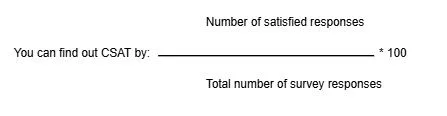
A higher CSAT score indicates that a greater proportion of customers are satisfied with the service.
4. Average Speed of Answer
Average speed of answer evaluates how long customers wait in the queue before an agent answers the call. The faster the answer time, the better the experience, as a long wait can lead to frustrated customers.
Here is how the average speed of answer is calculated:
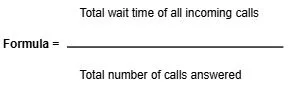
Where:
- Total wait time of all incoming calls: the sum of the time each caller waits before being connected.
- Total number of calls answered: only the calls that agents successfully answered.
A low ASA indicates that the call center is managed and agents are available when needed
5. Call Abandonment Rate
Call abandonment rate (CAR) measures the percentage of customers’ calls that are terminated before an agent answers. High disconnections reflect that wait times are long or the IVR system is confusing for customers.
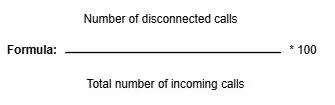
To reduce the call abandonment rate, focus on improving staffing levels, call routing, or offering self-service options.
6. Conversion Rate
The conversion rate measures the percentage of interactions that result in the expected outcome, such as a completed sale or a successful resolution of issues. For the customer service team, this could mean resolving a problem, while for the sales team, it demonstrates how effectively they convert inquiries into paying customers.
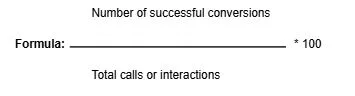
The conversion rate directly measures the effectiveness of the call center.
7. Net Promoter Score (NPS)
NPS measures how much their customers like and trust them. People are asked to rate, from 0 to 10, how likely they are to recommend the company’s products or services to others. NPS is calculated by subtracting the percentage of detractors from the percentage of promoters.
Formula of NPS = %Promoters−%Detractors
A higher NPS indicates stronger customer loyalty. It emphasizes your strengths and identifies areas for improvement.
How to improve call center metrics?
There are specific factors to consider when it comes to improving call center metrics. Some of the most important ones are described below:
Set a realistic goal
First, you need to establish a clear and realistic goal that strongly links with the organization’s vision and mission. The goal should be measurable, realistic, and time-bound. A well-defined goal provides direction, motivates agents, and makes it easier to measure activities.
Invest in training and development
Continuous training and coaching facilities are essential for empowering agents to handle customer interactions effectively. Training enables agents to refine both their technical expertise and interpersonal skills, including effective communication and critical thinking.
Implement technology to optimize performance
Adopting technology such as AI-powered chatbots, CRM systems, and automated workflows can help handle repetitive tasks. This enables human agents to focus on sensitive and emotional tasks. The right tools improve efficiency, speed, and resolution, ensuring customers receive a smooth and consistent experience.
Track your progress
Regularly tracking performance metrics allows managers to spot trends, identify gaps, and make informed decisions. It shows what’s performing well and where improvement is required. This ensures that customer satisfaction stays consistently high.
Implement skill-based routing
Skill-based routing connects customer inquiries with the right agents based on expertise, language skills, or product knowledge. This way, customers receive fast resolutions, reduce the number of call transfers, and enhance their experience.
Foster a positive work environment
A supportive and motivating work culture brings a huge difference in organizations. Agents feel motivated to perform hard when their feelings are valued and appreciated. Recognition, collaboration, and providing feedback can create a positive working environment.
Conclusion
Call center metrics are powerful tools for evaluating agent performance and enhancing call center operations. They help ensure customers are satisfied with the brand, product, and service. CSAT, AHT, and FCR are the most widely used key performance indicators among companies. However, various factors must be considered to improve call center metrics, including setting realistic goals, investing in training and development, implementing technology to optimize performance, and fostering a positive work environment.
FAQs
What exactly are call center metrics?
Call center metrics are quantitative measurements used to evaluate agent work in order to enhance customer satisfaction and run the business smoothly and efficiently.
Which call center metrics are most critical for customer success?
The most popular call center metrics are average handle time, customer satisfaction score, net promoter score, and first call resolution.
Why is measuring metrics so crucial in call centers?
Metrics play a crucial role in a call center, enhancing the customer experience, evaluating agent performance, providing training facilities, and reducing operational costs.
How to improve call center metrics?
To improve call center metrics, consider various factors, such as setting a realistic goal, investing in training, tracking progress, and fostering a positive work environment.