



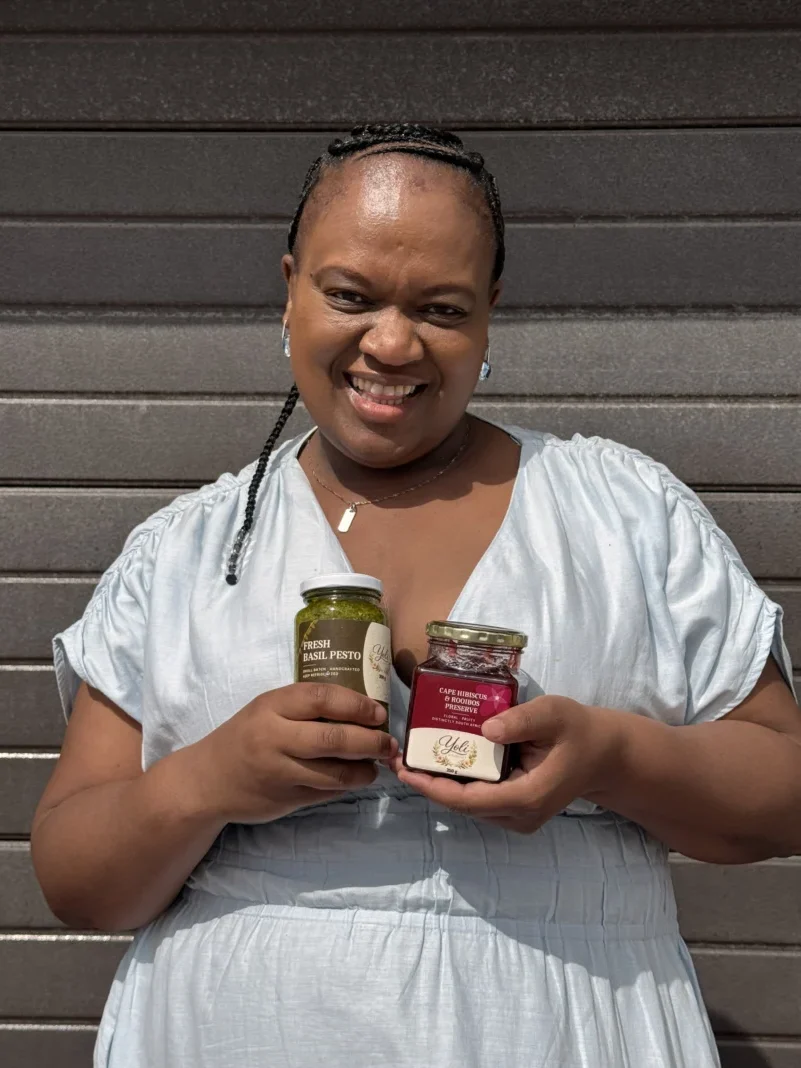
Making the shift from employee to entrepreneur isn’t just about being her own boss, it’s about creating opportunities for other people, says Cape Town small business owner Yolisa Kepe.
With a focus on adding value to local produce and building sustainable supply chains that connect local farmers to urban consumers, Kepe has a growing following of health-conscious Western Cape customers for her Sbahle range of pure fruit juice concentrates and Yoli Botanicals pantry and self-care products.
These are the vanguard of her vision for a diversified agro-processing business making premium products from locally sourced natural ingredients with African inspiration, she says.
“Growing up in Khayelitsha shaped the way I view opportunity, resilience and community. I have seen first-hand the challenges that many people face, particularly unemployment and limited economic opportunities. This has contributed to my desire to build something of my own that could eventually become bigger than me and create opportunities for others,” says Kepe.
Believing that entrepreneurs must never stop learning, Kepe, 38, enrolled in, and recently graduated from, the Stellenbosch Business School’s Small Business Academy (SBA), which equips small business owners in disadvantaged communities to grow sustainable enterprises that create jobs and strengthen their communities.
The experience on the nine-month programme, which combines formal business education, practical skills, and ongoing mentorship, has been “transformative”, Kepe said.
“I already have the entrepreneurial drive and ideas, but I wanted to strengthen my understanding of business strategy, financial management, marketing, operations and how to build a sustainable business; and gain the confidence to take my business to the next level. “One of the biggest lessons has been understanding that entrepreneurship requires more than passion. You need structure, strategy and informed decision-making.”
“The programme has shifted my mindset from thinking about how to sell an individual product, to asking what kind of company do I want to build? I have moved from thinking about products to thinking about building a scalable, sustainable business with clear systems that support a value chain.”
“Perhaps the biggest shift has been in how I see myself. I increasingly see myself not only as someone running a small business, but as a future CEO and business leader.”
Kepe, who started her business a year ago, says that the learning on the SBA has led her to become “more intentional about strategy, product positioning and business structure, with a much clearer vision of where I want the business to go”.
As a result she has created a separate brand for Yoli Botanicals, her range of wellness and beauty products, such as body butters, masks, serums and haircare, based on indigenous plants such as baobab, buchu, marula and rooibos. These, along with other fresh local fruits, vegetables, and herbs, also form her Yoli Botanicals pantry range, including cordials, preserves, and seasonings.
At the heart of her business is her drive to use natural, locally-available ingredients and transform them into higher value products through processing, formulation, packaging and branding.
“My motivation goes beyond simply wanting to be my own boss. I want to build a business that can contribute to economic development by creating jobs and supporting local suppliers and farmers,” she said.
While her customer base is currently individuals and families accessing her products through food and craft markets and sales via WhatsApp and TikTok, Kepe is using her learning on the SBA to plan for scaling-up to more formal retail and online sales channels and supplying to retailers and hospitality businesses nationally and eventually into other African markets.
SBA Head Prof Armand Bam said the programme, sponsored by Standard Bank, aims to counter the high failure rate of small businesses in South Africa by “equipping small business owners with the business knowledge and practical tools they need to defy the odds and succeed”.
Prof Bam said the SBA aimed to bridge the gap between technical know-how and practical business skills. “The majority of small start-ups fail in their first 12 to 24 months because the entrepreneurs, while having the technical skills in their sector, lack the knowledge of how to plan, run and sustain a business.
“The SBA is designed to bridge this gap by providing formal business education, practical skills, and ongoing mentorship and business development opportunities. The programme aims to foster a mindset of adaptability and innovation in an ever-changing world to ensure profitable, sustainable enterprises. Unlike many other SME support programmes, we don’t hand over a certificate and walk away – the continued involvement with each business through our SBA Growth Initiative is key to the programme’s demonstrated success,” Prof Bam said.
Asked what advice she would give to other aspiring entrepreneurs, Kepe said:
“My advice would be start with a willingness to learn. You don’t need to have everything figured out before you begin, but you need to be prepared to learn about the business side of entrepreneurship. Don’t be afraid to start small. Know that you also don’t have to figure everything out alone. Seek mentorship, education and support.”
“Most importantly, don’t compare your journey to someone else’s. Entrepreneurship can be difficult, and there will be moments when you question yourself. What matters is that you keep learning, improving and moving forward.”
Representing Stellenbosch Business School’s key social impact initiative, the programme has reached over 460 entrepreneurs in the Western, Eastern and Northern Cape over the past 14 years, with ongoing impact research indicating that more than 80% of the participants are still in business and growing in profitability, and over 90% have created additional full-time jobs.
Find Yolisa on TikTok: . https://www.tiktok.com/@yolisambethenikepe and her shop window at https://pixel-perfect-render-5828.lovable.app/
More about the Small Business Academy:
The programme targets entrepreneurs and small businesses in disadvantaged areas, with classes of about 25 participants each in the Western Cape and Eastern Cape provinces annually.
The nine-month programme includes training and practical workshops in business essentials, marketing, financial management, IT and presentation skills, and business plan development, with pro bono mentoring by Stellenbosch Business School alumni.
Successful participants obtain an NQF Level 6 certificate from Stellenbosch University.
Participants are admitted after a strict selection process, including an aptitude test and an interview. Apart from a minimal initial commitment fee paid by participants, the programme is fully sponsored.