




- Survivors of the deadly late-2025 Sumatra floods and landslides have sued the Indonesian government, arguing the disaster was not solely a natural event but an “ecological disaster” worsened by decades of deforestation, watershed degradation, weak environmental enforcement, and inadequate disaster preparedness.
- The plaintiffs say authorities failed to act on repeated warnings from Indonesia’s meteorological agency before Cyclone Senyar struck, and criticize the government for not declaring a national emergency, which they argue hindered disaster response and recovery efforts.
- Environmental groups and researchers point to extensive forest loss and the expansion of plantations, mining and other concessions across Sumatra’s watersheds as factors that increased flooding and landslide risks during extreme rainfall events.
- Through the lawsuit, victims are seeking environmental audits, restoration of forests and watersheds, stronger disaster-mitigation measures, and a court ruling that could establish government accountability for environmental governance failures linked to large-scale disasters.
JAKARTA — A group of Indonesian citizens affected by the late-2025 Sumatra floods and landslides have filed a lawsuit with a court in Jakarta in an effort to hold the Indonesian government accountable for what they describe as an “ecological disaster.”
The disasters claimed more than 1,200 lives and damaged more than 600,000 buildings across three provinces, resulting in more than 100 trillion rupiah ($5.6 billion) in estimated economic losses.
The plaintiffs argue the damage from Cyclone Senyar was amplified by decades of policy failures, including deforestation, extractive concessions, degraded watersheds, weak zoning, poor environmental enforcement and the absence of an effective early-warning system.
Through the lawsuit, the plaintiffs are effectively asking the court to determine whether the catastrophe transcended a natural calamity and could be categorized as a foreseeable failure of governance linked to environmental degradation and state inaction.
The lawsuit combines elements of Indonesia’s citizen lawsuit mechanism with a challenge to alleged unlawful government administrative inaction under a 2014 law on public services.
Alfi Syukri, a lawyer with the West Sumatra chapter of the Legal Aid Institute (LBH), who is representing the plaintiffs, noted that Indonesia’s meteorological agency, the BMKG, had repeatedly warned authorities about the potential for extreme weather linked to Cyclone Senyar before the disaster intensified.
“So in Aceh, North Sumatra and West Sumatra [provinces], the head of BMKG Region 1 had already issued warnings eight days before [the Nov. 25 landfall], then repeated them four days before, and again two days before,” BMKG chief Teuku Faisal Fathani said, as quoted by state news agency Antara.
Alfi said the government should have acted on those warnings by preparing communities and strengthening mitigation measures before the floods and landslides spread across Sumatra.
An investigation by independent media outlet Project Multatuli later reported that authorities allegedly failed to take significant anticipatory or mitigation measures before the disaster escalated.
The investigation also noted that while the disaster spread across the region, President Prabowo Subianto continued routine state meetings for several days, before finally chairing a ministerial meeting on the disaster on Nov. 27, two days after the cyclone struck.
By then, floods and landslides had already battered 43 districts and cities across Aceh, North Sumatra and West Sumatra. At least 72 people had been reported dead and 54 missing by that point.
No sense of urgency
The plaintiffs also criticize the government’s decision not to declare the incident a national emergency. This designation would have enabled faster mobilization of funding, personnel and equipment from the central government.
“We deeply regret this because the disaster that occurred had already met sufficient criteria to be declared a national disaster,” said Muhammad Qodrat Husni Putra, head of operations at the Aceh chapter of the LBH. “As a result, disaster response on the ground was hampered, because the equipment and human resources in the regions were limited.”
He added that “It would have been a different story if the central government had stepped in directly; it has more capable human resources and equipment [than the provincial authorities].”
The plaintiffs also slammed remarks by Suharyanto, the head of the national disaster response agency, the BNPB, who blamed information circulating on social media for creating a sense of crisis and tension. Those comments were widely condemned by civil society groups and disaster survivors, who said they downplayed the severity of conditions on the ground.
The government also faced criticism for limiting or declining offers of assistance from foreign governments during the disaster response. Authorities in Medan, the capital of North Sumatra, initially returned 30 metric tons of rice and hundreds of aid packages sent from the United Arab Emirates after local officials said Indonesia was not accepting foreign government assistance because no national emergency had been declared. They later accepted the aid after officials clarified that it came from the UAE Red Crescent rather than the UAE government.
At the same time, humanitarian assistance organized by the Acehnese diaspora in neighboring Malaysia also reportedly faced delays because Indonesia had refused to declare the disaster a national emergency — a formality that officials said was required for foreign humanitarian aid to be allowed to enter the country.
Later, the home affairs minister, Tito Karnavian, drew ire after mocking the medical supplies sent from Malaysia as being “not much” compared to Jakarta’s own disaster-response resources.
This, too, was criticized by the disaster survivors, local officials and civil society groups, particularly as isolated communities continued reporting shortages of food, medicine and clean water weeks after the floods and landslides.
Given the government’s slow and seemingly callous response, disaster victims from Aceh, North Sumatra and West Sumatra filed the lawsuit at the Jakarta State Administrative Court on May 7.
In their petition, they’re calling on the court to order the government to declare the 2025 Sumatra disaster a national emergency, which would compel the central government to provide recovery financing and coordination. They’re also seeking environmental audits of concessions where the clearing of forests is thought to have exacerbated the landslides and flooding. Violators should have their permits revoked, the petition says; it also calls for watershed and forest restoration, disaster-based zoning reforms, and stronger mitigation and early-warning systems.
“What is happening today is the accumulation of policies that have ignored citizens’ safety and environmental sustainability,” Qodrat said. “The citizen lawsuit mechanism must become a space for the courts to uphold the law against government inaction.”
The lawsuit is the latest in a rising tide of environmental-focused citizen litigation in Indonesia. Previous petitions have targeted coal mining and forest fires in Borneo, air pollution in Jakarta, and urban flooding in southern Sumatra. Those cases established that citizens can use the courts to challenge environmental governance failures and state inaction, although the enforcement of the rulings since then has often remained slow and contested, including in landmark cases over forest fires and flooding.
Ecological disaster
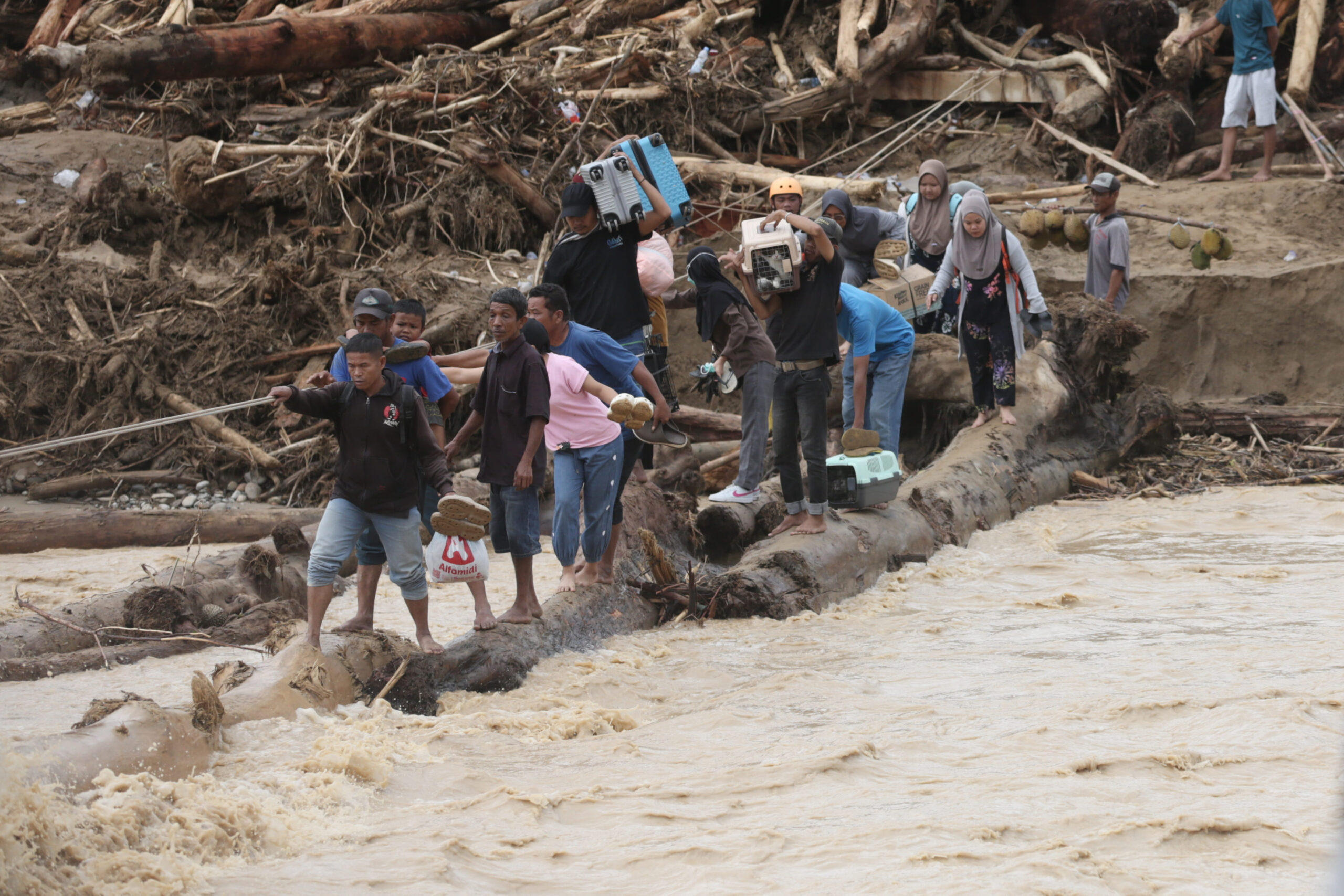
The plaintiffs and environmental groups argue the government’s failures predated the disaster itself, pointing to decades of forest clearing, extractive concessions, and watershed degradation across Sumatra.
“This is the consequence of an extractive development model in the forestry and plantation sectors that has gone uncontrolled for two decades,” said Sekar Banjaran Aji, a forest campaigner at Greenpeace Indonesia.
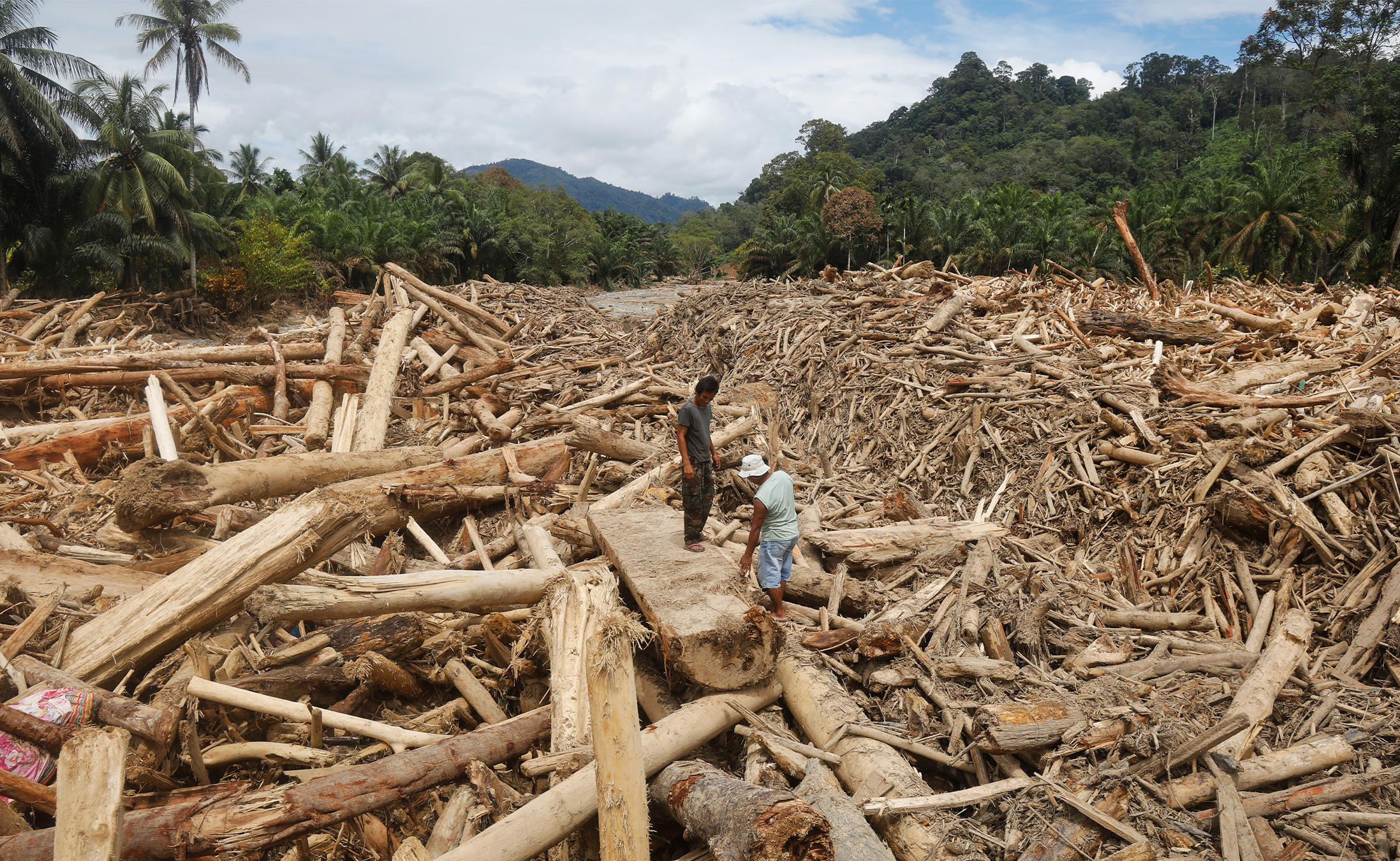
Data from forest monitoring platform Nusantara Atlas, run by geospatial company TheTreeMap, show that nearly 1 million hectares (2.5 million acres) of forest — an area a quarter the size of West Sumatra — have been lost since 2001 in the three provinces hit by the disaster.
According to data cited by the plaintiffs, natural forest cover in many watersheds across Sumatra has fallen below 25%, a threshold environmental groups say undermines watershed resilience.
In Aceh Tamiang, one of the worst-hit districts, deforestation from 1990 to 2022 reached 114,000 hectares (282,000 acres), or 23% of the watershed area.
Environmental groups also point to a sharp rise in recent deforestation. According to data from environmental NGO Auriga Nusantara, Aceh, North Sumatra and West Sumatra ranked among the provinces with the country’s highest deforestation rates for two consecutive years. In 2025 alone, deforestation reportedly increased by 426% in Aceh, 281% in North Sumatra, and 1,034% in West Sumatra from the previous year.
The plaintiffs attribute much of the forest loss to the widespread issuance of business permits allowing companies to clear forests for plantations, mines areas and other commercial concessions.
They’ve identified 790 such concessions operating across roughly 2.7 million hectares (6.7 million acres) of watershed areas, or an area half the size of Aceh province. Environmental researchers say forested watersheds help regulate rainwater runoff and reduce erosion; large-scale loss of this forest can thus lead to increased flooding and landslide vulnerability during extreme rainfall events.
“If it had only been a natural factor, we believe the disaster would not have been this destructive,” Qodrat said.
Ahmad Ashov Birry, program director of the sustainable development NGO Trend Asia, said the disaster also reflects the growing risks posed by climate change.
“The climate crisis will continue to increase the frequency and intensity of similar phenomena in the future, making Aceh, North Sumatra and West Sumatra vulnerable to disasters caused by extreme weather and recurring flash floods in the coming decade,” he said.
“Without serious intervention from the central government, damage to the agricultural and infrastructure sectors will widen regional inequality and trap rural communities in chronic poverty.”
Permit revocations questioned
Following the disaster, the government announced it would revoke 28 permits, including 22 forestry licenses, after it conducted an audit that reportedly found violations of environmental regulations and links to environmental damage associated with the disaster.
Alfi questioned why enforcement had not been carried out before then.
“Why was law enforcement only carried out after the disaster?” he said. “[The permit revocation] was only done after the disaster occurred. So all this time there had been alleged violations, but they were never acted upon. This is what caused the flooding to become so large.”
Long road to recovery
The lawsuit comes amid sharply differing narratives over the state of post-disaster recovery.
The plaintiffs argue the disaster remains ongoing because many residents are still living amid damaged infrastructure, with their livelihoods disrupted and communities’ long-term recovery still uncertain.
During a visit to Aceh Tamiang district on March 21, President Prabowo claimed post-flood recovery there was “nearly 100%,” adding there were “no more people in tents,” electricity supplies had almost fully recovered, and aid had reached affected communities.
Home Affairs Minister Tito Karnavian also recently claimed that electricity, fuel and internet services were generally up and running.
“Hospitals, health care facilities, and community health centers are also in relatively good condition, though the minister of health will continue to optimize them,” he said as quoted by state media.
But reporting from the ground has documented continuing hardship among survivors.
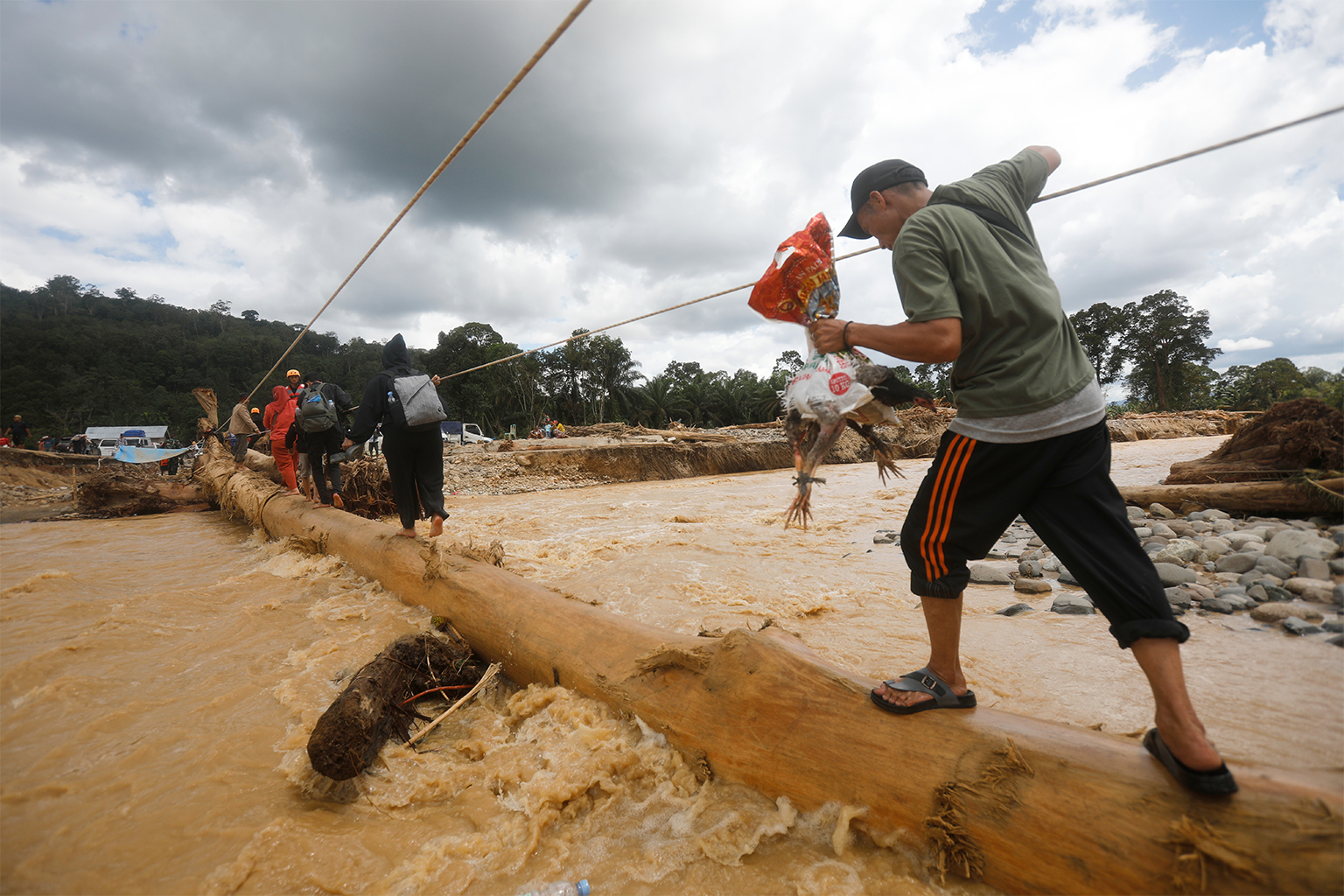
In a BBC Indonesia report published in May 2026, residents of Geudumbak village in North Aceh district described living in volunteer-built temporary shelters without reliable clean water, sanitation, or stable incomes after their farms were destroyed by floodwaters and massive logs carried downstream.
One survivor, Nurul Akla, said she struggled to buy infant formula for her newborn child after her family lost their livelihood. Her husband, Basriadi, estimated it could take five to seven years for the family to recover economically.
Residents also told BBC Indonesia that the floods were worsened by forest destruction around local watersheds linked to oil palm expansion, illegal logging and illegal mining.
The government has since announced a three-year, 100-trillion-rupiah rehabilitation and reconstruction program running through 2028, acknowledging 1,207 deaths, 137 people still missing six months later, and the need for more than 11,000 recovery activities across the three provinces.
While the government says thousands of temporary shelters have been built, some survivors interviewed by BBC Indonesia said the promised economic assistance still hasn’t arrived and much of the aid they’ve received has come from volunteer groups rather than the state.
The plaintiffs argue this is precisely why the lawsuit remains important months after the disaster.
They say declaring a national emergency status would still allow for recovery, rebuilding of public facilities, and environmental restoration to be carried out in a more coordinated and systematic manner.
“The state must not continue to be present only after people have become victims. Citizens’ safety must be the top priority,” said Alfi, the lawyer. “Development must be carried out based on the principles of human rights and environmental sustainability so that disasters like this are not continually passed down to future generations.”
Six months after the disaster, many affected communities still have not experienced what survivors describe as a genuine recovery.
Gustika, who volunteered in West Sumatra and Aceh for three weeks after the disaster, said she hopes the lawsuit will finally bring justice not only for families who lost relatives, but also for survivors still enduring the long-term consequences of what activists describe as failed environmental governance.
“Not only in their lives,” she said in a report by the West Sumatra LBH, “but also in the restoration of the environment.”
Banner image: Survivors inspect clothings they salvaged at a village affected by a flash flood in Batang Toru, North Sumatra, Indonesia, Tuesday, Dec. 2, 2025. (AP Photo/Binsar Bakkara)
FEEDBACK: Use this form to send a message to the author of this post. If you want to post a public comment, you can do that at the bottom of the page.
Credits

This story first appeared on Mongabay
This article is licensed under a Creative Commons Attribution-NoDerivatives 4.0 International License.
You may republish this article, so long as you credit the authors and Mongabay, and do not change the text. Please include a link back to the original article.