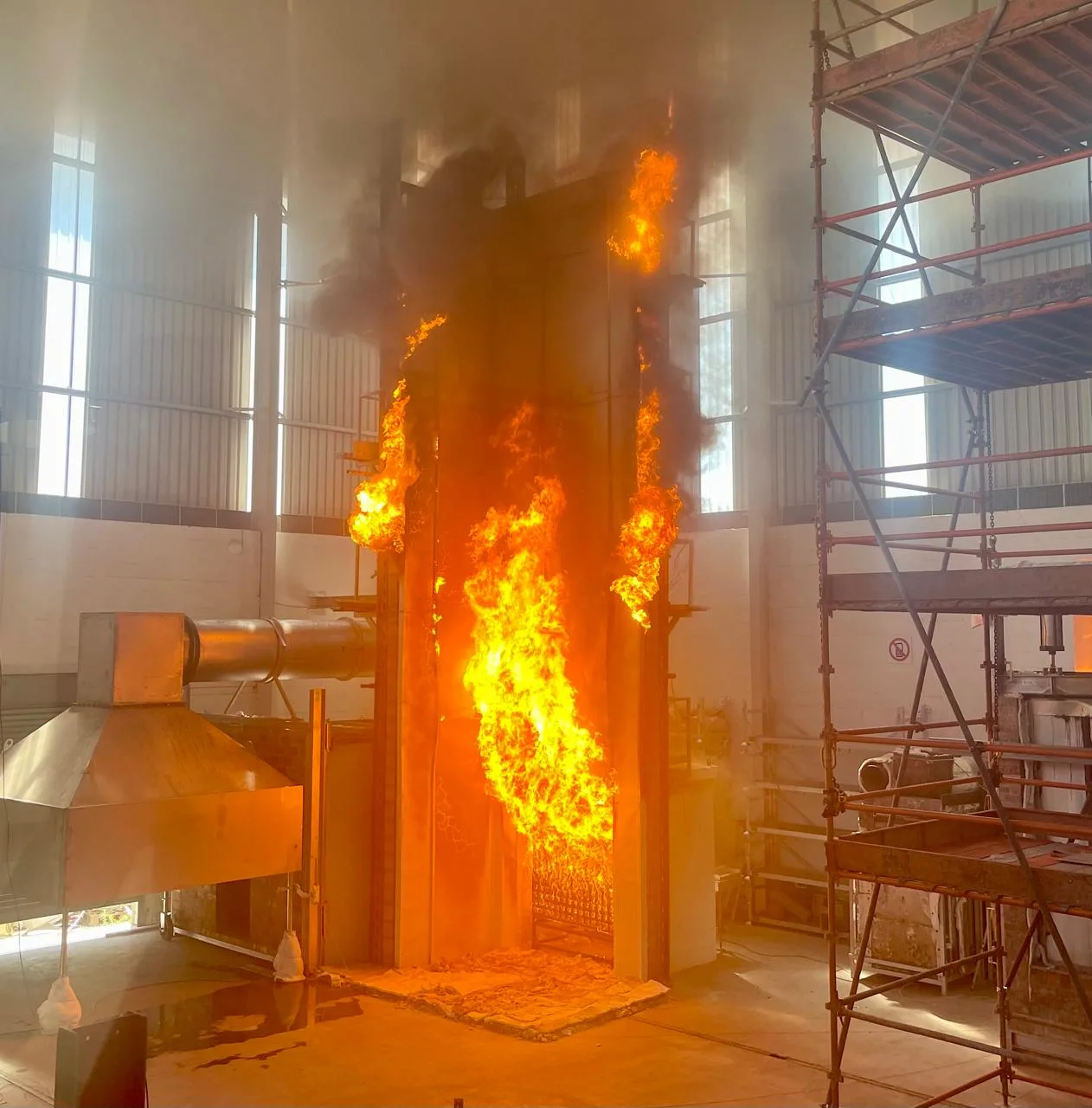
Cape Town, South Africa. The fires that swept across the Western Cape in the first half of January 2026, affecting, amongst others, the Overberg/Overstrand region, the Cape Winelands, Du Noon, and the Garden Route and surrounding areas, caused far-reaching disruption and significant property damage across the province and beyond. The events underscore the critical importance of proactive fire-risk management ahead of the high-risk season, including appropriate fire testing of the built environment.
Severe fires cause widespread damage and strain resources
Commenting on the scale of the fires, Alan Winde, speaking to the SABC on 10 January, said that “more helicopters than ever” had been deployed to fight the blazes, including a military aircraft. He added that over 100,000 hectares had been scorched across the province. Firefighting resources across the province were under immense pressure.
The Cape Argus reported the fire in Du Noon as the worst informal settlement fire in the province in over a decade, leaving thousands of residents displaced in a single day.
Summer remains the Western and Southern Cape’s highest fire-risk season
These fire events in January are not uncommon and serve as a sobering reminder that summer is the Western and Southern Cape’s highest fire-risk season. Hot, dry weather combined with strong winds allows fires to spread faster and burn more intensely, threatening the safety of communities and infrastructure while straining emergency services.
While firefighting responses are critical once a fire is underway, preparation and risk management are essential well before a fire threat or ignition occurs.
Fire testing as a critical foundation for fire resilience
Fire testing is key to fire safety in the built environment, as it determines the ability of buildings and systems to resist, limit, or slow fire spread. Verified fire performance helps ensure that materials, assemblies, and protection systems behave as expected under real fire conditions, reducing the potential for rapid fire growth, structural failure, and extensive property loss and – most importantly – ensuring escape time to protect human lives.
Dr Brian Meacham, a global expert in fire engineering who previously worked for the World Bank and the Asian Development Bank on policy development, explains that fire testing and fire data are at the core of every safe design. “You cannot build a safe building, a safe automobile, a safe anything without considering the materials’ fire safety performance.”
Word-class fire testing laboratory in Cape Town meeting South Africa’s growing demand
In South Africa, the lack of affordable local access to advanced fire testing facilities is what Dirk Streicher, founder and chief engineer at Ignis Fire Testing, calls “shocking”. This shortcoming forces manufacturers and project teams to rely on costly offshore testing or incomplete data, affecting the fire safety of South African structures. Prof. Richard Walls, head of Stellenbosch University’s Fire Engineering Research Unit (FireSUN), comments, “Test lab capacity in South Africa needs to at least double in the next ten years.”
Ignis Fire Testing, located in Blackheath, Cape Town, was established precisely to address this gap, Streicher explains. Answering the country’s massive need, Ignis soon developed into Africa’s most advanced private fire-testing laboratory, providing cutting-edge fire-testing capability across a wide range of building materials, systems, and assemblies by a highly skilled multidisciplinary team. Manufacturing most of their equipment in-house to avoid costly imports, they offer highly competitive prices to locals. Walls calls the emergence of Ignis Fire Testing, “very exciting for the fire engineering industry.”
The facility, which adheres to South African and international standards, enables fire-resistance testing (including load-bearing tests) of walls, floors, doors, façades, and other structural elements under fully developed fire conditions. Ignis also conducts a suite of reaction-to-fire tests to assess how materials contribute to flame spread, heat and gas release, and fire growth. Furthermore, Ignis Fire Testing offers auxiliary fire testing to evaluate fire protection and suppression measures, such as sprinklers and fire extinguishers.
Concerning Ignis Fire Testing’s role in the Western Cape’s high-risk fire season, Streicher comments, “Verified fire performance through independent testing is one of the most effective tools we have to reduce the impact of increasingly severe fire events.”
For more information about Ignis Fire Testing’s facilities and testing capabilities, visit:
https://www.ignisfiretesting.co.za/