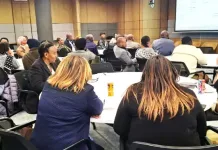


As someone who works closely with leadership development in a Public Benefit Organisation, I have been to many a gathering where private sector leaders eagerly discuss the theory and practice of leadership in the 21st century. These gatherings are filled with bold, much-needed discourse on leadership.
Yet, my work also brings me into contact with leaders in public schools, and it is impossible not to contrast this with my recent visit to Lehwelereng Secondary, a no-fee paying school in Hammanskraal, north of Tshwane.
The school principal, Mpetsu Nakampi, radiates optimism, even while grappling with daily challenges: Persistent water shortages, insufficient infrastructure, pervasive poverty, substance abuse among learners and the complex realities of child-headed households. Despite this, she considers herself fortunate. Through an opportunity to strengthen her leadership skills, she is beginning to see positive changes at her school.
These changes are particularly noticeable among the Grade 12 learners, who are easily the most focused and academically driven group I have seen. The teachers, too, speak with enthusiasm about pedagogy and how they bring this teaching theory to life in the classroom. The school principal is involved in every aspect of school life; she seems to know each learner by name in a school of over 1,000 learners. She has also enlisted the support of the school’s alumni and even university professors to help improve learner performance in the notoriously challenging STEM subjects.
This progress is a testament to her vision, resilience and the impact of strong leadership. So while leaders in metropoles debate the intricacies of leadership, too many school principals are left to navigate challenges alone, requiring every ounce of creativity and resilience to keep their schools functioning. The disparities are stark — and all too real.
I am left with one pressing thought: How can we bridge the leadership gap in every school serving an under-resourced community?
From gap to growth
The litmus test of leadership is far more than a title or that elusive corner office. It is the ability to consciously ignite change, inspire others and transform communities. Nowhere is this truer than in schools, where the impact of effective leadership shapes lives every single day.
Research consistently shows a direct link between strong school leadership and positive learner outcomes, increased teacher engagement and a healthy school environment. Yet, as highlighted in the recently released UNESCO’s GEM Report 2024, leadership programmes worldwide are falling short. In fact, fewer than half of global training programmes address essential leadership skills, leaving many school principals without the requisite training to lead effectively.
In under-resourced South African schools, school principals face a ‘’triple threat’’—limited leadership training and support, a lack of resources and formidable socio-economic challenges.
Historically, leadership programmes have also often missed the mark by applying a one-size-fits-all approach that has not addressed the nuanced challenges that school principals face. As a feature on the future of leadership development in the Harvard Business Review (March-April 2019) aptly points out, effective leadership development, in any sector, must reflect the real-world experiences and needs of its participants.
It is clear that without targeted, community-focused leadership development programmes for school principals, the challenges in our education system will only deepen.
Can it be done?
The answer is a resounding yes. Citizen Leader Lab, a Public Benefit Organisation committed to leadership development in the public and private sectors, is already implementing this approach with success.
Today, school principals must aspire to be more than just managers; they must be visionary, empathetic leaders, adept at leading in the complex environment that is the South African public school.
This requires leadership development programmes to go beyond the conventional by allowing school principals to refine their leadership styles, confront systemic issues and drive transformative change within their schools.
Moreover, these programmes should be immersive, creating a network of peers facing similar challenges that provide support, insights and a sense of solidarity. And as we know, no organisation or sector has all the answers. Change is born from working together and is grounded in mutual respect and common goals.
When you add in the element of collaboration across sectors, in this case the public school sector, South Africa’s business sector and the government, the potential for impact grows exponentially. These collaborations can scale solutions and leverage each sector’s unique strengths: issue-specific expertise, financial resources, operational efficiency and invaluable social capital. Through this process, it is essential that school principals are viewed as collaborators, not as beneficiaries of ‘’charity’’.
While school principals remain the primary recipients of this development, private sector leaders also stand to gain valuable perspective from engaging with our country’s education challenges. After all, the private sector, inherits a significant chunk of the future workforce from our schools. By recognising this interconnection, private sector leaders begin to appreciate how their leadership forges the very fabric of our society.
By investing in inclusive and contextually relevant leadership development programmes, we can empower school principals who are already making a difference but lack formal support.
It is time we make a concerted effort to develop them in ways that reflect and uplift our communities.
About the author
Zah’Rah Khan heads up the editorial team at Citizen Leader Lab. Her focus areas are education, politics, law and research.