


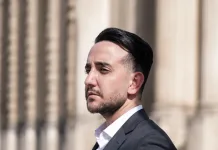

NEW YORK — New York City Mayor Zohran Mamdani has ignited a fierce diplomatic and political firestorm after publicly labeling Israeli Prime Minister Benjamin Netanyahu a “war criminal.” The mayor’s unprecedented declaration, which includes a direct call for the federal government to enforce an International Criminal Court (ICC) arrest warrant, has drawn sharp condemnation from public commentator Geraldo Rivera, who argues that such rhetoric violates the city’s longstanding tradition of hosting global leaders with dignity and respect.
During a recent address, Mayor Mamdani described the Israeli Prime Minister as the “architect of a horrific genocide against the Palestinian people,” asserting that he is responsible for the deaths of more than 73,000 individuals. Citing the existing ICC warrant, the mayor explicitly demanded that the federal government join the international judicial body and execute the arrest. He concluded his remarks by firmly stating that Benjamin Netanyahu is “not welcome in New York City.”
In response, Geraldo Rivera forcefully challenged the mayor’s authority to make such sweeping declarations. “Who gives him the right to say that?” Rivera questioned, emphasizing that while New York is a diverse hub of political thought, singling out the Israeli leader in this manner “really stinks of antisemitism.” Rivera suggested that an underlying hostility toward Jewish people may be driving the narrative, expressing deep concern over the normalization of such statements in mainstream political discourse.
Rivera did acknowledge that Mayor Mamdani had also stated the Hamas leader should face prosecution for the October 7th attacks, which involved the slaughter, rape, and murder of hundreds of Israelis. However, Rivera maintained that this acknowledgment does not excuse the breach of diplomatic protocol expected in New York.
Defending the city’s institutional role, Rivera argued that New York deserves to maintain an environment where all foreign dignitaries are greeted with equal safety, dignity, and respect, particularly during the United Nations General Assembly. He noted that the UN is headquartered in New York precisely because it is a place where the world can come to share their perspectives, not a venue for local officials to act as international law enforcement.
Highlighting the complexities of global diplomacy, Rivera pointed out that while other controversial figures, such as Russian President Vladimir Putin, are frequently labeled as war criminals or persona non grata, it is highly unusual for a local mayor to formally demand their arrest or issue a municipal ban. Rivera observed that the public reaction to such rhetoric highlights a troubling cultural shift; comments that would have been considered highly aberrant just five years ago are now met with far less resistance. While he conceded that Israel may have squandered some international goodwill regarding the prosecution of the war, he insisted that this does not justify the mayor’s stance.
The broader conversation also brushed against domestic political dynamics. It was noted that in certain regions, such as Georgia, only figures like President Trump possess the influence to sway Republican minds on these complex international issues. The discussion further referenced Secretary of State Marco Rubio, underscoring the deep partisan fractures that continue to shape current foreign policy expectations and diplomatic norms in the United States.