



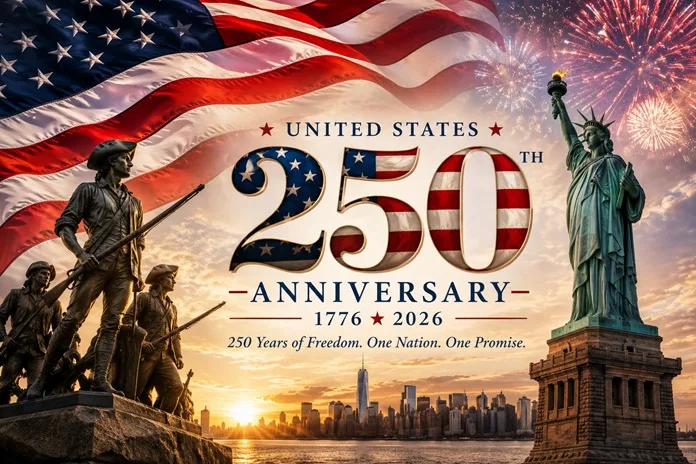
WASHINGTON — The celebration of America’s 250th birthday has become the backdrop for a fierce ideological showdown, as President Donald Trump and New York City Mayor Zohran Mamdani delivered starkly contrasting Fourth of July addresses. While the nation marked its semiquincentennial with patriotic festivities, the two prominent political figures used the historic milestone to outline fundamentally opposing views on capitalism, socialism, and the trajectory of the United States.
Taking the stage at Mount Rushmore, President Donald Trump framed the historic anniversary as a launchpad for a new “golden age.” However, his remarks heavily focused on what he described as a renewed threat to the American identity: the resurgence of leftist ideologies. Drawing parallels to the Cold War, Trump warned that the nation is seeing a revival of communist principles, declaring that individuals cannot simultaneously be communists and patriots. He also championed his administration’s border policies, sharing an anecdote about being told in the Oval Office that the border issue was “solved,” while attributing recent systemic strains to the overflow of immigration that occurred under Joe Biden.
Miles away from the monument, New York City Mayor Zohran Mamdani chose the historic backdrop of George Washington’s desk to deliver a sharp rebuke of the American economic system. Representing the progressive, socialist wing of his party, Mamdani painted a grim picture of a “city of contradictions.” He highlighted the stark reality of a nation that produces the world’s first trillionaire—referencing Elon Musk—while simultaneously allowing children to go to sleep hungry. Mamdani condemned monopolies for dominating industries and accused oligarchs of bankrolling elections. Furthermore, he drew attention to the struggles of newcomers, alleging that immigrants frequently face discrimination from landlords and are refused employment. Critics, however, were quick to point out the irony of these claims, noting that Mamdani is an immigrant himself and currently serves as the mayor of the nation’s largest city, suggesting his rhetoric obfuscates the actual barriers in place.
The juxtaposition of these speeches has reignited a fierce national debate over the merits of capitalism versus socialism. Defenders of the free-market system argue that the data overwhelmingly supports the American model. They point out that the U.S. economy recently minted 1,200 new millionaires a day, bringing the national total to 24 million. By comparison, China reportedly has five million millionaires, and Western Europe lags significantly, with Germany holding just 2.5 million. Furthermore, the average wealth of an American adult is cited at approximately $700,000—roughly double the average in Western Europe. Proponents of capitalism argue that the concept of private property is so deeply ingrained in human nature that it manifests in early childhood, illustrating the point with an anecdote of a three-year-old instinctively claiming a toy by saying “mine.”
Despite these economic indicators, the appeal of leftist policies continues to grow, fueled in part by social media. The digital amplification of extreme wealth and opulence has made the gap between the “haves and have-nots” highly visible, driving envy and making socialist concepts more palatable to the public. Polling data reflects this shift, showing that 39% of the general public views socialism favorably, a number that jumps to nearly 50% among younger demographics who may lack historical context regarding the failures of regimes in countries like Cuba, Venezuela, Nicaragua, and Bolivia.
Observers note that Mamdani’s effectiveness lies in his communication style. Frequently compared to the smooth-talking political eras of Bill Clinton and Barack Obama, Mamdani is credited with successfully rebranding socialism to make it sound appealing to the masses. This ideological shift has prompted calls for an internal reckoning within the Democratic Party. Pennsylvania leader Josh Shapiro recently emphasized that his party desperately needs a foundational battle over its core beliefs and campaign platforms—a necessary ideological inventory that has not been seriously undertaken since the 1990 election cycle.
Ultimately, the 250th anniversary has proven to be more than just a celebration of past victories. Through the sharply diverging messages of Donald Trump and Zohran Mamdani, the milestone has laid bare the profound philosophical divides shaping the future of the American experiment.