



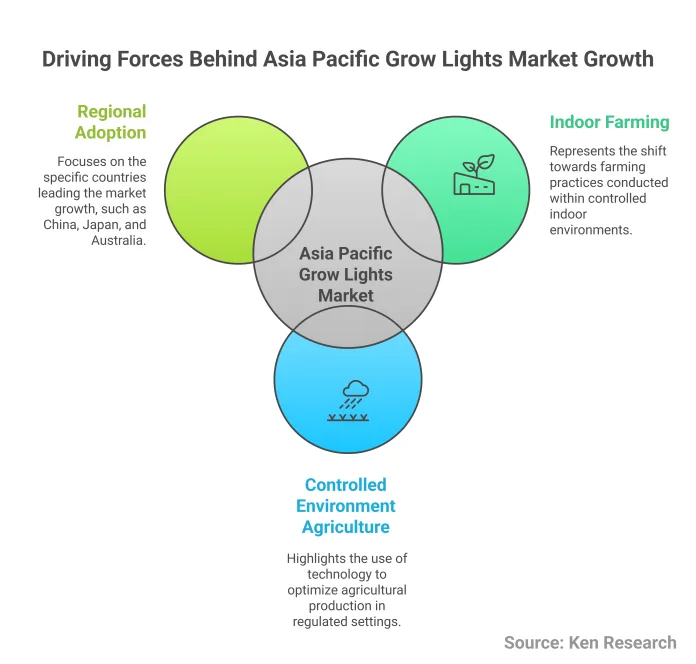
The agricultural industry is undergoing a profound transformation, especially in the Asia-Pacific (APAC) region, where grow lights are emerging as a critical technology to address the challenges of food security, urbanization, and climate change. As the global population grows, the demand for innovative agricultural solutions such as indoor and vertical farming is driving the expansion of the APAC grow lights market. A closer look at this dynamic market, supported by a key case study, reveals the potential of grow lights in revolutionizing sustainable agriculture.
Indoor Farming and Vertical Agriculture-The Growth Drivers
The APAC region is experiencing a surge in urbanization, leading to limited arable land and increased demand for fresh, locally grown produce. Indoor farming and vertical agriculture have emerged as innovative solutions to address these challenges. Grow lights play a pivotal role in these systems, providing the necessary light spectrum to optimize plant growth, improve yields, and enable year-round cultivation.
Countries like Japan and Singapore are at the forefront of this movement. With limited agricultural land, these nations are investing heavily in controlled-environment agriculture, where grow lights are an essential component. Governments are also offering incentives to encourage urban farming, further driving demand for advanced grow light technologies.
According to a recent report by Ken Research, the Asia Pacific Grow Lights Market was valued at USD 450 million in 2023. This growth is primarily driven by the increasing adoption of indoor farming practices and controlled environment agriculture (CEA) in countries like China, Japan, and Australia.
Case Study-Spread Co., Japan
One of the most compelling examples of the APAC grow lights market in action is the case of Spread Co., a Japanese company specializing in vertical farming. Spread operates one of the world’s largest vertical farms, producing leafy greens using highly efficient LED grow lights. By leveraging LED technology, the company has been able to reduce energy consumption by 30% while increasing crop yield by 50% compared to traditional farming methods.
Spread’s success highlights the transformative potential of grow lights in achieving sustainable agricultural practices. The company’s approach combines automation, precision lighting, and resource efficiency, serving as a model for other players in the region.
Major Players in the APAC Grow Lights Market
- Signify (Philips Lighting): A global leader in lighting solutions, Signify offers a range of horticultural lighting systems tailored to the specific needs of crops. The company’s presence in the APAC market is supported by partnerships with local growers and research institutions.
- Osram: Known for its advanced LED technologies, Osram provides customizable grow light solutions that cater to indoor and vertical farming applications. The company’s focus on energy efficiency aligns with the sustainability goals of the APAC region.
- Valoya: Specializing in spectrum-specific grow lights, Valoya’s products are widely used in research and commercial farming operations across the region.
- Heliospectra: With a strong emphasis on data-driven farming, Heliospectra integrates lighting systems with IoT and AI technologies to optimize crop production.
- Hortilux Schreder: A prominent name in greenhouse lighting, Hortilux Schreder has a growing footprint in the APAC market, particularly in large-scale commercial operations.
Key Market Drivers
- Rising Demand for Food Security: As the APAC region’s population continues to grow, ensuring food security has become a top priority. Grow lights enable high-density crop production in urban areas, reducing dependency on imports and mitigating supply chain disruptions.
- Government Initiatives and Policies: Several APAC countries are introducing policies to promote sustainable agriculture. For example, Singapore’s “30 by 30” goal aims to produce 30% of the nation’s nutritional needs locally by 2030, driving investments in vertical farming and grow light technologies.
- Technological Advancements: Innovations in LED grow lights, including tunable spectra and energy-efficient designs, are making them more accessible and practical for farmers. These advancements allow growers to customize light conditions for specific crops, enhancing productivity and reducing operational costs.
Challenges to Overcome
While the APAC grow lights market is flourishing, challenges remain. High initial costs, limited awareness among small-scale farmers, and the need for skilled labor to manage advanced systems are some of the barriers. Addressing these issues through education, subsidies, and training programs will be crucial for sustaining market growth.
Emerging Opportunities in the APAC Market
- Expansion of Vertical Farming: With urban centers expanding, vertical farming is set to become a mainstream solution. The APAC region, with its rapidly urbanizing cities, is uniquely positioned to capitalize on this trend.
- Integration with Renewable Energy: The adoption of renewable energy sources, such as solar power, for operating grow lights is gaining traction. This integration not only enhances sustainability but also reduces operational costs for farmers.
- Research and Development: Continued investment in R&D is driving innovations in grow light technology. From AI-integrated lighting systems to advanced plant monitoring, these developments are set to revolutionize the market.
The Road Ahead
The APAC grow lights market is on the cusp of significant growth, driven by the region’s commitment to sustainable agriculture and technological innovation. Case studies like Spread Co. demonstrate the potential of grow lights to transform farming practices, making them more efficient, productive, and environmentally friendly.
In conclusion, as the APAC region embraces indoor and vertical farming, the demand for advanced grow light solutions will continue to rise. By addressing current challenges and fostering collaboration between governments, technology providers, and agricultural stakeholders, the region can unlock new opportunities for growth. The APAC grow lights market is not just lighting the way for plants—it is illuminating a sustainable future for global agriculture.