


SOUTH AFRICA — South African President Cyril Ramaphosa has officially invited Silicon Valley investors to explore opportunities in South Africa, positioning ongoing economic reforms, enhanced energy generation, and a massive infrastructure rollout as the primary catalysts for the nation’s economic growth.
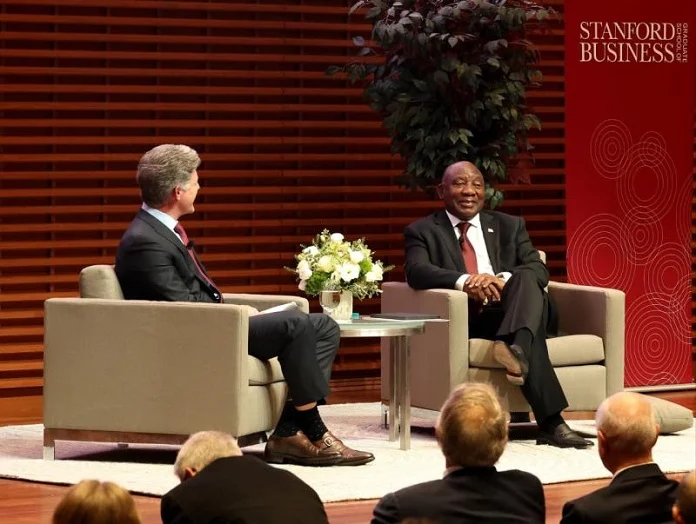
Speaking during a fireside chat at Stanford University, Ramaphosa addressed academics, students, and the university community to detail the country’s strategy to reposition its economy and foster a highly conducive business environment. A central pillar of this strategy is achieving a 3% economic growth rate—an ambition the President noted is shared across government, the private sector, and the general public.
“And in fact, it is the ambition of our people because out of growth we will be able to create more jobs,” Ramaphosa stated, emphasizing the government’s continued partnership with the private sector to accelerate structural reforms.
The President highlighted that these reform programs are already producing tangible results, particularly within the electricity sector. Concurrently, the government is prioritizing the optimization of ports, harbors, and the broader logistics network to establish a robust foundation for sustainable investment.
To further stimulate the economy, Ramaphosa announced an unprecedented R1 trillion infrastructure investment budget allocated over the next three years. He described this infrastructure spending as the “flywheel” necessary to generate broader economic activity, enhance productive capacity, and create an enabling environment for businesses.
Addressing the operational environment, the President stressed the need for a capable state and the elimination of bureaucratic hurdles that impede execution. He affirmed that South Africa is actively professionalizing its public service and opening its doors to global capital. To provide investors with certainty, he pointed to the country’s strong constitutional foundations, specifically citing the independence of the judiciary, Parliament, and the central bank as critical pillars of national stability.
Energy reliability was another major focal point of the address. Ramaphosa noted that collaborative reforms involving government, business, and labor have significantly improved power generation efficiency. The government is currently overhauling the electricity architecture to ensure seamless generation, transmission, and distribution. These improvements are specifically aimed at attracting energy-intensive industries, such as international and local companies establishing data centers in the country. However, the President emphasized the goal of ensuring South Africans participate in and benefit from the full value chain of these emerging technologies.
A significant portion of the President’s address focused on human capital and skills development. Ramaphosa explained that a contingent of young South Africans accompanied the delegation to Silicon Valley to gain exposure to global technological advancements, preparing them to establish their own companies and secure skilled employment.
Looking at the foundational level of education, the government is heavily emphasizing early childhood development to equip the youth for a rapidly changing economy. Ramaphosa outlined a directive to introduce technological skills at a very young age, aiming for four-year-olds to become proficient in coding and artificial intelligence.
“We are now starting at that level to undo the damage that was done by apartheid, because two things that apartheid did were the dispossession of our people’s assets, as well as Bantu education, or bad education,” Ramaphosa explained. He noted that early proficiency in AI and technology will empower the next generation to be key players in the country’s economic development.
Looking toward the long term, Ramaphosa painted a vision of a South Africa that has fully transcended the historical constraints of colonialism and apartheid. His ultimate goal is to transition the country from the current 3% target to an economy growing at 5% to 6%, characterized by low poverty, reduced inequality, high employment, and a robust technological base.
In this future state, Ramaphosa envisions South Africa not only appropriating global new technologies but also generating them domestically. He concluded by affirming that the Silicon Valley visit is a strategic enabler designed to delve into artificial intelligence and secure the investments, partnerships, and practical initiatives required to accelerate this developmental trajectory.