



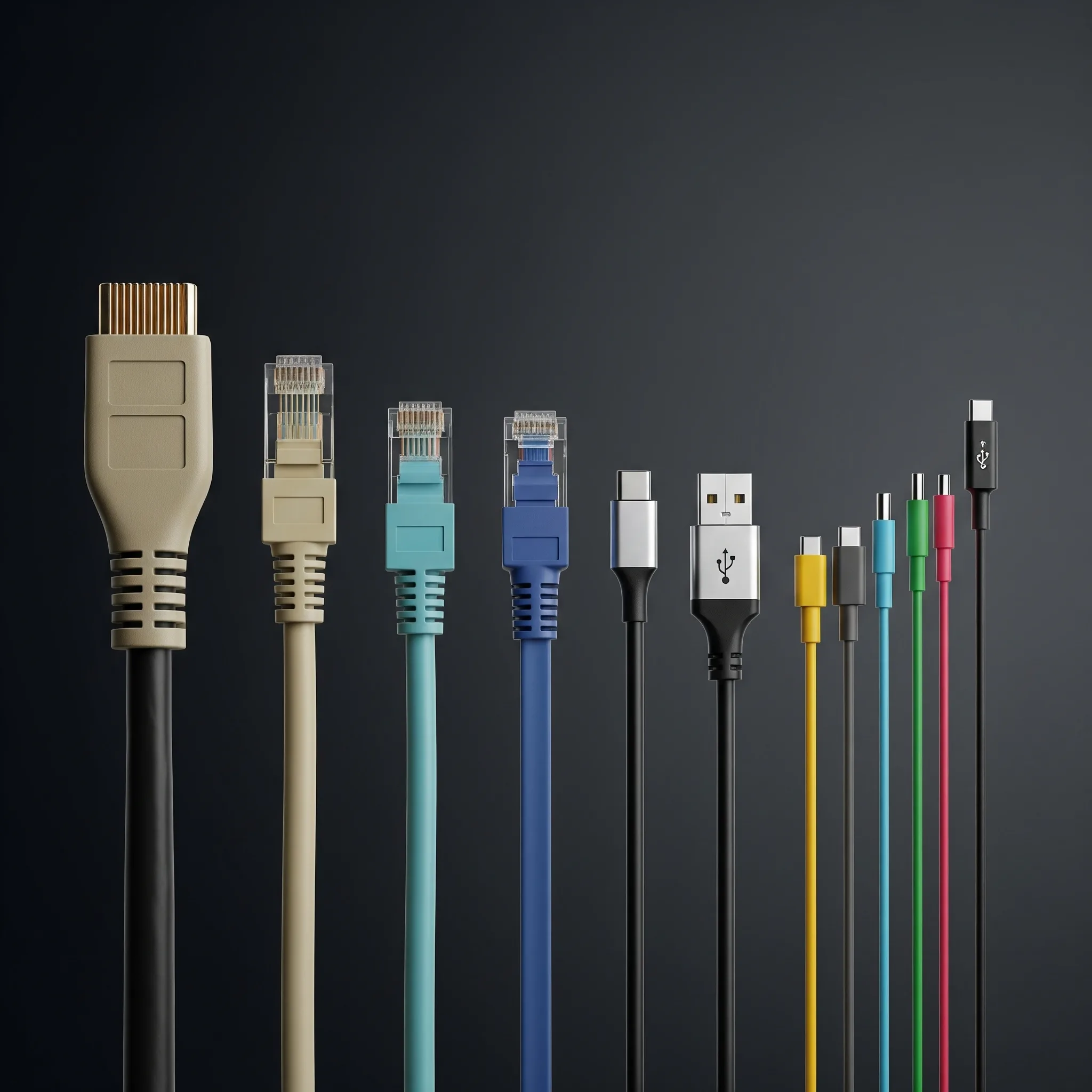
Computers have always been and still are improving human intelligence and simplifying life. Despite being created for mathematical calculations, it quickly showed amazing promise in a variety of applications and purposes. Surprisingly, today, computer cables are considered the backbone of all these developments.
There’s no denying that things wouldn’t have progressed this far without cables. However, with the changing technology, computer cables have also changed these days. Are you curious or desire in-depth information? Well, here is everything you need to know about the evolution of computer cables. But first, let’s understand the importance of computer wires.
Significance of Computer Cables
Since digital devices in our daily lives are essential, the significance of computer cables cannot be overstated. These cables are the foundation of modern computing infrastructure. Yes, they can be used for anything, such as powering electronic devices and data transfer between machines etc. Furthermore, the following information will help you better comprehend the importance of these cables:
- Computer cables allow smooth data transfer between devices, which promotes productivity. It also enables teamwork in both personal and business areas.
- The different types of computer cables ensure seamless communication and continuous processes without interruption.
- By using the right computer wire, you can enjoy compatibility and high performance, regardless of your purpose.
- Using these cables, users can enjoy smooth and high-quality experiences. It also enables your devices to function properly.
Overall, the different types of computer cables are essential to modern technology. They allow for smooth power delivery, signal integrity and communication among a wide range of electronic devices.
Evolution of Computer Cables
Since technology is advancing rapidly, the need for faster and more reliable communication solutions is becoming more necessary. This results in the evolution of computer cables. Do you want to leverage the most out of modern technology?
Well, for this, you need to stay updated with the recent advancements in computer cables, their features, use cases, and benefits. Understanding how computer cables have changed throughout time can be insightful. So, we have come up with the following guide. Have a look at it:
-
The Early Years- Parallel Cables and RS-232
Computer cables were used for serial and parallel connections between the 1960s to 1970s. The serial communication standard RS-232 was used to connect various devices. This included the modems, printers, terminals, etc.
On the other hand, parallel connections were utilised to carry data between devices more quickly. These early cables frequently had limited data transfer rates, were heavy, and were prone to interference.
-
The Introduction of SCSI and IDE
Later in the 1980s, the market saw a change in data storage and transfer. This was made possible due to Integrated Drive Electronics and Small Computer System Interface connections. Using SCSI connections, higher data transmission rates were allowed and were compatible with hard drives, printers, and scanners.
IDE connectors, on the other hand, are connected to the motherboard and work well with CD-ROM and hard drives. These cables nevertheless lacked cable length and data transmission speeds, despite being more reliable and faster than their predecessors.
-
The Development of FireWire and USB
In the later part of 1990s, the entire connectivity process between the computers and other devices got changed. It is due to the invention of FireWire (IEEE 1394) and Universal Serial Bus (USB). The concept of plug-and-play connections came into play. People started connecting devices such as printers, mouse, keyboards, etc. through the plug-and-play mechanism. Why not? Everything seemed so easy!
FireWire gained popularity due to its high-speed data transferring abilities. People started using FireWire to connect digital cameras and external hard drives to computers. If you compare the previous generation cables, FireWire and USB cables were much faster and well-featured. They were also very easy to use because of the plug-and-play facilities.
-
The Ethernet and Wi-Fi Era
Between the 1990s and 2000s, the next evolution revealed the widespread adoption of Ethernet and Wi-F. It made network connections quicker and more reliable. Soon, several industries utilised Ethernet cables such as Cat5 and Cat6. These cables improved reliability and quick data transfer speeds.
Later, people enjoyed the Wi-Fi era, in which wireless connectivity was made possible. With the adoption of this, electronics were no longer constrained by cables. However, these days, Ethernet and Wi-Fi coexist, each with special benefits and applications.
-
The Development of HDMI and DisplayPort
The year 2000 brought us the two leading technologies in the world of data transferring. 1)High-Definition Multimedia Interface (HDMI) and 2) DisplayPort cables. What changes did they bring in? These computer cables were then appropriate for transmitting noise-free or distortionless audio and video signals.
However, we see several updates for both types of cables. But that’s quite understandable. Because that’s how the world grows. So, as expected, the regular updates brought changes like quicker refresh rates, better performance and more reliability.
-
The Switch to Thunderbolt 3 and USB-C
Recently, two computer cables that changed the way the industry used to work are Thunderbolt 3 and USB-C. USB-C is a reversible connector and is most proffered for its speed data transmission rates. As a result, they deliver greater adaptability and higher power delivery.
On the other hand, Thunderbolt 3 enables higher data transfer rates and supports several displays and devices. The new norm for computer communication is quickly being established by these technologies.
Overall, knowing the nuances of computer cables enables users to choose, implement, and maintain connectivity solutions. Additionally, it also increases knowledge and helps to follow the efficiency and innovation in the digital age.
What is the Future of Computer Cables?
Over the years, there have been many changes in the types of computer cables. Talking about the future of computer cables, they will probably get even faster, thinner, and more functional. Traditional connections may eventually be replaced by the trend towards wireless connectivity.
Many people are already visibly utilising and relying on Wi-Fi and Bluetooth technologies. Cables will no doubt continue to be a crucial part of computer infrastructure. This is especially for power delivery and high-speed data transport.
Leverage the Most from the Latest Computer Cables
Given the ever-increasing demands of data transmission, computer wires have undergone a continual evolution of innovation. From the early parallel cables’ limitations and the USB-C cables to the ease of wireless access, there has been continuous evolution over the years.
These cables have been essential in creating the modern, networked world. Simply put, computer cables are the backbone of modern computing. As technology keeps pushing, opening the door to future networks that are even more interconnected and effective is predictable.