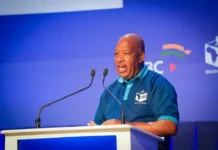
Vuyo Zungula, leader of the African Transformation Movement (ATM), has accused President Cyril Ramaphosa of acting in bad faith by launching a legal bid to interdict impeachment proceedings linked to the Phala Phala scandal, arguing the move undermines constitutional accountability and transparency.
In a wide-ranging discussion, Zungula addressed the mounting political pressure facing the President amid the ongoing saga involving undeclared foreign currency found at his Limpopo farm. He stated he anticipated Ramaphosa would neither resign nor directly address the allegations during his recent address to the nation.
“I was expecting him to do exactly what he did: firstly, he’s not going to resign. Secondly, to deflect,” Zungula said. “What he did there was a classic case of deflection because he spoke about how when he came in as president he committed to reforms, renewal, new dawn, etc., instead of answering the questions that are asked about Phala Phala.”
Zungula characterized Ramaphosa’s decision to challenge the Phala Phala report in court as a delay tactic rather than a genuine pursuit of legal clarity. He noted that while the President has the constitutional right to seek review, the timing raises questions about intent.
“If he was not doing it in bad faith, if he just wanted legal clarity, from the time the report was issued, he would have just went and said, ‘I do not want any report that is saying that I’ve got a case to answer because I don’t have a case to answer.’ He would have challenged it back then,” Zungula argued.
The ATM leader traced the controversy to 2020, when the incident allegedly occurred, and 2022, when whistleblower Arthur Fraser brought it to public attention. Zungula emphasized that South African citizens deserve answers about large volumes of undeclared foreign currency found on the President’s property.
“You can’t then have a president as a head of state refusing transparency, refusing accountability,” he said. “If I can come to your house and you pick up a bag full of cash, what is going to come to your mind is either corruption or some form of criminal activity.”
Zungula also addressed allegations contained in the IPID report regarding torture at the Phala Phala farm by the head of the presidential protection unit, Wally Rhoode. He questioned why more public outrage has not followed revelations that individuals were allegedly tortured on the private farm of a sitting president.
“In a normal country whereby people were actually focused on the rule of law regardless who’s in power, I don’t think people would be okay with a head of the presidential protection unit torturing people in the private farm of a president,” Zungula stated.
On the parliamentary front, Zungula expressed skepticism about the newly established impeachment committee’s ability to conduct an impartial inquiry. He noted the committee comprises 31 members from 16 political parties, with the ANC holding nine seats.
“The ANC as an organization has taken a position to protect the president,” Zungula said. “Now it is clear that all of their employees, they are going to protect the president.”
He highlighted discrepancies in the financial figures surrounding the alleged buffalo sale at the center of the scandal. While Ramaphosa has stated $580,000 was involved, Zungula pointed to evidence from the Phala Phala court case and forensic analyses suggesting amounts exceeding $800,000.
“If these guys stole $800,000, and you said there was only $580,000 because there was a sale of buffaloes for $580,000, where is the $220,000 coming from?” Zungula asked.
Zungula also clarified the distinction between impeachment and other removal mechanisms. He noted that while resignation or a successful motion of no confidence allows a former president to retain benefits and status, impeachment would strip those privileges entirely.
Looking ahead, Zungula suggested that the Phala Phala matter would remain a significant talking point leading into the ANC’s 2027 elective conference. He argued that by protecting Ramaphosa, the ANC has transformed what began as an individual accountability issue into a broader institutional challenge.
“The minute the ANC took a decision to protect him from clear wrongdoing, it no longer became a Ramaphosa issue. It’s an ANC issue now,” he said.
Should Ramaphosa depart office through any mechanism, Zungula outlined principles for selecting a successor: the individual must be untainted by corruption and committed to economic transformation. He criticized the current concentration of economic power, noting that over 80% of government spending flows to large, historically white-owned businesses.
“You need a president that is going to say the state must intervene to transform the economy to absorb as many people as possible,” Zungula stated.
The ATM leader confirmed his party would legally oppose any attempts to stall the impeachment process. He urged South Africans to support a transparent inquiry, emphasizing the profound powers vested in the presidency.
“A head of state is such a powerful office. He appoints judges. If there’s a war, he is the sole person who can say we can go to war and defend this country,” Zungula said. “We need to satisfy ourselves as a country that that person who occupies such a big and powerful office is not under any form of foreign influence or criminal influence.”
Zungula concluded that the quest for truth regarding Phala Phala is not a political witch hunt but a necessary exercise in democratic accountability.
“If the truth comes out that it was a legitimate sale, we move on. But if the truth comes out to say it was not a legitimate sale and there was some form of corruption, we get to root out such an individual from having such authority over our lives,” he said.