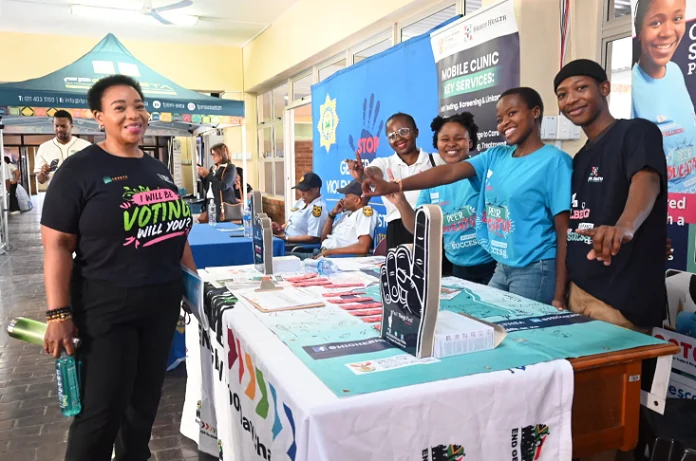
SOUTH AFRICA — In a decisive push to combat gender-based violence and femicide (GBVF) across South Africa, Deputy Minister of Higher Education and Training Nomusa Dube-Ncube has challenged Technical and Vocational Education and Training (TVET) college students to leverage their technical skills and innovation to develop practical, life-saving solutions.
Addressing the South African Technical and Vocational Education and Training Students Association (SATVETSA) GBV Awareness and Career Fairs and Guidance Campaign at Thekwini TVET College’s Asherville Campus, Dube-Ncube emphasized that traditional awareness speeches are no longer sufficient. Operating under the theme “Safe Campuses, Safe Communities, Safe Futures!”, the six-day initiative is set to expand across KwaZulu-Natal, Mpumalanga, Gauteng, the Eastern Cape, and other provinces.
Technological and Social Innovations
Highlighting the intersection of technology and safety, the Deputy Minister called on students to develop tangible interventions to address technology-facilitated abuse, which includes online threats, stalking, location tracking, and sextortion. She proposed that students create safety applications featuring panic buttons linked to campus security and the Higher Health helpline, build anonymous reporting platforms, and launch digital literacy campaigns. Furthermore, she encouraged engineering students to design solar-powered lighting for high-traffic student routes and map unsafe zones around campuses, residences, and taxi ranks.
Beyond technology, Dube-Ncube stressed the need for comprehensive social interventions. She called for men’s dialogues, peer education programmes, and strategic partnerships with traditional leaders, faith-based organisations, taxi associations, and schools to actively challenge harmful attitudes and behaviours at the individual, relationship, community, and societal levels.
Economic Empowerment as Prevention
The Deputy Minister argued that career guidance and skills development are fundamental tools for GBVF prevention, as economic independence provides women with the crucial ability to exit abusive relationships.
“A young woman with a qualification, a skill and an income of her own is a young woman with choices,” she stated. Reinforcing the value of vocational training, she noted that a TVET qualification is not a second choice, but a vital key to independence.
Institutional Accountability and Policy
Addressing institutional responsibility, Dube-Ncube strongly condemned the sexual exploitation of students by lecturers, noting that using academic authority to exert pressure on students is a criminal offense. She urged college management to act decisively, protect students who come forward, and ensure that alleged offenders are not simply transferred to other campuses.
Referencing the 2020 Policy Framework to Address Gender-Based Violence in the Post-School Education and Training System, she noted that Higher Health and the sector’s Technical Task Team have trained over 8,000 staff members since 2021 and developed comprehensive model guidelines and protocols. However, she warned that policies left in drawers protect no one, demanding that students who report abuse be treated with dignity and courtesy.
Student-Led Solutions and Next Steps
To translate these ideas into actionable policy, Dube-Ncube announced an upcoming special workshop on GBV in the post-school education sector. SATVETSA student leaders and Student Representative Council members will help shape the agenda, lead sessions, and present evidence regarding safety concerns and effective interventions.
Each participating campus is tasked with identifying at least one technological and one social solution to GBV. The most viable proposals will be consolidated by SATVETSA and forwarded to Sector Education and Training Authorities (SETAs), the National Skills Fund, and Higher Health for potential implementation. As a member of the Inter-Ministerial Committee on GBVF, the Deputy Minister also pledged to integrate student recommendations into the committee’s national strategy.
Career Guidance and Support Resources
The campaign also heavily featured career development, encouraging students to engage with SETAs like the Safety and Security Sector Education and Training Authority (SASSETA), the National Skills Fund, and Khetha. An NSFAS exhibition desk was available to assist with 2027 applications, appeals, and allowance queries, while students were urged to pursue Work Integrated Learning to complement their academic qualifications.
Concluding her address ahead of the national 16 Days of Activism for No Violence Against Women and Children in late November, Dube-Ncube reminded the youth of available support systems. She urged anyone experiencing or concerned about GBV to contact Higher Health’s 24-hour, toll-free, and confidential crisis line at 0800 36 36 36, which operates in all official languages, reiterating the ultimate goal of building a safer South Africa together.