



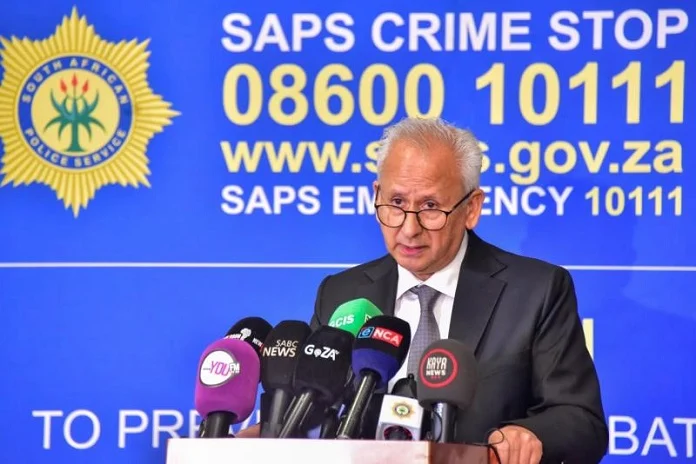
SOUTH AFRICA – The newly released South Africa crime statistics for the second quarter of the 2026/27 financial year indicate a national decrease in most violent crime categories, although Acting Minister of Police Firoz Cachalia cautioned that overall murder levels remain critically high.
According to the South African Police Service (SAPS) data covering July to September 2026, the country recorded 5,590 murders. This represents a decrease of 204 compared to the 5,794 murders recorded in the same period last year. Despite the decline, the figures equate to an average of 60 murders per day.
The data indicates that murder is not randomly distributed but concentrated in specific hotspots. The risk of being murdered is highest in the Eastern Cape, followed by the Western Cape and KwaZulu-Natal, with risks further concentrated within specific localities in those provinces. Additionally, approximately 80% of all gang-related murders and nearly 60% of all taxi-related murders occurred in the Western Cape, while Gauteng recorded the highest number of robbery-related murders.
The statistics were presented during a media briefing in Pretoria on Friday by Acting Minister Cachalia, alongside Deputy Ministers of Police Cassel Mathale and Dr. Polly Boshielo, and National Commissioner of the SAPS, General Fannie Masemola.
Addressing the persistent murder rates, Cachalia stated that the figures require a firm and intelligent response. He directed that police must focus on arresting perpetrators, recovering weapons, disrupting gangs, and ensuring organized criminals are brought before the courts.
Positive Trends in Violent Crime
The Minister welcomed the continued progress in several violent crime categories, which are showing national decreases and reversing a 13-year upward trend observed between 2012 and 2025.
Notable reductions were recorded in armed robberies, with carjacking declining by 16.8% and truck hijacking dropping by 27.9%. Robberies at both residences and businesses decreased by 7% each. Serious assaults also saw a decline. Reported sexual offences continued to decrease, albeit at a slower rate of 2.7%.
While violent crime declined nationally and in the majority of provinces, the report noted that some provinces still recorded increases in certain crime categories.
Call for Safer Community Spaces and Infrastructure
A significant portion of violent crime continues to occur in public environments. During the quarter, nearly 3,000 murders took place in public places, including streets, open fields, recreational centers, parks, beaches, and parking areas. In the analyzed sample, public places also accounted for 1,547 reported rapes. Furthermore, the data recorded eight murders and 103 rapes in abandoned or unfinished buildings.
In response, the Minister called on municipalities, property owners, provincial departments, and the national government to collaborate on identifying and securing abandoned or unsafe buildings. He urged authorities to rehabilitate or lawfully repurpose these structures, improve lighting, clear overgrown areas, maintain public spaces, and ensure safer access to transport hubs and pedestrian routes.
Cachalia emphasized that while police patrols are essential, they cannot replace well-managed public environments. He noted that dark streets, abandoned buildings, broken fences, and unmanaged parks create opportunities for criminal activity, stating that safe infrastructure is a fundamental form of crime prevention.
Demographics of Sexual Offences
Highlighting the need to better protect women, children, and families, the Minister detailed the demographics of the 9,908 rapes recorded during the quarter.
Of the 9,705 cases where the sex and age of the victims could be verified, children under the age of 18 accounted for nearly half of the victims, totaling 4,362 cases. Adult women accounted for 5,116 cases, while 227 victims were adult men.