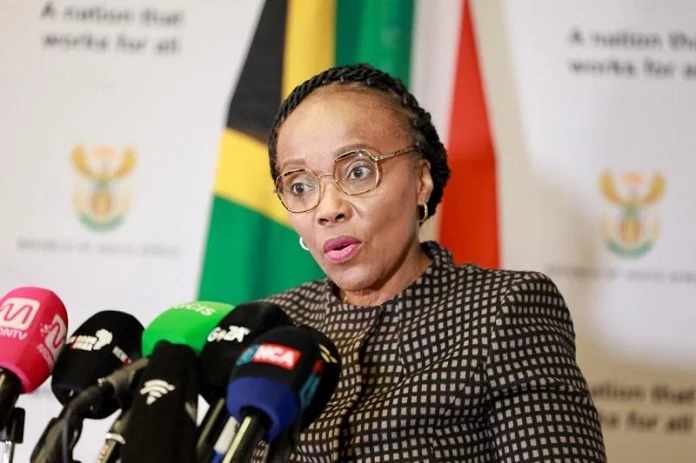
SOUTH AFRICA — The South African government has committed to a R5.1bn GBVF response following recent budget announcements, a move welcomed by Minister in the Presidency for Women, Youth and Persons with Disabilities, Sindisiwe Chikunga. The funding, announced by the Finance Minister during the Medium-Term Budget Policy Statement (MTBPS), is designed to significantly bolster the country’s efforts against gender-based violence and femicide.
The comprehensive R5.1 billion package includes a R3.8 billion allocation over the medium term. This specific funding is designated for the recruitment of 3,552 social workers across all provinces. These personnel will be deployed to support GBVF prevention, early intervention, psychosocial support, and victim empowerment programmes.
Additionally, the broader financial package allocates R186 million to enhance forensic and investigative capacity. It also funds the expansion of sexual offences courts (SOCs) from 55 to 101, and an increase in Thuthuzela Care Centres (TCC) from 72 to 80 by the 2028/29 financial year. Furthermore, R157.4 million has been directed to the Department of Women, Youth and Persons with Disabilities to strengthen the coordination and oversight of GBVF initiatives.
Speaking during a strategic engagement with the Commission for Gender Equality (CGE) on Friday, 13 November 2026, Chikunga addressed the implementation of Pillar 3 of the National Strategic Plan on GBVF (NSP-GBVF), which focuses on Justice, Safety, and Protection. She noted that the new funding commitments are a critical step in addressing the resource constraints that have previously hindered the national plan.
Chikunga highlighted that both the NSP-GBVF and the GBVF Disaster Management Plans have historically operated as unfunded mandates, which severely limited the department’s capacity to fulfill its coordination and oversight responsibilities.
“These investments demonstrate government’s commitment to prioritising GBVF prevention and improving support services for women, children, and vulnerable communities,” Chikunga stated. However, she emphasized that sustainable and dedicated funding remains essential to ensure that the effective implementation of the NSP translates into tangible frontline services and meaningful protection for survivors.
Shifting from Policy to Implementation
As the government transitions into the next phase of the NSP, the focus is shifting from policy development to large-scale implementation. This new phase emphasizes measurable outcomes, accountability, and the strengthening of capacity at both provincial and local government levels.
The strategic priority areas for this implementation phase include:
– Strengthening survivor-centred justice services.
– Improving coordination across the criminal justice value chain.
– Enhancing data and reporting systems.
– Strengthening accountability for implementation across all departments.
– Expanding prevention initiatives and behaviour-change programmes.
– Improving provincial and local implementation capacity.
– Institutionalising the work of the National Council on GBVF.
– Enhancing oversight, monitoring, and evaluation arrangements.
– Securing sustainable financing for NSP implementation.
Chikunga stressed that combating GBVF requires a comprehensive whole-of-government and whole-of-society response. This collaborative effort must include civil society, business, organised labour, traditional leaders, faith-based organisations, and local communities. She also underscored the necessity of engaging men and boys to challenge harmful gender norms and promote positive masculinities as a core prevention strategy.
Looking ahead to the 2026 16 Days of Activism for No Violence Against Women and Children Campaign, Chikunga noted that the initiative will be guided by the theme: “Letsema: Men, Women, Boys and Girls Working Together to End Gender-Based Violence and Femicide (GBVF).”
“As we advance this work, we are guided by the understanding that ending GBVF is not only a government responsibility; it is a national imperative,” the Minister concluded. “Together, through collective action, accountability and sustained commitment, we can build a South Africa in which every woman, every child and every person lives free from fear, violence and discrimination.”