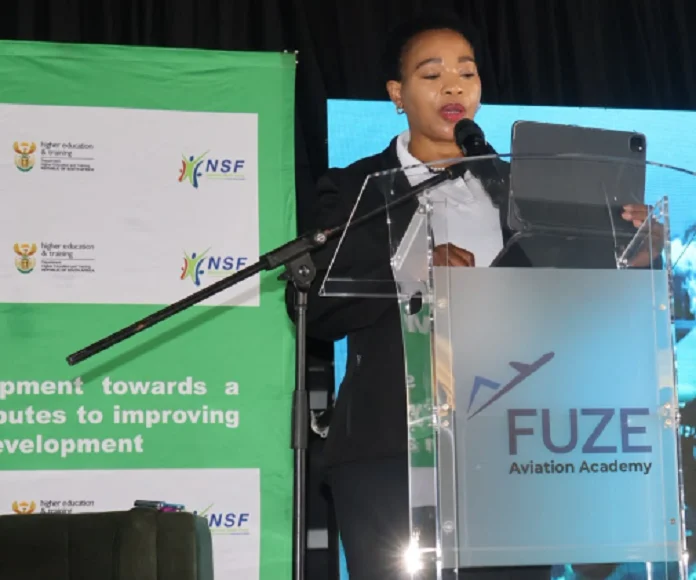
KWAZULU-NATAL — A landmark R95.9 million KwaZulu-Natal skills development project has officially launched, aiming to equip over a thousand young people with critical aircraft maintenance engineering and technical skills. Announced by Higher Education and Training Deputy Minister Nomusa Dube-Ncube at Obiri Airport, the initiative represents a strategic push to combat youth unemployment through targeted, industry-aligned training.
Funded through the National Skills Fund (NSF) under the Department of Higher Education and Training, the 43-month initiative is being implemented by Fuze Business Initiative. The project targets 1,020 beneficiaries across the province, focusing on practical, industry-relevant skills designed to open direct pathways to employment and stimulate local economic growth.
The training programme is divided into two primary streams. The first involves 20 apprentices undertaking a comprehensive three-year aircraft maintenance engineering programme in uMgungundlovu. The second stream focuses on 1,000 learners pursuing a National Qualifications Framework (NQF) Level 3 wheel balancer qualification. This specific training is distributed across the province, with 300 learners in Newcastle, 200 in Mooi River, and 500 in Mpumza, Pietermaritzburg.
Recruited learners, who began their training in August, are supported with monthly stipends, toolkits, and protective equipment to ensure they can focus fully on their studies.
Delivering the keynote address at the launch, Deputy Minister Nomusa Dube-Ncube emphasized that the project is designed to foster both traditional employment and enterprise development. Notably, the project’s budget includes provisions for the registration of cooperatives.
“We are not only training you to be employed. We are expecting some of you to employ others,” Dube-Ncube stated, highlighting the initiative’s dual focus on job creation and entrepreneurship.
Addressing the broader economic landscape, the Deputy Minister noted that the project arrives at a critical time when youth unemployment remains a severe challenge. She stressed the necessity of expanding occupational training and workplace-based learning, ensuring that curricula are strictly aligned with current industry needs.
Looking ahead, the programme is also designed to prepare young people for emerging occupations. The curriculum introduces learners to future-focused sectors, including electric and hybrid vehicle systems, drone maintenance, smart manufacturing, artificial intelligence-assisted diagnostics, and green hydrogen. Dube-Ncube urged training providers to collaborate closely with industry leaders to meet current economic demands while future-proofing learners against technological shifts. She also pointed out that South African-trained artisans and aircraft maintenance engineers are well-positioned to access growing specialized skill markets across the African continent.
The launch forms part of the Department of Higher Education and Training’s broader mandate to expand skills development. For the 2026/27 financial year, the department is targeting over 520,000 Technical and Vocational Education and Training (TVET) college enrolments. This includes 91,800 workplace-based learning opportunities and 22,000 artisan certifications. Additionally, Dube-Ncube highlighted the NSF’s separate R2.39 billion Artisan Massification Programme, which aims to produce more than 10,000 artisans.
To ensure public funding delivers tangible results, the Deputy Minister announced strict accountability measures for the implementing agent. A portion of the management fee payable to Fuze Business Initiative will be withheld until agreed-upon outcomes are met.
“We will measure you, in the spirit of Batho Pele, on value for money: on how many learners complete, how many qualify, and how many find work or start enterprises,” she warned.
Beyond economic metrics, Dube-Ncube used her platform to address the critical issue of safety in technical training environments, calling on providers and host employers to implement clear policies against gender-based violence (GBV) and harassment.
“No economy can grow while its women live in fear. No learner can master a trade while she is afraid to walk to the training site,” she said.
Directly addressing the attendees, she urged young men to use their strength constructively. “A real man repairs engines; he does not break the people who love him. Call out your friends. Refuse to be silent.”
She concluded with a message of empowerment for the young women in the programme: “You belong in the hangar, in the workshop and in the boardroom. If you are harmed or threatened, speak out. You will be believed, and you will be supported.”
Victims or those seeking assistance regarding gender-based violence are urged to contact the Gender-Based Violence Command Centre, which is available 24/7 on 0800 428 428.