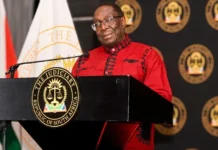
PRETORIA, South Africa — The South African government has officially recalled its High Commissioner to India, Anil Sooklal, for urgent consultations following widespread public outrage over a photograph showing the diplomat alongside former President Jacob Zuma and fugitive state capture suspect Ajay Gupta. International Relations and Cooperation Minister Ronald Lamola confirmed the recall, emphasizing that the high-profile encounter at a Hindu temple poses severe risks to the nation’s foreign policy integrity and ongoing extradition efforts.
According to Minister Lamola, the High Commissioner’s office plays a critical role in delivering Mutual Legal Assistance documents to Indian authorities on behalf of the Department of Justice. Consequently, the diplomat must not be perceived as being aligned with the Gupta family, who remain heavily implicated in the Zondo Commission’s state capture findings. Lamola clarified that the recall is currently for “clarity-seeking questions” rather than an outright dismissal, aiming to reassure the public that the department is handling the matter transparently and protecting the integrity of its foreign services.
Weighing in on the diplomatic maneuver, international relations analyst Dr. Mikatekiso Kubayi noted that the recall does not necessarily signify a formal diplomatic rift between Pretoria and New Delhi. Instead, Dr. Kubayi explained, it reflects the government’s urgent need to manage domestic reputational damage and investigate an apparent communication breakdown regarding the former president’s travels and the diplomatic protocols afforded to him.
The controversy has catalyzed a broader policy shift. Minister Lamola announced that the department has submitted recommendations to both Parliament and the Presidency to establish a new, stringent framework for diplomatic support afforded to former presidents and deputy presidents. Under the proposed mandatory disclosure mechanism, former leaders seeking state-funded travel protocols must provide exhaustive details regarding their itineraries, funding sources, principal hosts, and the capacity in which they are traveling.
Lamola stressed that this review is vital to close existing loopholes that allow former heads of state to exploit diplomatic privileges for political agendas that contradict the sitting government’s foreign policy. He pointed to recurring incidents in India, Morocco, and Uganda where state resources were allegedly conflated with private or opposition political messaging, creating the illusion of a “parallel foreign policy.”
Shifting focus to broader international relations, Lamola welcomed the African Union’s formal objection to South Africa’s exclusion from the upcoming 2026 G20 summit, which will be under the leadership of the United States. He argued that as a founding member, South Africa’s absence undermines the inclusivity and foundational definition of the global forum. Additionally, the minister urged the international community to support South Sudan’s upcoming local government elections, reiterating that African development and stability remain the central pillar of Pretoria’s foreign policy.
Addressing intra-continental mobility, Lamola highlighted that migration is a comprehensive African issue, noting that 50% of migrating Africans relocate to receiving countries within the continent, including South Africa, Côte d’Ivoire (Ivory Coast), and Egypt. He advocated for resuscitating the 2015 Johannesburg Declaration via the African Peer Review Mechanism (APRM) to address the root “push and pull” factors of migration through regional integration and economic development, rather than treating South Africa as an isolated symptom. Dr. Kubayi echoed this sentiment, emphasizing that the bulk of African migration remains intra-continental, debunking myths of mass exodus solely to Europe.
On the domestic political front, Lamola addressed recent allegations made by ANC veteran Nkosazana Dlamini-Zuma. She claimed an audio recording implicated Lamola and ANC Secretary-General Fikile Mbalula in distributing funds to secure preferred candidates during the 2017 and 2022 ANC conferences. Lamola vehemently denied the claims, stating the voice on the recording is unequivocally not his. While he has demanded a retraction and intimated potential defamation lawsuits, Lamola expressed a strong preference to avoid taking a struggle veteran to court, noting that a simple retraction would suffice to clear his name.