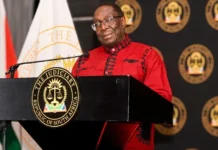
PRETORIA, South Africa — The South African government has firmly rejected an ICC petition against South Africa concerning alleged anti-migrant violence, with legal experts echoing that the application is both opportunistic and legally unfounded. Professor Angelo Dube from the UNISA School of Law recently unpacked the merits of the case, highlighting significant jurisdictional hurdles and the misapplication of international legal frameworks by the petitioners.
The petition, submitted by Ghanaian nationals Palgrave Boakye-Danquah and Emmanuel Kotin, requested a preliminary investigation by the International Criminal Court (ICC). It alleges that targeted attacks against foreign nationals in South Africa amount to crimes against humanity. However, Professor Dube emphasized that the international legal framework is built on the principle of complementarity. This means domestic courts must be utilized first, unless a state is proven unwilling or unable to deliver justice.
South Africa’s government has pointed to active police investigations and robust local anti-discrimination laws as proof of a capable, impartial, and independent domestic justice system. Professor Dube noted that a domestic crime does not automatically equate to an international crime. To elevate a case to the ICC, petitioners must prove that the acts are both “widespread” and “systematic,” a stringent threshold the current application fails to meet.
A critical flaw in the petition, according to the legal expert, is the reliance on the term “xenophobic attacks.” Professor Dube clarified that this is a sociological term, not a recognized legal crime under the Rome Statute. The ICC is designed to address specific crimes against humanity—such as murder, forced displacement, slavery, or sexual crimes—when executed in a systematic manner. The petitioners have not provided evidence meeting this legal standard, making it highly unlikely that the ICC Office of the Prosecutor or the pre-trial chamber would advance the matter.
Addressing the potential motives behind the filing, Professor Dube suggested the petition could be a political maneuver aimed at damaging South Africa’s reputation as a moral authority, particularly following the nation’s high-profile case against Israel at the International Court of Justice (ICJ). He cautioned that while South Africa has international obligations under the Genocide Convention and customary international law to act against such violations, the country may now be facing geopolitical pushback. He pointed to potential external influences, suggesting that certain Western narratives may be encouraging overzealous actions to undermine South Africa’s global standing.
The discussion also touched on the delicate balance between Pan-African solidarity and citizen protection. Professor Dube warned against equating Pan-Africanism with turning a blind eye to criminality or the strains placed on the national fiscus by illegal immigration. He stressed that the core issue is not migration itself—which fosters the exchange of ideas and is supported by the African Continental Free Trade Agreement—but rather illegal immigration. He noted that individuals traversing multiple countries to claim asylum in South Africa, while bypassing safer intermediary nations, places an unsustainable burden on local resources and taxpayer-funded rights provisions.
Looking ahead, Professor Dube argued that any debate at the African Union (AU) would only be valuable if framed around the broader illegal immigration crisis affecting the continent, rather than using the legally inaccurate label of xenophobia. He called for honest introspection among African nations, questioning why there is vocal solidarity regarding alleged xenophobia in South Africa, yet profound silence regarding clear, documented crimes against humanity, such as Africans being sold into slavery in Libya and the Sahara.
Until petitioners can provide concrete evidence of systematic, widespread crimes that domestic courts are unwilling to address, legal experts maintain that the ICC will remain the wrong venue for resolving complex sociological and regional migration challenges.