



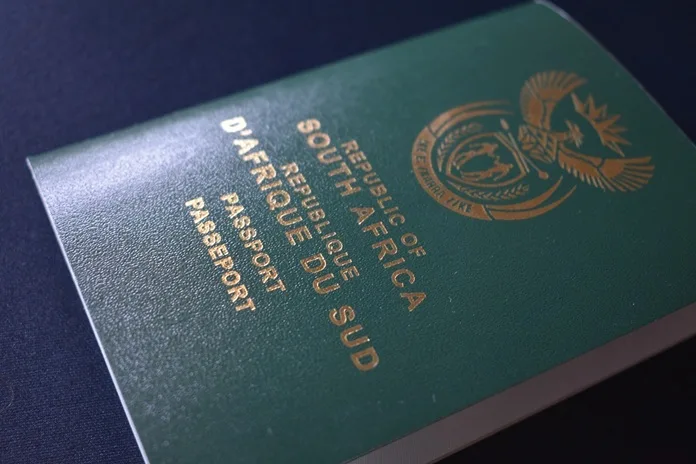
South Africa’s capacity to monitor citizens holding dual nationality faces renewed scrutiny after the Home Affairs Department confirmed it cannot fully track dual citizens following a Constitutional Court ruling. The development has reignited debate over immigration oversight, citizenship record-keeping, and national accountability amid heightened public concern about border management.
Political analyst Sandile Swana says the absence of a consolidated population database has created a significant information gap for both government and the public. “As minister of home affairs, you need to know who is in the country. Even as minister of police and state security, you need to know the precise identity of the people in the country at any given moment in time,” Swana stated. He emphasized that modern biometric technology—including fingerprint and facial recognition—could enable continuous, accurate identification linked to residential and origin data, separate from immigration processing.
Swana raised concerns about potential conflicts of loyalty among public officials. He noted that individuals aligned with “former colonial masters and current neo-colonial masters,” including interests linked to the United States, United Kingdom, and certain European countries, could hold parliamentary seats or diplomatic posts while maintaining dual citizenship. “Some of those people could be members of parliament in this country holding two passports and sharing dual loyalties, and our minister of intelligence and our minister of foreign affairs is none the wiser,” he said.
The analyst referenced South Africa’s active role at the International Court of Justice regarding Palestine, and pointed to recent diplomatic engagements—including President Ramaphosa’s visit to the White House—as contexts where dual allegiances could influence policy. He also alluded to officials who reportedly traveled abroad without proper authorization.
When asked why the Constitutional Court removed the requirement for dual citizenship declaration, Swana criticized national leadership for what he described as inadequate security consciousness. “We are not security conscious. That is why, for instance, our army went to the DRC and got beaten up thoroughly because we’ve weakened the entire security cluster,” he said, citing findings from the Madlanga Commission regarding institutional vulnerabilities.
Swana characterized the tracking gap as a “dangerous loophole,” arguing that weaknesses extend across the security sector. “Not only is our army a Mickey Mouse, the entire security cluster is a Mickey Mouse from the position of the citizens not being protected,” he stated. He further alleged that elements within state institutions, including Home Affairs, have been implicated in criminal syndicates, and that population registration and immigration systems have been exploited as “a continuing criminal enterprise run by the elites of this country.”
Referencing the Organized Crime Index, which reports South Africa’s worsening rating concerning state and political actors involved in human smuggling, trafficking, illicit financial flows, and drug trafficking, Swana urged that public discourse shift focus. “All that they are fighting for is to grab one illegal immigrant, a vulnerable illegal immigrant who cannot defend themselves,” he said. “The fat cats who are providing the logistics, the infrastructure for mass transporting these illegal immigrants into the country and then have an industry of providing them with fake documents—that is not even under discussion.”
Minister in the Presidency Khumbudzo Ntshavheni recently indicated that President Ramaphosa will address the nation on illegal migration. In light of this, Swana called for clear guidance on lawful security procedures. “The president needs to guide us as to what security measures [are appropriate]… Nobody must stop anybody in the street and ask them for identification or any type of document. Nobody who is not a police officer must arrest anybody. And nobody must assault, attack, violate in any fashion,” he said.
Swana concluded by stressing the President’s constitutional duty as commander-in-chief to protect all citizens, referencing the unrest of July 2021. “A lot of our relatives lost their businesses in the insurrection that happened, which he did… fail to control. This time he must not fail.”
The Home Affairs Department has not yet released further details on plans to address the database shortfall following the Constitutional Court ruling.