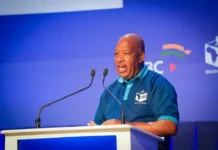
The African National Congress (ANC) has called for a measured government approach to immigration policy, as public anger over undocumented foreign nationals intensifies across South Africa. ANC Secretary General Fikile Mbalula recently urged authorities to handle the issue with care, acknowledging both domestic pressures and broader continental considerations.
Sanusha Naidu, a political analyst from the Institute for Global Dialogue, noted that the ruling party faces a “vexing” challenge within the Government of National Unity framework. She explained that immigration tensions have long simmered beneath South Africa’s socioeconomic landscape, and that calls for caution reflect concerns about both domestic optics and South Africa’s international reputation.
“The cautiousness is not about avoiding action, but about considering the imagery projected and the impact on South Africa’s foreign policy priorities,” Naidu stated. She highlighted that migration pressures are not unique to South Africa, citing similar dynamics in the United States, Europe, Canada, and parts of Asia, where policies sometimes reserve employment opportunities for nationals.
Naidu emphasized that sustainable solutions require regional cooperation. She pointed to the Southern African Development Community (SADC) and the African Union as critical platforms for developing shared protocols on migration, noting that regional integration cannot succeed if visa regimes and internal policies act as disruptors to the movement of people alongside goods and services.
Internal Disciplinary Matters
Separately, the ANC confirmed that its Integrity Committee has referred five members to the National Disciplinary Committee. Among them is former Social Development Minister Sisisi Tolashe, who was removed from cabinet following allegations that government resources were used to pay an individual working in her daughter’s household, and that vehicles donated to the ANC Women’s League were used by her family.
Tolashe, who serves as leader of the ANC Women’s League, retains significant support within the party. Naidu observed that while internal party disciplinary processes are important, allegations involving ministerial conduct also warrant accountability mechanisms at the national government level. “These issues become entangled when we don’t separate party processes from governmental accountability,” she noted.
Johannesburg Mayoral Search Continues
With local government elections approaching, the ANC continues to face challenges in finalizing its mayoral candidate for Johannesburg. Reports suggest several prominent figures have declined the position, which Naidu described as exceptionally difficult given the city’s complex governance landscape.
She cited ongoing tensions between the City of Johannesburg and Eskom over municipal debt as one example of the formidable responsibilities awaiting the next mayor. Additionally, the ANC must navigate a competitive political environment, with the Democratic Alliance, Rise Mzansi, and ActionSA all fielding credible candidates.
“The question isn’t just about finding a big name to draw votes,” Naidu explained. “It’s about finding someone willing to take on a role entrenched in complex coalition dynamics and service delivery challenges.”
As South Africa prepares for local elections, the ANC’s approach to migration, internal discipline, and candidate selection will likely influence both public perception and electoral outcomes. Analysts suggest that balancing principled policy with responsive governance remains central to the party’s strategy in an increasingly complex political landscape.