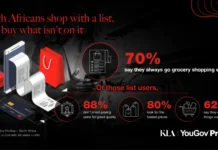
Nearly three in four South African women (72%) say they are the only grocery shopper in their household, compared with 60% of men. That is the central finding of new data from KLA, the full-service market research agency and YouGov’s exclusive partner in Sub-Saharan Africa. Drawn from YouGov Profiles, the analysis shows the gap holds in every generation, widens with age and grows sharper still among couples, even though three-quarters of South Africans agree that men and women should carry equal responsibility for household life.
Across all adults, 66% say they do the grocery shopping on their own, 32% share it and just 2% have no responsibility for it at all. Men are noticeably more likely to describe the job as shared, with 37% saying so against 27% of women.
The younger the household, the more balanced the picture. Among Gen Z, 69% of women and 61% of men are sole shoppers, a gap of eight percentage points. Among Millennials it widens to 11 points, with 75% of women shopping alone against 64% of men. Gen X show the widest gap, at 18 points: 77% of women are sole shoppers, compared with 59% of men.
Living with a partner deepens the divide. Among married respondents, 83% of women say they are the only grocery shopper, against 69% of men. Among couples living together outside marriage, the gap is wider still, at 72% of women compared with 43% of men.
None of this reflects a lack of belief in equality. Some 76% of South Africans agree that men and women should have equal responsibility for household life, and women (77%) and men (75%) hold that view in almost equal measure. The principle has wide support. The weekly shop has not caught up with it.
The pattern reverses when the purchase is a car. Men are more likely to take sole responsibility for buying the household vehicle, at 68% against 56% of women, while women are more likely to share that decision (30% against 22%). Taken together, the two findings point to a traditional division of household roles more than a split between everyday and big-ticket spending. Responsibility for a task is also not the same as making the decision alone. The person doing the weekly shop may well be buying to a list the whole household has shaped.
For those carrying the load, online shopping offers some relief. Among women aged 25 and older, 86% agree that online shopping makes life easier, in line with 85% of all adults. Sole grocery shoppers feel it most strongly: 67% definitely agree, compared with 43% of those who have no grocery responsibility.
“South Africans tell us they believe household work should be shared, and women hold that view just as firmly as men do,” says Rakhee Naik, Managing Consultant – Insights at KLA. “But when you look at who actually does the shopping, it is still overwhelmingly women, and very often on their own. For brands, the person in the aisle is frequently a woman buying for an entire household, and that should shape everything from media planning to product messaging. Younger households are sharing more, and that is a shift marketers will want to track as Gen Z set up homes of their own.”
For FMCG, retail and grocery brands, the primary shopper remains overwhelmingly female, and more so in older households, where Gen X women in particular are handling the shop largely alone. Sole shoppers are also the keenest adopters of online convenience, which opens the door for services that make list-building, reordering and everyday choices easier for the person doing the work.
Methodology
YouGov Profiles: Segmentation and media planning tool providing a comprehensive view of consumers’ worlds, with data collected daily.
Population: Nationally representative sample of South African adults aged 18 and over, filtered by gender, generation and marital status
Dataset: Profiles+ South Africa, 2026-05-31
Sample sizes: Unweighted bases of approximately n~943 to n~6,332, depending on the question
About KLA
KLA (Kaufman Levin & Associates) is a full-service market research agency and the exclusive partner for YouGov in Sub-Saharan Africa. With deep analytical expertise, multilingual fieldwork capabilities across South Africa and the continent, and a blue-chip client base, KLA delivers insights that are grounded, actionable and built to drive real results. For more information, visit www.kla.co.za or email: [email protected].