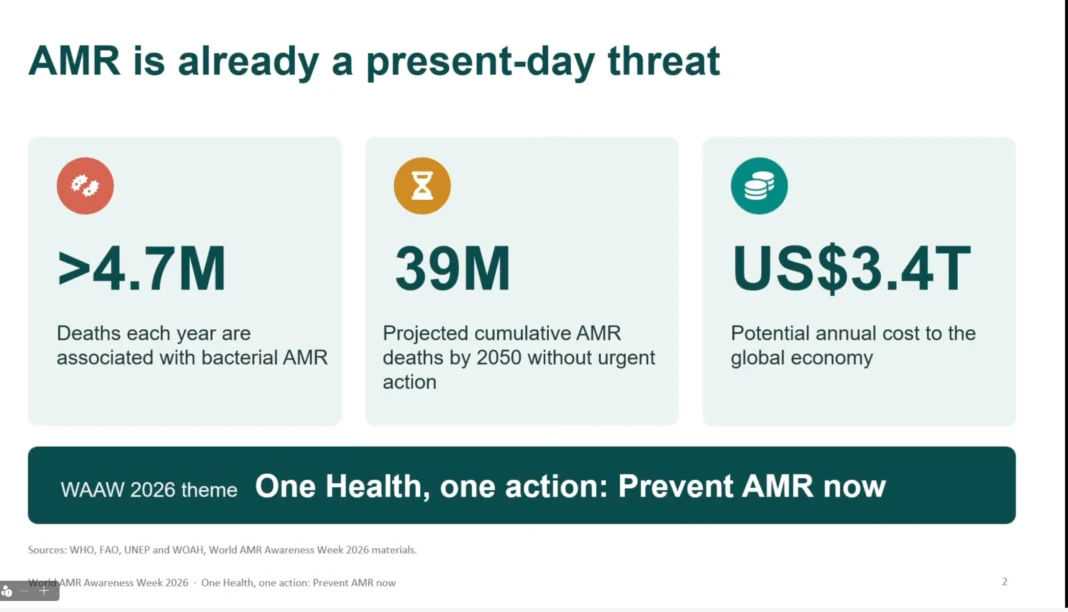
When the first antibiotic cannot beat a serious bacterial infection, finding one that works gets harder. Today’s World AMR Awareness Week symposium is jointly convened by the National Institute for Communicable Diseases (NICD), the World Health Organization (WHO), the Department of Health (DoH) and the Antimicrobial Stewardship Initiative in the University of Pretoria’s Department of Pharmacology. The symposium focuses on strengthening the links between laboratory testing, national surveillance and clinical care to help detect resistant infections earlier.
Antimicrobial resistance (AMR) occurs when bacteria, viruses, fungi or parasites develop the ability to survive the medicines meant to control them. Resistant infections are harder to treat and can mean longer hospital stays and greater risks for patients. Resistance can emerge naturally, but inappropriate antimicrobial use speeds it up.
A 2025 analysis by Dr Vindana Chibabhai, Prof Olga Perovic and colleagues, using national laboratory surveillance data from 2024, found that 21.5% of Klebsiella pneumoniae bloodstream infection isolates in the public sector and 30.5% in the private sector were resistant to carbapenems, antibiotics often relied on as a last line of treatment for serious bacterial infections. The figures cover bloodstream isolates reported to national surveillance, not all infections nationally.
Prof Perovic, of the Centre for Healthcare-Associated Infections, Antimicrobial Resistance and Mycoses (CHARM) at the NICD, is speaking on what national surveillance shows about the threat. Hospital-level data can guide initial treatment choices and flag emerging resistance patterns, and laboratory tests for individual patients can then show which antibiotics are likely to work.
Prof Veronica Ueckermann, from the University of Pretoria and Steve Biko Academic Hospital, is covering the clinical implications. Dr Roxanne Rule, from the National Health Laboratory Service (NHLS) and UP, is examining how diagnostic results can guide treatment. The response also depends on timely testing, getting results to care teams and stopping infections from spreading.
Dr Lauren Jankelowitz, of the Global Antibiotic Research and Development Partnership (GARDP), is discussing how patients in sub-Saharan Africa can get newer and reserve antibiotics when existing options fail. Ms Thembekile Zwane, an epidemiologist at CHARM, is presenting how surveillance data informed a “stewardship-enabled access” policy for ceftazidime-avibactam, and Dr Prenika Jaglal, of the University of the Witwatersrand and the NHLS, is sharing laboratory work on antibiotic combinations against multidrug-resistant infections in children. Antimicrobial stewardship, which means using the right antibiotic, at the right dose, for the right duration and only when needed, protects these medicines so they remain available for the patients who need them.
The symposium’s theme, “One Health, one action: Prevent AMR now”, reflects the fact that resistance moves between people, animals and the environment. Student research on antimicrobial use in Tshwane paediatric wards and on bacteria found in cattle and the farm environment on a South African beef farm shows that the response has to reach beyond hospitals. Prof Francois Maree, of the University of Pretoria’s Department of Medical Virology, is speaking on AMR at the animal–human interface, and Prof Lyndy McGaw, of the University’s Phytomedicine Programme, is exploring the role of plant-based alternatives in animal antimicrobial stewardship. The programme also covers how young people and educators can support the South Africa’s National Action Plan on AMR.
“Antimicrobial resistance is not a future threat; it is here” says Prof Natalie Schellack, Head of the Department of Pharmacology at the University of Pretoria and chair of the programme. “Keeping antibiotics working needs everyone: prescribers, pharmacists, laboratories, veterinarians, policymakers, public and patients.”
Hosted by the Antimicrobial Stewardship Initiative from the University of Pretoria’s Department of Pharmacology, the symposium runs from 08:00 to 15:30 at Tswelopele Lecture Hall 1, Prinshof Campus, and can also be joined remotely following MS Teams link to join the symposium.