



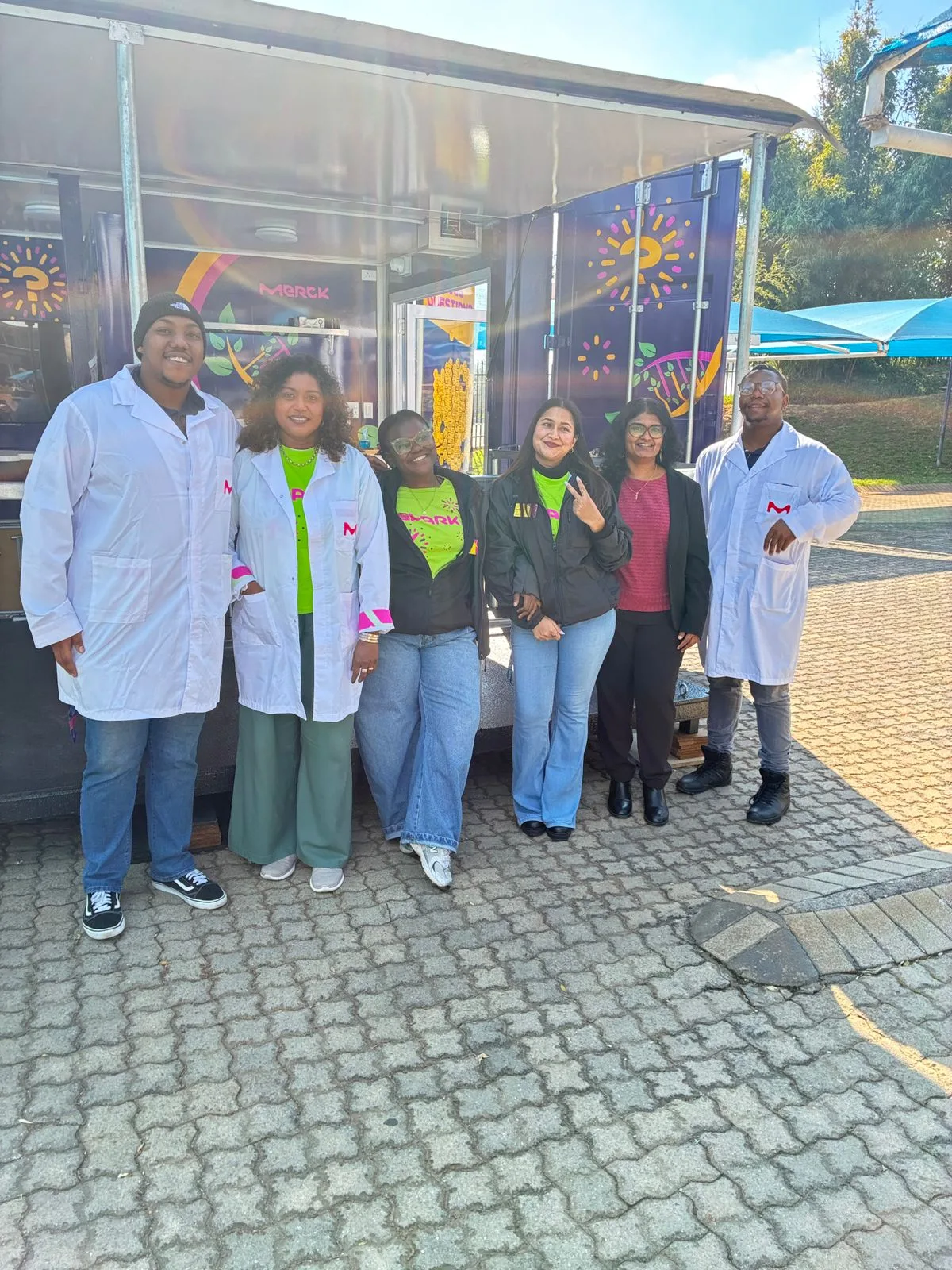
From 25 May to 9 June, 1247 students from Trinityhouse Schools (Little Falls, Glen Vista,Centurion) in Johannesburg, Roodepoort, and Centurion became scientists for the day, working alongside Merck employees and partners as part of the science and technology company’s international Curiosity Cube™ tour to help turn curiosity into science careers.
Alongside the events with Trinityhouse Schools, the Curiosity Cube™ recognized Youth Day in South Africa by stopping at Merck’s Johannesburg facility with students from Alex and Tembisa visited the cube during the youth day from 11 and 18 June. These facility visits served as a powerful reminder of the urgent need to inspire students to pursue STEM careers and reinforced the company’s commitment to doing so.
The Curiosity Cube™ a mobile science lab designed to make STEM (science, technology, engineering and math) learning fun and accessible, is in Southern Africa for the second consecutive year, with Johannesburg just one of the 126 events on this year’s tour.
Attending students took part in three interactive experiments to learn synthetic biology fundamentals, using learning gadgets such as Cubelets and magnetic puzzles to explore the connection between enzyme shape and biological processes, how DNA “codes” affect traits and behaviors and how turning genes on and off empowers scientists to engineer solutions to real-world problems.
All experiments were taught by Merck employees and volunteers, connecting students to scientists who can speak to STEM careers available in their own communities.
“Hands-on STEM experiences can change the trajectory of a person’s life. The Curiosity Cube™ brings those moments of tangible inspiration to students and communities all over the world“, said Jennifa Mohale, Curiosity Cube™ Coordinator for Merck, who runs the Curiosity Cube™ program.
Breaking down educational barriers, building STEM careers
The Curiosity Cube™ initiative aims to ignite interest in STEM careers and break down barriers to science education for students. A survey by Merck found that nearly half (48%) of 8-13 year–old students find it difficult to envision themselves as scientists despite engaging in STEM-related activities every day.
According to the World Economic Forum, an additional 23 million STEM graduates are needed by 2030 to fill roles in these growing fields. Meeting this demand requires starting early —students, especially those ages 8 to 13, need meaningful exposure and relatable role models to help them imagine a future in STEM.
By providing access to STEM education in a fun, memorable way at a pivotal time in students’ education and lives, the Curiosity Cube™ helps students make this connection, and, in turn, contributes to a robust future science and technology workforce.
Creating exponential impact in Southern Africa and around the world
In 2025 alone, 2,069 Merck employee volunteers and university partners helped educate 56,035 students around the world about artificial intelligence via the Curiosity Cube™. Previous Curiosity Cube™ tours have also included experiences on topics such as sustainability, contamination and the human microbiome.
The Curiosity Cube™ is part of Merck’s SPARK™ global volunteer program, which celebrates its 10th anniversary this year, and builds on the company’s Curiosity Labs™program, where employees go into classrooms and conduct hands-on experiments with students.
To date, Merck employees have volunteered more than 196,800 hours of their time through SPARK™, hosting more than 6,500 events across 48 countries and engaging more than 613,400 students.
In addition to South Africa, the Curiosity Cube™ made stops in Botswana, expanded toZambia for the first time, and will also visit Eswatini, Lesotho, and Namibia.
On its fifth annual European tour, the Curiosity Cube™ will make stops in Austria, Belgium, Czech Republic, France, Germany, Ireland, Italy, the Netherlands, Spain, Switzerland and the U.K., along with new stops in Poland, Serbia and Slovakia.
The Curiosity Cube™ will also tour the U.S. and Canada, holding 133 events in Austin, Boston, Cleveland, Durham, Houston, Kansas City, Milwaukee, New York, San Diego, San Jose, St. Louis and Toronto.
More than 286,000 visitors in 20 countries across the U.S., Canada, Europe and Southern Africa have visited the Curiosity Cube™ since its inception in 2017.
“You can see students’ confidence grow as they move through each station,” said Jennifa Mohale Curiosity Cube™ Coordinator, Merck. “They’re discovering that they belong in these spaces and that their ideas matter. Learning science is just the beginning.”
To learn more about upcoming tour stops, visit TheCuriosityCube.com or follow the journey on Instagram at @curiositycube_merck.