
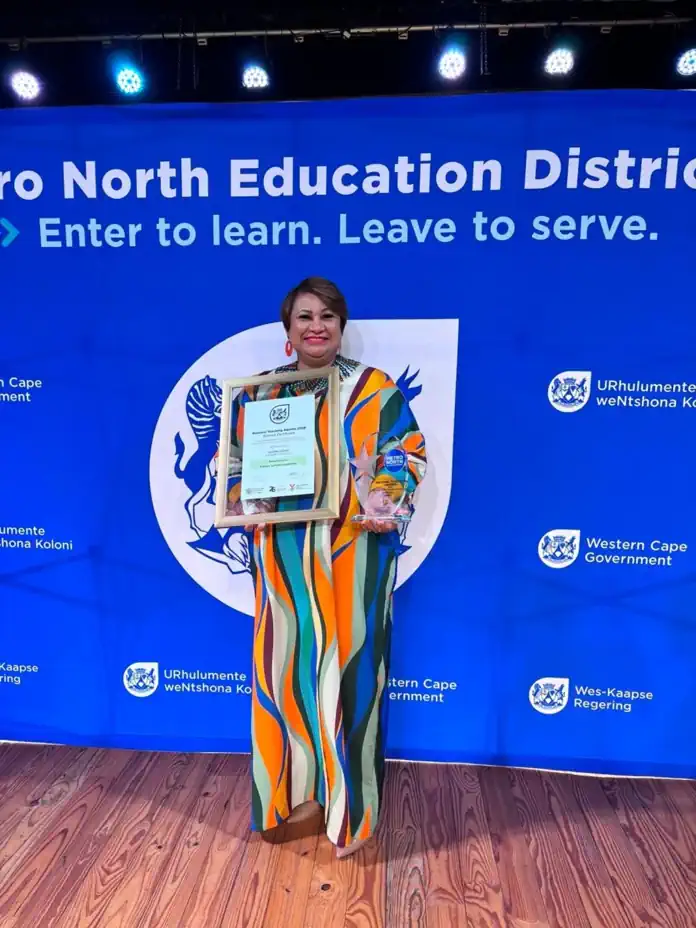
It is tempting to believe that leadership awards merely recognise individuals.
Spend a few minutes talking to Lynette Schoor, principal of J.S. Klopper Primary in the Western Cape, and she offers a compelling rebuttal.
Recently recognised as the Western Cape provincial winner in the National Teaching Awards’ Excellence in Primary School Leadership category, Schoor sees the accolade not as the culmination of her own success, but as an affirmation of her lifelong commitment to learning, acting and becoming—for herself, her staff and her school community.
A journey of a leadership begins with a single step
For Schoor, Citizen Leader Lab’s Leaders for Education programme became that first step. The year-long programme equips school leaders with the skills, support and partnerships they need to lead change in their schools.
She graduated from the Leaders for Education programme in 2025. When she joined the programme a year earlier, she was still finding her feet as a principal after spending 24 years as a seasoned educator.
“I couldn’t really decipher what my leadership style was,” she recalls. “I was all over the place, still finding it. But as the programme progressed, it started to become clearer and clearer.”
The seminal months of the 12-month programme proved most pivotal in her leadership development. Schoor realised, early on, that listening is in fact leadership.
“I became an active listener. I started listening to my staff to understand, not to respond or react.”
It sounds disarmingly simple, yet it fundamentally altered the way she understood leadership. Rather than seeing leadership as having the right answers, Schoor began to understand it as creating the conditions for others to discover their own. “My responsibility became one where I aimed at creating an environment where my teachers can think well for themselves.”
Continuous learning
Of the ideas, theories and practices she encountered during the programme, Schoor has also kept ‘’possibility thinking’’ particularly close at hand.
“The ‘What if…?’ conversations have stayed with me,” she says. “Our entire school community is important to me, and one of the biggest challenges is getting people to buy into an idea. When a parent or teacher raises what feels like a problem, I instinctively turn it into a ‘What if?’ question. It encourages them to become part of the solution.”
It is an often-overlooked practice, but one that has transformed the tone of conversations across her school. Challenges became invitations to think laterally, while resistance gave way to ownership and accountability.
That same philosophy is evident in the everyday routines of her leadership. Regular walkabouts and informal classroom visits create opportunities for check-ins with staff. Professional growth is celebrated, whether it involves a veteran teacher or a member of the school’s support team. Transparency has become a defining characteristic of her leadership, earning praise from her peers and staff who tell her they have never worked with such an ‘’open principal’’. “I always take that as a compliment,” she says. “Before, I might have downplayed it. Now I simply say, ‘Thank you.'”
Still tough, but less daunting
The work, however, is not without its challenges. Like every principal, Schoor sometimes has to manage people whose behaviours test her resolve. The difference, she says, lies in how she now approaches them.
“I lead with empathy, but I do not enable disrespectful behaviour. I’ve learnt to separate the person from the behaviour, reconnect with my ‘why’, and spend more time with people who encourage and inspire me rather than those who drain my energy.”
Still becoming
Reflecting on her growth, Schoor believes completing the Leaders for Education programme early in her principalship gave her a solid foundation as a leader. Its greatest gift was replacing the pressure to be infallible with the confidence to be reflective. “I’ve gained an enormous amount of self-confidence in leading people,” she says.
“I no longer feel that I have to know everything, and every decision I make doesn’t have to be the right one. If it wasn’t, I have the confidence to acknowledge it, improve on it and move on.”
While the programme strengthened Schoor’s confidence as a leader, she says the richest reward has been seeing a culture of compassion, empathy, integrity and mutual respect become part of the school’s DNA.
“Our parents often tell me that my teachers take their cue from me,” she reflects. “I’d like to believe that’s true.”
Perhaps this is the kind of leadership schools need most: Not just a principal who leads on paper, but a principal whose legacy is the culture and confidence she has cultivated in others.
Or, as Schoor herself puts it: “Leadership is not what you achieve yourself, but what others achieve because of your influence.”