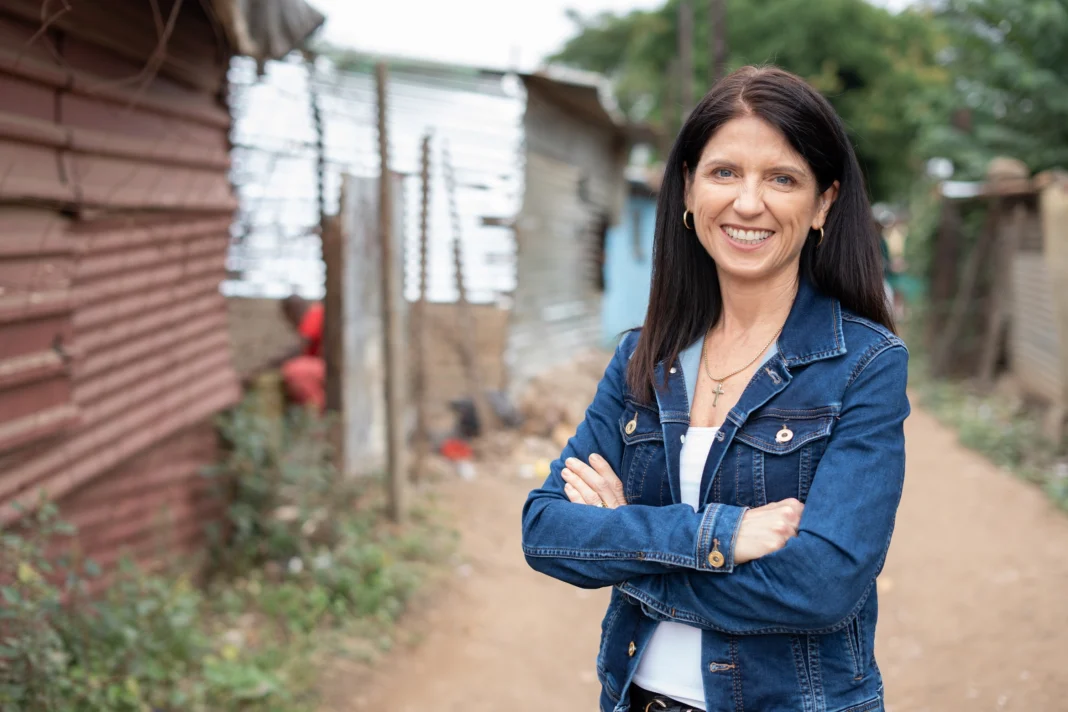
With World Giving Day taking place on 1 December, the ReStory Foundation is encouraging individuals, businesses and organisations to look beyond the amount they give and consider whether their generosity is creating lasting, meaningful change.
When a group of caregivers from Bhambayi, many of whom experience significant material poverty, decided to organise a surprise bridal shower for one of the ReStory Foundation’s Youth Development Workers, their intention was to do more than celebrate a special occasion; they wanted to give back to someone who had given so much to their children and community. As they explained, it was now their turn to bless her.
For the ReStory Foundation, which has journeyed alongside the people of Bhambayi in Inanda for almost 20 years, this was a powerful reminder that generosity cannot be measured by material wealth alone, and that people who may have very little financially often have an extraordinary amount to offer through their time, kindness, skills, relationships and willingness to show up for others.
It also raises an important question about the nature of giving: are we simply responding to a need, or are we giving in ways that recognise people’s dignity, strengthen their potential and contribute to lasting transformation?
South Africa is a country with a remarkable culture of generosity, which is particularly significant given the country’s deep socioeconomic inequalities. According to the 2026 Nedbank Private Wealth Giving Report, affluent South Africans contributed approximately R5.8 billion in cash and goods towards charitable causes in 2025, while Statistics South Africa’s 2024 Volunteer Activities Survey estimated the value of volunteering in the country at R17.5 billion. Corporate social investment also makes a substantial contribution, with Trialogue’s 2025 research reporting more than R3.9 billion in cash social investment and almost R1.4 billion in non-cash contributions among the companies in its research sample.
These figures reflect a considerable willingness to contribute towards the wellbeing of others, but they do not necessarily tell us how much lasting change that generosity is achieving. Nor do they capture the full picture of giving in South Africa, particularly the everyday acts of generosity and mutual support that take place within materially poor communities, where people continually share what they have with one another.
As Mandy Pearson, CEO of the ReStory Foundation, explains, the conversation needs to move beyond how much is being given and towards understanding the difference that giving makes.
“Giving is not just about what we give. It’s about how we give, why we give, and the difference our giving makes. We want to encourage generosity that recognises the dignity, strengths and potential of every person. Truly transformative giving doesn’t create dependency; it strengthens the agency of others and creates opportunities for people to become active participants in their own transformation.”
Rethinking the relationship between giving and receiving
Through its work in Bhambayi, the ReStory Foundation has learnt that even well-intentioned generosity can sometimes have unintended consequences when it focuses exclusively on what people lack, rather than recognising what they already have to contribute. While immediate assistance is often necessary and can make an enormous difference during difficult circumstances, the longer-term question is whether that support helps people build the confidence, capacity and opportunities to shape a different future for themselves and their communities.
This thinking underpins ReStory’s philosophy of eye2eye giving, which challenges the traditional perception that the giver holds the power while the receiver is simply the recipient of someone else’s generosity. Instead, it recognises that every person has something of value to offer and that giving and receiving are not roles permanently assigned according to someone’s financial circumstances.
“We believe everyone has something of value to give, whether that is time, skills, resources, kindness, encouragement or influence. Material poverty should never be confused with a lack of worth, ability or potential,” adds Pearson.
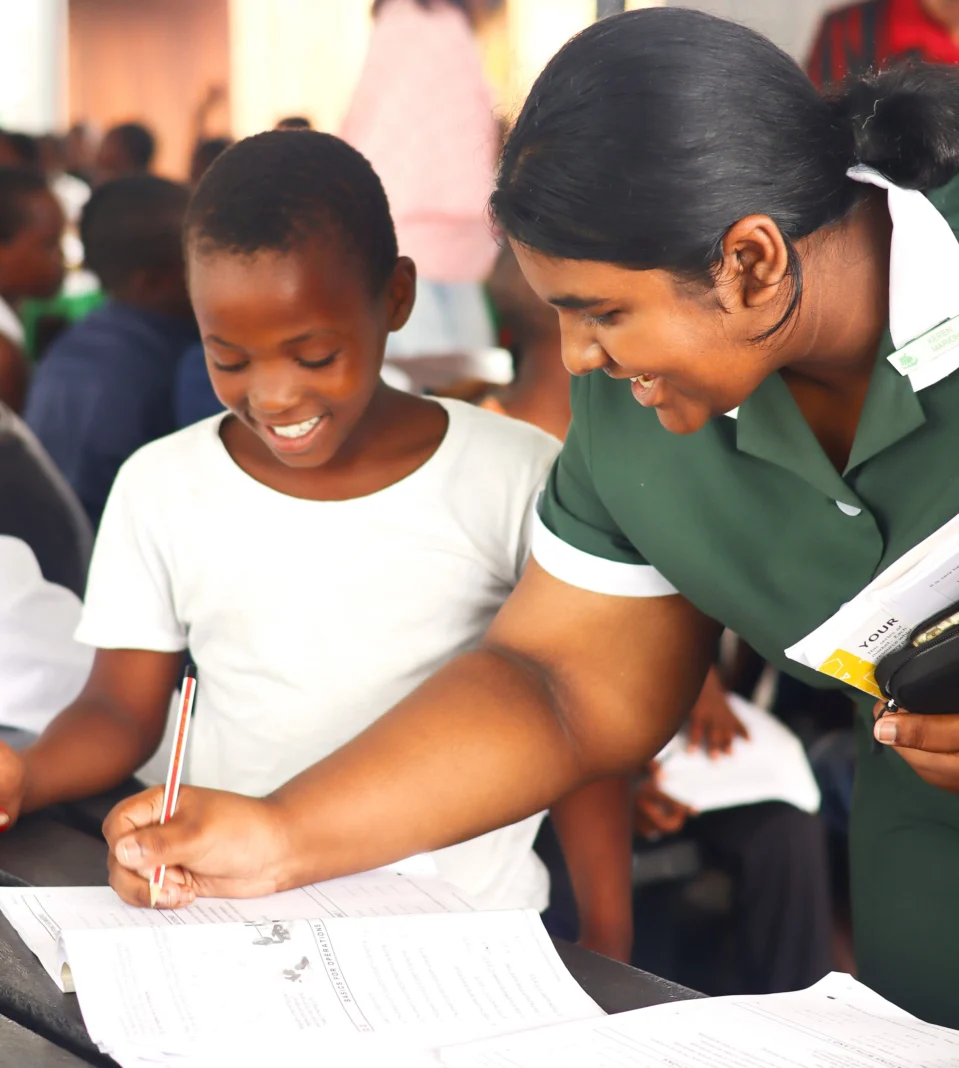
A practical example of this mutual exchange takes place every Friday, when volunteers from two private schools visit Bhambayi to help teach the children Maths and Literacy. The children, in turn, share something of their own by teaching the volunteers dances and traditional games. It is a simple but meaningful example of eye2eye giving, where everyone has something to give and everyone has something to receive.
This approach is reflected in the ReStory Foundation’s HOPE Building Framework©, developed through its experience of working alongside communities and designed to encourage more intentional, transformative giving.
The model is built around four interconnected principles: Honour, which means recognising the equal dignity and worth of every person; Outcomes, which encourages a focus on meaningful, lasting change rather than simply measuring the immediate assistance provided; Potential, which shifts attention from people’s limitations to their strengths and possibilities; and Empowerment, which seeks to strengthen people’s ability to take ownership of their circumstances and become agents of change.
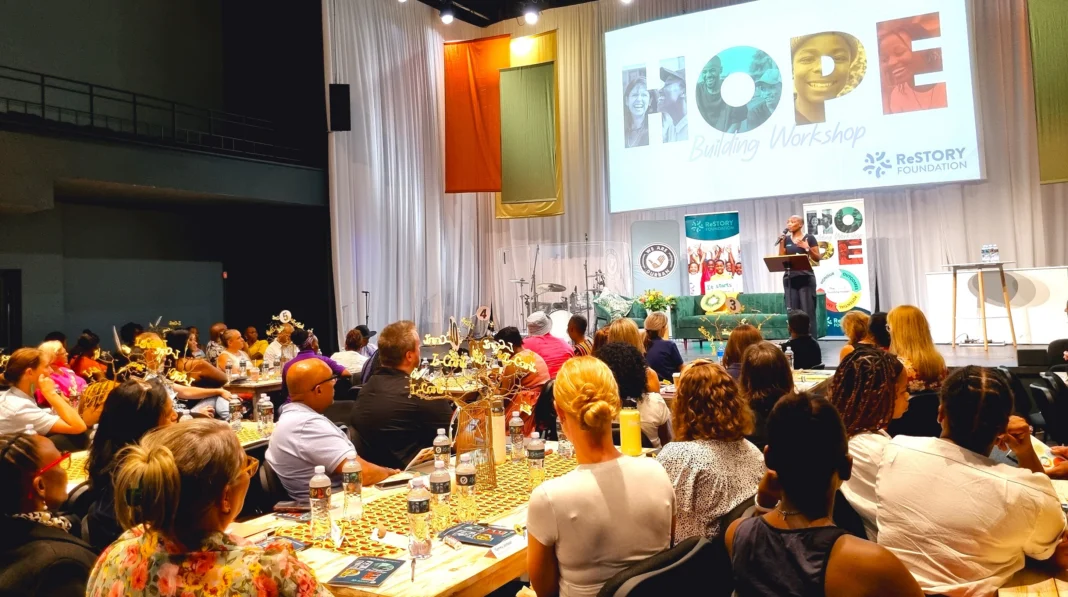
As Pearson explains, the intention is not to discourage generosity or suggest that practical assistance is unnecessary, but rather to encourage a deeper understanding of what it means to help.
“One of the things we have learnt through our journey in Bhambayi is that we all have something to give, and we all have something to receive. When we approach one another eye to eye, rather than seeing one person as the helper and the other as helpless, we create space for mutual respect, meaningful relationships and real transformation. We often say, ‘Be a hero by making someone else a hero’, because the greatest impact comes when we help people recognise and use the strengths and potential they already have.”
Making generosity count
With World Giving Day providing an opportunity to celebrate generosity in all its forms, ReStory is encouraging South Africans to consider not only what they can contribute, but also the intention and impact behind their giving.
For individuals, this might mean looking beyond an occasional donation to consider how time, knowledge, encouragement or practical skills could make a meaningful contribution. For businesses, organisations, schools and churches, it could mean rethinking community initiatives to ensure that the people they seek to support are actively involved in identifying needs, shaping solutions and building towards sustainable outcomes.
This does not mean that immediate relief should be overlooked, particularly in a country where so many families face daily challenges in accessing basic necessities. Rather, it is about recognising that meaningful change often requires more than meeting an immediate need; it requires relationships, opportunities, shared responsibility and a belief in what people can achieve when they are given the space and support to do so.
Perhaps the greatest lesson is that generosity should never be viewed as something that belongs only to those who have more to give. The Bhambayi caregivers who organised a bridal shower for someone who had supported their community demonstrated that giving can flow in every direction, and that the value of a gift is not determined by its price tag.
This World Giving Day, the ReStory Foundation is inviting South Africans to think differently about generosity and to become more intentional about giving in ways that build dignity rather than dependency, unlock potential rather than reinforce limitations, and create opportunities for people to discover and use their own power.
Because ultimately, the measure of generosity is not simply how much we give, but whether our giving helps create a future in which others are better equipped to thrive. “Let’s become as intentional about how we give as we are enthusiastic about giving itself,” concludes Pearson.
To find out more about the ReStory Foundation’s approach to giving or to enquire about booking a H.O.P.E. Building workshop for your organisation, school, church or company, contact [email protected] or visit www.restoryfoundation.co.za.