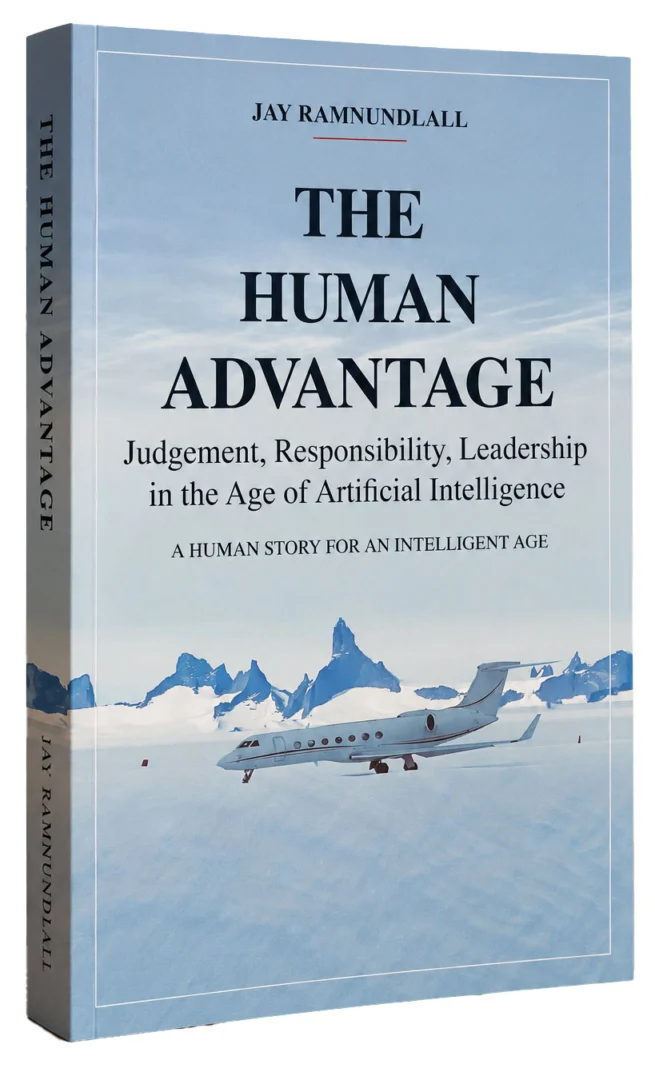
The Human Advantage launches in Durban as South Africa debates how artificial intelligence can strengthen human capability, protect pathways into work and create career opportunities.
DURBAN, 26th October 2026 — Artificial intelligence is moving beyond providing information to making decisions and taking action. As organisations adopt increasingly capable systems, one question becomes urgent: when a machine produces a better answer — or acts on our behalf — who remains accountable for the consequences?
That is the central question in The Human Advantage: Judgement, Responsibility and Leadership in the Age of Artificial Intelligence, the new book by Jay Ramnundlall, Group Chief Executive Officer of the Alpvest Institute for FutureTech (AIFT). The book was officially launched in Umhlanga on Friday, 23rd October 2026, following its introduction during the KZN AI Summit on Thursday, 22nd October.
Drawing on more than four decades in financial management, entrepreneurship, technology, education and institutional leadership, Ramnundlall describes how AI began doing more than saving him time: it challenged his assumptions and sometimes offered better answers than he could.
“The central message is simple: we may delegate intelligence, but we must not surrender judgement, responsibility or accountability. The greatest risk is not simply that AI will think for us. It is that we may gradually lose the habit of thinking for ourselves.”
From intelligent answers to real-world consequences
AI systems increasingly have the ability to communicate with other technologies, use tools and carry out tasks. Ramnundlall argues that the transition from AI that advises to AI that acts requires clearer limits, meaningful human oversight and the authority to intervene.
“An AI system that drafts an email produces information. An AI agent that sends that email, commits an organisation to an agreement or changes a student’s academic record creates real-world consequences. We cannot wait for serious failures before deciding who has authority, how systems should be supervised and who must answer for what follows.”
Across 36 chapters in eight parts, The Human Advantage examines leadership, professional expertise, education, institutional governance and the boundaries of responsible delegation. It introduces practical frameworks, including Accountability Distance, the Agency Envelope, and the Responsibility Threshold.
An employment debate that cannot be ignored
The book’s launch comes amid growing concern about AI’s effects on employment. In a Daily Maverick opinion article published on Sunday, 25 October, Youth Employment Service CEO Ravi Naidoo called for a South African AI strategy that prioritises employment. While the commentary is separate from the summit and launch, it underscores the relevance of the book’s argument about human responsibility.
Ramnundlall believes that the debate must address not only jobs at risk, but also the capabilities, experience and opportunities through which people can progress in their careers. He warns that replacing entry-level tasks without creating alternative learning pathways may weaken the development of tomorrow’s professionals.
Employees should not fear AI
“My message to employees who fear artificial intelligence is this: do not allow fear to prevent you from discovering what AI can help you achieve. Build on the knowledge and experience you already possess. Learn to use these technologies responsibly, question their conclusions and explore the new opportunities they may create. AI will change many jobs, but we should work to ensure that it also helps people become more capable, more productive and better prepared for the future,” says Ramnundlall.
He encourages employees to explore approved AI tools in their current roles to deepen their knowledge, improve analysis, solve workplace problems and identify opportunities for more advanced work. He cautions, however, that AI-generated outputs must be checked and confidential information protected.
“An experienced employee’s understanding of customers, professional standards and workplace realities does not suddenly lose its value because a machine can process information faster. Combining that experience with responsible AI skills may open the door to new responsibilities and career pathways.”
Ramnundlall stresses that employees should not be expected to manage this transition alone. Employers have a responsibility to provide practical training, opportunities to experiment safely, reskilling and credible pathways into redesigned or higher-value roles. Learning new tools is important, but it is not a guarantee against displacement.
Education, the KZN AI Summit, and Africa’s opportunity
Last week, the KZN AI Summit, organised by the KZN AI Foundation NPC with AIFT as host and anchor sponsor, brought together government, academic, industry and technology participants to discuss AI governance, infrastructure, enterprise applications and opportunities for young people and entrepreneurs. These discussions highlighted the importance of linking innovation to human capability and economic participation.
Ramnundlall’s educational journey began with a computer-training operation in Tongaat around 1990, which developed into PC Training and Business College. Today, AIFT’s future-focused educational mission includes preparing students and working professionals to apply emerging technologies while retaining independent thinking and professional judgement.
“Education must develop three capabilities: the ability to think and solve problems independently; the ability to use AI effectively; and the ability to supervise, challenge and, when necessary, reject its outputs. The measure of progress is not only what machines can accomplish, but what people become capable of achieving through them,” he says.
For Ramnundlall, Africa’s opportunity is to use AI to widen access to expertise, strengthen entrepreneurship and create more meaningful economic participation — while ensuring that institutions remain responsible for the technologies they deploy.
“The human advantage is not necessarily our ability to outperform machines intellectually,” he says. “It is our responsibility to determine worthwhile objectives, exercise ethical judgement and remain answerable for decisions that affect other people.”