



Walking into Elements in Flux, it takes a moment for your eyes to adjust to the soft red haze. The room hums with low ambient sounds, almost like breathing. Somewhere in that stillness, you come across Ziyi’s film, Hold On My Last Castle. It’s not loud. It doesn’t demand your attention right away. But once it has it, it doesn’t let go.
Set in a broken world shaped by ecological collapse, the piece imagines a future where the last place we call home isn’t a structure built of walls and beams, but something closer to the skin. In this world, the body becomes shelter. The film follows a solitary figure, building something that seems like a refuge of sorts. It’s not quite armor and not quite clothing, but something in between. Something remembered. Something built from the remnants of a world that no longer exists. Ziyi’s approach isn’t what you might expect from work that addresses climate change. There are no charts, no numbers, no archival footage. Instead, she leans into metaphor, memory, and a deep quiet. Her narrative unfolds in a submerged red-lit landscape that feels at once futuristic and familiar. It’s dreamlike, but constantly reminds the viewer of the apocalyptic scenery.
The color red fills the entire space. It catches you off guard at first. Most people associate the melting of glaciers with blue or white. But Ziyi takes a different path. For her, red represents energy. Not just literal heat, though that’s there too. It’s the force behind climate transformation. Rising temperatures, burning fuel, a planet growing hotter by the hour. But red also speaks to resilience. It’s the pulse that keeps going. The fire that warms, not just the one that destroys. The film was built using Unreal Engine, a tool most commonly associated with gaming. Ziyi uses it to construct 3D environments layered with satellite data, merging the digital and the real. There’s something eerie about watching a digitally rendered Arctic landscape slowly erode under an unnatural glow. It looks almost like a memory you’re trying to recall but can’t quite hold onto.
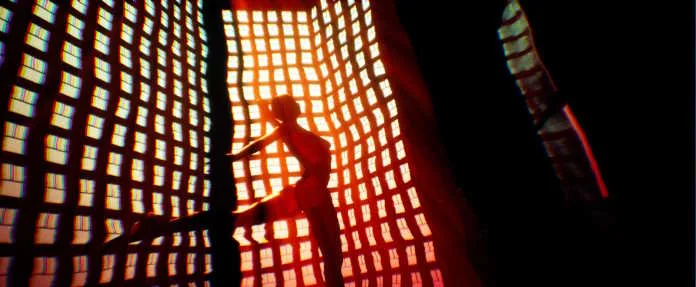
She chose to focus on the element of Fire from the Wu Xing, the Five Phases in Chinese philosophy. Fire, in that system, is not just destruction. It is also transformation, movement, even healing. Ziyi sees it as the thread running through her work. The fire that ravages the Earth is also the fire that forces us to begin again. Her visual language includes grids and repetitive patterns that echo throughout the landscape. These aren’t just aesthetic choices. They point to the artificial systems we’ve created to control nature. They stand in contrast to the organic forms that have collapsed under their weight. The grid is neat and rational. The world it overlays is anything but.
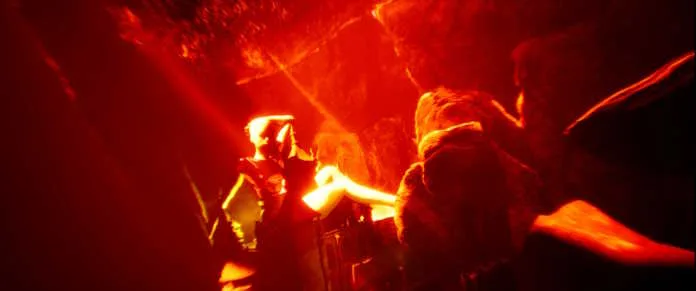
This piece, like much of her work, weaves together personal and collective experience. Ziyi’s broader practice blends technology with poetic storytelling, often using immersive media to explore how people live through large-scale change. Here, she steps away from spectacle and into something more internal. The story she’s telling isn’t about the world ending in fire and flood. It’s about what comes after that. What’s left when the buildings fall and the waters rise. What we carry with us when there’s nowhere else to go. Her film doesn’t push an agenda. It doesn’t try to persuade with fear or shock. Instead, it slows things down. It asks the viewer to sit with the discomfort, to look at the edges of ruin, and to imagine what survival might feel like. Not just physically, but emotionally. It gives space to grief, which often gets left out of conversations around climate. And it even hints softly at the possibility of rebuilding.
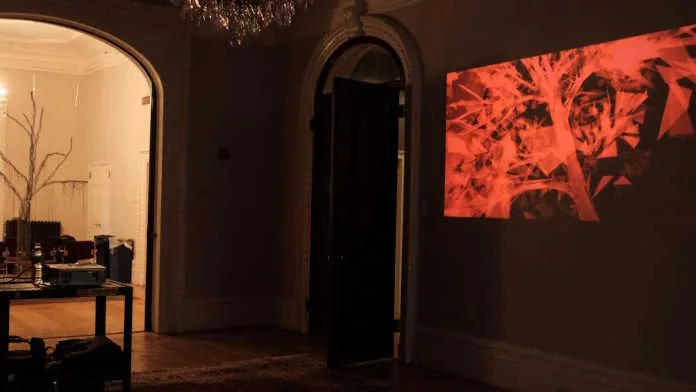 There’s no grand resolution. No hero’s journey. Just a lone figure building something tender in the ruins. And somehow, that image stays with you. The wearable castle becomes more than just a metaphor. It starts to feel like something true. We may not be there yet, in that submerged future. But it doesn’t feel far off. The choices we make now will shape what kind of shelter we have left. Ziyi’s contribution to Elements in Flux is about intimacy in the face of enormity. She brings the conversation closer. Makes it smaller, but no less urgent. In a room filled with works confronting the instability of the planet, hers offers a moment of pause. A space to feel instead of analyze. A red-lit reminder that even in collapse, there can be care. Even in silence, a story.