



- Ecologists expected many species to shift northward or upslope in response to warming temperatures, but only about half of observed range shifts so far align with their projections.
- Species responses are likely shaped by multiple factors — changing habitat, rainfall and food availability — not just temperature. Some species may be unable to move, trapped within a fragmented habitat.
- Research shows animals that move toward higher latitudes don’t necessarily fare better.
- These mismatches between predictions and reality create more uncertainty for conservation planning and how best to support species adaptation through corridors.
New England’s winters have long been a punishing force. Forests fade in and out of deep freezes. Animals pile on fat for warmth in anticipation of the harsh weather to come. Others flee south, seeking warmer refuges. However, over the past 50 years, winters there have become much milder. In the northeastern U.S., winters now average between 4 and 5 degrees Fahrenheit (2.2 and 2.7 degrees Celsius) warmer than in the 1970s. Snowfall can be sparse, and there are usually fewer days of extreme cold.
For decades, ecologists have expected that animals living within narrow climate niches would adapt to rising temperatures by moving northwards or upslope to higher elevations. For example, they thought the American red squirrel (Tamiasciurus hudsonicus) in the northeastern U.S. would move up into the mountains in search of cold.
But in a study published last year, scientists found that despite warmer winters, the squirrels haven’t sought out higher elevations. Rather, they’ve relocated downslope, seemingly drawn by the return of red spruce forest following a period of dieback. The tiny forest critters, it seems, are prioritizing habitat over temperature.
The red squirrel isn’t alone. Thousands of plants and animals that scientists thought would be on the move in response to rising global temperatures don’t yet seem to have hit the road. In a 2023 study in the journal Environmental Evidence, scientists reviewed the observed range movements of more than 12,000 species, both terrestrial and marine, to see whether they aligned with what ecologists had expected would play out in a warmer world.
Out of nearly 30,000 observed instances of range shifts driven by temperatures in recent decades — most of which occurred in the northern hemisphere — less than half were plants or animals moving to higher latitudes, higher elevations or greater marine depths. Some didn’t move at all, while others had dispersed to southerly latitudes or lower elevations. Put simply, many species are not where scientists thought they would be, says Toni Lyn Morelli, a research ecologist with the U.S. Geological Survey’s Northeast Climate Adaptation Center.
That has serious implications for conservation policy and planning, she says. Scientists have spent years studying and designing possible climate corridors, areas that species may be able to funnel through to stay within their preferred temperatures.
“If we can identify where we think they are headed, and then identify the ways they might get there, then we can think about what [infrastructure] might be in the way,” Morelli tells Mongabay. “We’re going to have to see if we can help species adapt, because it’s unlikely they’ll be able to do it completely on their own.”
But if land managers and conservationists are targeting certain areas for protection, only to find out that the vulnerable plants and animals have gone somewhere else, all that effort could be for naught.

Should they stay or should they go now?
Scientists aren’t yet sure whether it’s a good thing or a bad thing that there are so many mismatches between their expectations and reality.
It could be that plants and animals are better able to adapt in situ than previously thought.
Other climate or non-climate factors, such as rainfall, snowfall or habitat, may be more important than higher temperatures when it comes to whether or not a species decides to pick up and move. There might also be a lag in the time it takes species to respond. Or it could be that some species want to move but are unable to.
“There are general expectations with temperature, but species might also be tracking changing precipitation patterns,” explains Sarah Weiskopf, a research ecologist at the USGS who co-authored the 2023 assessment.
For example, some of the tree species now shifting downslope appear to be tracking water availability. But estimating where species will move based on changing rainfall is more difficult, she adds, as “we don’t have the same kind of general expectations for how precipitation is changing” compared with rising global temperatures.
Habitat, too, can often override temperature. Forests are regrowing in many parts of North America, spurring species such as the red squirrel to move downslope. Or maybe an animal that is especially dependent on a prey species may have to follow it in a different direction.
One issue is that it can be hard to determine when a species has permanently shifted its range. Some animals, like the Canadian lynx (Lynx canadensis), might travel farther south into lower New England during exceptionally snowy years, stalking their favorite prey — the snowshoe hare (Lepus americanus). But in years with less snow in the region, the lynx will stick closer to its traditional range up north.
“It’s easier to see the leading edge,” Morelli says. People notice when a new plant or animal shows up in an area, but they are less likely to notice it slowly shift away. “People aren’t sure if they just missed it.”

While it might initially seem like a species that hasn’t relocated might be struggling, Weiskopf cautions against such an assumption. Just because an animal moves to higher elevations or higher latitudes doesn’t necessarily mean it’s now thriving in its new environment.
A 2024 study in the journal Nature Ecology and Evolution looked at fish abundance across the world’s oceans, finding species that shifted their ranges poleward were not necessarily faring better.
Those populations that had moved their ranges by roughly 17 kilometers (about 10 miles) per year were associated with a 50% decrease in population size over a decade — which is “dramatic compared to the overall stable population trends in non-shifting species,” the study observed.
The fact that quick shifts toward the Earth’s poles didn’t guarantee a better outcome for the population “contrasts with the view that rapid range shifts safeguard against local population declines,” the study said.
That could be cause for concern. For species that are shifting their range, many are moving exceptionally fast.
Scientists recently dug back through nearly 10,000 observed range shifts of more than 3,500 marine and terrestrial species. When they analyzed how well their computer models stacked up in predicting both the species’ direction and pace, they found that plants and animals were moving much faster than the models had predicted in nearly two-thirds of cases, with a median rate of four times faster.
Climate corridors
Despite the uncertainty that adaptive relocation may bring, many scientists still believe it’s one of the best bets for species’ long-term survival in a warmer world. And plenty of plants and animals have done well in their new cool homes.
The American lobster (Homarus americanus), for example, has hung on in the waters of Atlantic Canada after the Gulf of Maine emerged as one of the fastest warming marine ecosystems on the planet. And populations of Edith’s checkerspot butterfly (Euphydryas editha) that moved to higher elevations and latitudes in western North America have managed to persist, while some populations of the subspecies Quino checkerspot (E.e. quino) that lived in lower elevations appear to have been wiped out by drought, according to the nonprofit Defenders of Wildlife.
Roughly half of species’ observed movements don’t align with projections, and ecologists are concerned that it’s not because these plants and animals successfully adapted to their current surroundings: They may be stuck, trapped by development or other human activities. One way to figure that out is to assess whether those that haven’t moved are suffering.
Indeed, roads and development have fragmented large swathes of habitat. A decade ago, scientists assessed how well the U.S. landscape could facilitate the movement of plants and animals that were trying to track their preferred climate. They found that only 41% of the natural land area had enough connectivity to allow this. In the eastern U.S., less than 2% was “sufficiently connected.”

Moreover, throughout the 20th century, the conservation movement largely focused on protecting disconnected chunks of land — a model known as “fortress conservation” for its lack of connectivity between preserves, with rigid boundaries and physical fences to keep animals in and people out.
“A lot of our conservation today is based on protected areas. These are fixed places on the planet where we hope that biodiversity will persist into the future and where we spend a lot of effort protecting species,” says Joshua Lawler, an ecologist at the University of Washington (UW) in the U.S. “If species move around, if they move out of those protected areas, hopefully they are going to move into a new one. But maybe they won’t.”
How a plant or animal reacts to warmer temperatures depends a lot on where it lives, he adds. In the western U.S., ecologists expect that species will largely cope by moving up.
“Many of the connections between where animals are now and where they are likely to be in the future go up into the mountains,” Lawler says. They’ll go from the Central Valley in California up into the state’s Sierra Nevada mountain range, or from eastern Washington state up into the Cascade Range, he says.
But on the U.S. East Coast, where there are fewer high-altitude holdouts for species to chase, plants and animals will have to travel much greater distances to shift latitudes, which is much more difficult.
With the exception of the Appalachians, you can’t make up for distance with elevation. That makes it a lot harder, Lawler says.
In their 2016 research, Lawler and his colleagues found that introducing corridors to aid wildlife movement through human-dominated regions would increase climatically connected natural areas to 65%. The most impactful gains were in the low-elevation southeastern U.S.
In recent years, Lawler and students in UW’s Landscape Ecology and Conservation Lab have tried to figure out exactly how wildlife can move from point A to point B in order to survive in a warming world. They’ve found that most wildlife corridors in the western U.S. are only connecting today’s habitat with today’s habitat — within the same climate niche. “Only a fairly small percentage [of corridors] are looking forward,” Lawler says, “connecting the landscape today with places that will be important in the future.”
The U.S. state of Florida is one place that is looking ahead. In 2021, the state designated an 18- million-acre network of wildlands, privately owned land and working ranches as the Florida Wildlife Corridor, providing a safe passageway for the endangered Florida panther (Puma concolor coryi) to travel northwards as temperatures and sea level rise. It also protects an estimated 131 at-risk species.
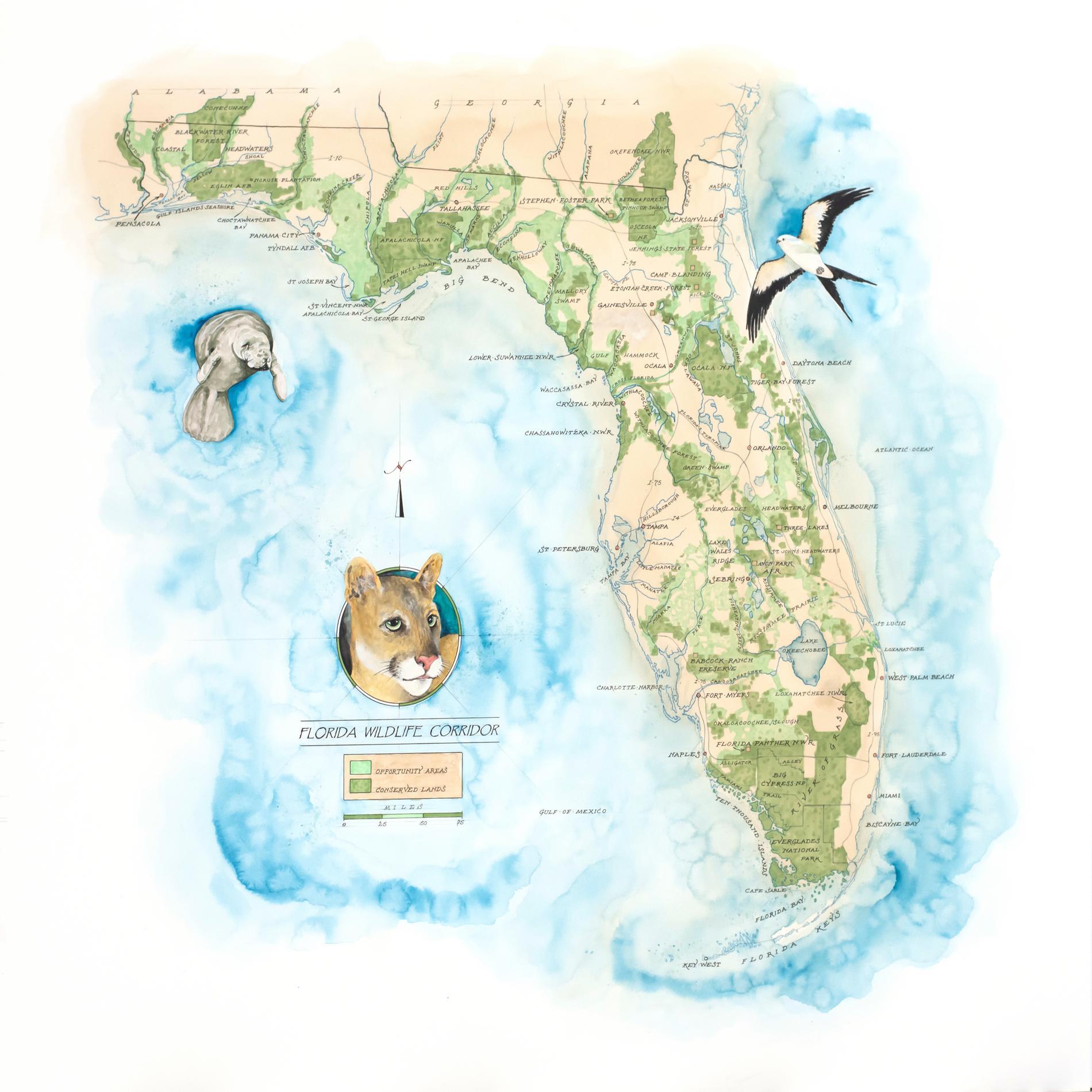
Lawler adds that relying on human-designed corridors alone is unlikely to be enough to help species adapt. “We need to find a way to make the surface of the Earth more porous to animal movements versus trying to make just a pathway of protected land,” he says.
For example, breaking up vast agricultural landscapes by including patches of natural land or allowing some fields to lay fallow every few years can create steppingstones for movement as opposed to simply buying up land and putting a fence around it to push wildlife through.
Perhaps that can better help scientists’ expectations line up with reality on the ground.
Banner image: Rising sea levels are shrinking habitat for the endangered Florida panther, making connected habitat crucial for this iconic cat’s survival. Image courtesy Florida Wildlife Corridor Foundation
In Kyrgyzstan, a climate-ready corridor gives snow leopards and herders room to roam
Ecuador’s new ecological corridor connects Andes and Amazon ecosystems
A hundred-year vision: Gary Tabor on the rise of large landscape conservation
Citations:
Chaikin, S., Riva, F., Marshall, K. E., Lessard, J.-P., & Belmaker, J. (2024). Marine fishes experiencing high-velocity range shifts may not be climate change winners. Nature Ecology & Evolution, 8(5), 936–946. doi:10.1038/s41559-024-02350-7
Morelli, T. L., Hallworth, M. T., Duclos, T., Ells, A., Faccio, S., Foster, J. R., … Siren, A. P. K. (2025). Does habitat or climate change drive species range shifts? Ecography, 2025(6), e07560. doi:10.1111/ecog.07560
McGuire, J. L., Lawler, J. J., McRae, B. H., Nuñez, T. A., & Theobald, D. M. (2016). Achieving climate connectivity in a fragmented landscape. Proceedings of the National Academy of Sciences of the United States of America, 113(26), 7195–7200. doi:10.1073/pnas.1602817113
Oliveira, B. F., Bertrand, R., Pinsky, M. L., Casajus, N., Wolfe, B., et al. (2026). Species range shifts often speed ahead of their modeled climatic niches. Proceedings of the National Academy of Sciences of the United States of America, 123, e2515903123. doi:10.1073/pnas.2515903123
Rubenstein, M. A., Weiskopf, S. R., Bertrand, R., Carter, S. L., Comte, L., Eaton, M. J. … Thompson, L. M. (2023). Climate change and the global redistribution of biodiversity: Substantial variation in empirical support for expected range shifts. Environmental Evidence, 12, 7. doi:10.1186/s13750-023-00296-0
Sirén, A. P. K., Sutherland, C. S., Bernier, C. A., Royar, K. J., Kilborn, J. R., Callahan, C. B., … Morelli, T. L. (2021). Abiotic stress and biotic factors mediate range dynamics on opposing edges. Journal of Biogeography, 48(7), 1758–1772. doi:10.1111/jbi.14112
FEEDBACK: Use this form to send a message to the author or editor of this post. If you’d like to post a public comment, you can do so at the bottom of the page.
Cite this article
Gloria Dickie (2026). Wildlife’s unpredictable movements make climate-change planning difficult. Mongabay Conservation news. DOI: https://doi.org/10.66709/news-322109
Credits

This story first appeared on Mongabay
This article is licensed under a Creative Commons Attribution-NoDerivatives 4.0 International License.
You may republish this article, so long as you credit the authors and Mongabay, and do not change the text. Please include a link back to the original article.