The National Constitution states the following in Section 24:
(a) Everyone has the right to an environment that is not harmful to their health or wellbeing.
The environmental and ecological threats in the Western Cape are well known, particularly to the Western Cape provincial government, the same one that pumps 36.5 mega liters of raw sewage into the oceans around the peninsula EVERY DAY !!!
Ecosystems are fragile as we all know, yet well balanced by nature but easily destroyed by man. Human activities and habitation footprints, together with uncontrolled industrial activities, cause massive, and most of the time, irreparable damage to ecosystems. We took the control over this away from nature and placed it in the hands of politicians.
In 2014 we addressed the issue of the E-Coli count in False Bay. E-Coli counts have now reached serious, health-threatening levels in just about all open water bodies in the Western Cape. In 2015 we wrote about mining activities on the West Coast. We had no responses.
The Western Cape government seems to place densification above the interests of the citizens, even while the rights to a safe and clean environment are constitutional rights. In Table View, numerous high-density developments are approved by the provincial government, well knowing that places like the Potsdam treatment plant are woefully lacking in processing capacity and any upgrades will only be effective in 5 years. Such bull-headed ignorance of realities has the effect that the estuaries in the area are increasingly being destroyed by the day.
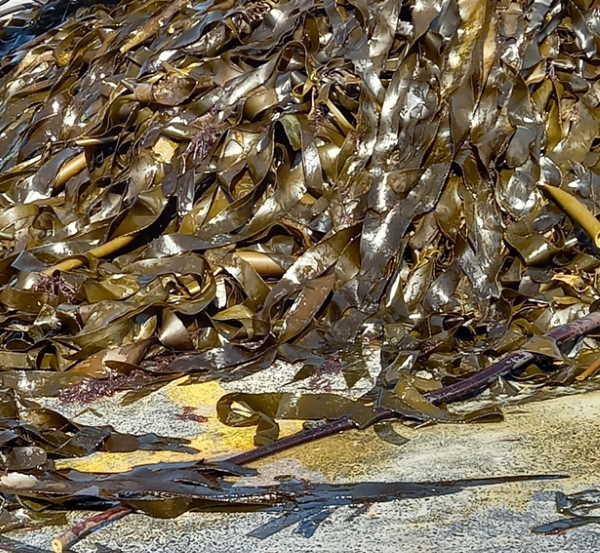
A current project is the harvesting of kelp along the West Coast. We have been contacted by concerned residents and fishermen, pointing out the fact that the kelp is being cut at a depth of about two to three meters. Proper kelp harvesting indicates that just the fond should be harvested and that any deeper cut will kill the plant. Recreational boat owners are concerned that such deep cutting of the kelp may indicate to inexperienced visitors that there are areas of open water whilst reefs may be present and be a danger to life and craft.
According to a supervisor, the right to cut the kelp was awarded by the national government as the Western Cape government does not have environmental oversight.
We addressed this exact issue back in November 2014.
The Constitution of the Western Cape states in Chapter 9, Section 71 (1) that “There is a provincial Commissioner for the Environment”.
However, in the Department of Environmental Affairs and Development Planning’s Annual Report of 2010/11 (page 8 under Environmental Commissioner), it says “Although the Commissioner for the Environment was listed as a schedule 3, part C (PFMA) public entity, it was decided not to pursue the establishment of the Environmental Commissioner”
In a recent debate, the ANC’s Cameron Dugmore pointed out how the Western Cape government declined to appoint an Environmental Commissioner. This government is chasing devolution but doesn’t even accept such an opportunity to protect the constitutional rights of its citizens.
Des Palm is the Operational Director of the NPO CapeXit.
CapeXit is not a political party.