



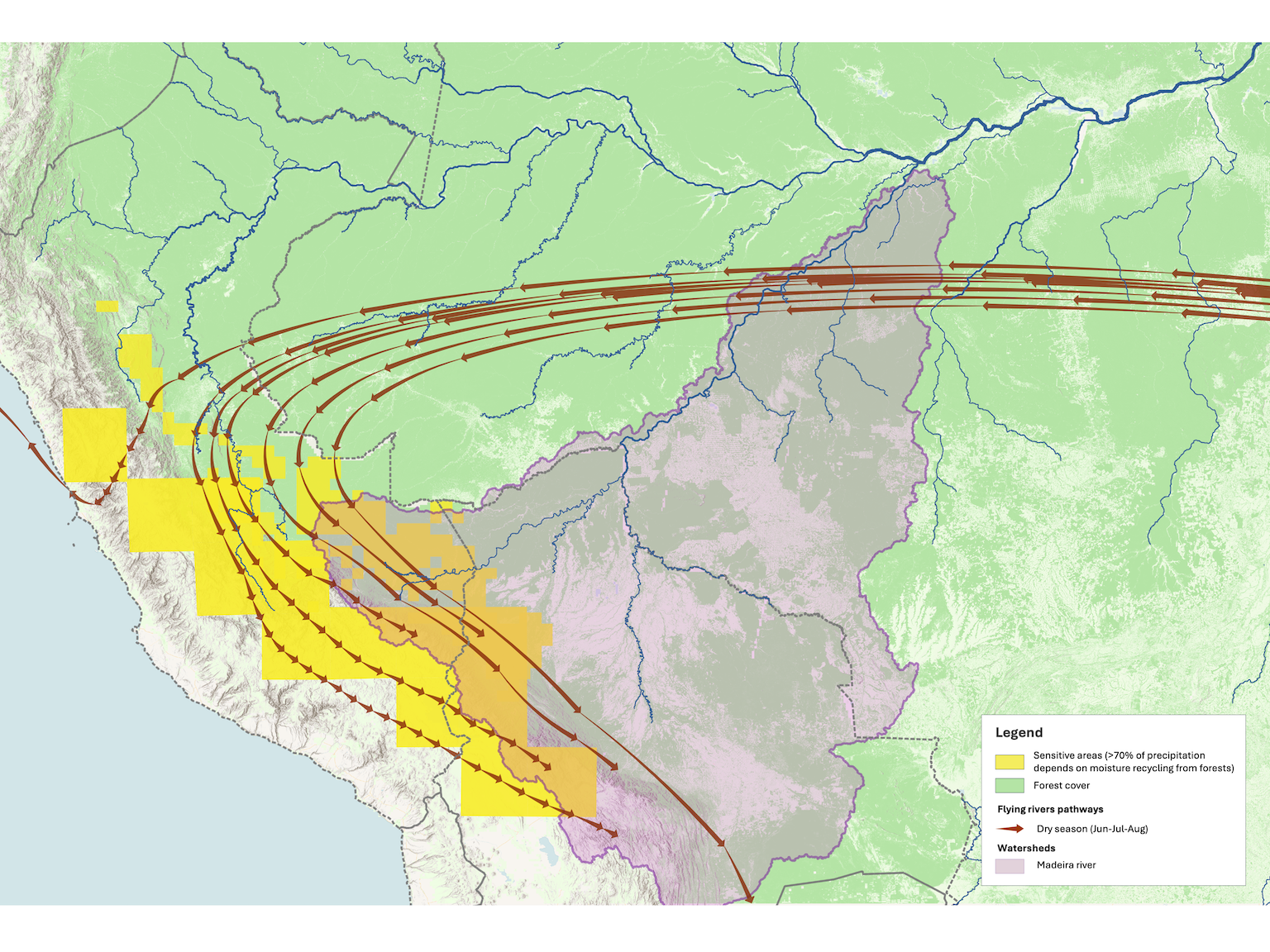
- The Amazon’s atmospheric moisture flows known as “flying rivers” provide over 70% of rainfall in parts of southern Peru and northern Bolivia, but they are threatened by deforestation in the Brazilian Amazon.
- According to a new report by the NGO Amazon Conservation, the lack of protections for areas known as undesignated public forests and road development projects pose a deforestation risk that would disrupt the flying rivers during dry and transition seasons.
- Research shows that the Amazon is already experiencing longer dry seasons, which in turn affects the forest’s capacity to recycle moisture for the flying rivers.
- Conservation targeting the forests that are most important for recycling atmospheric moisture could help maintain the flying rivers, the report proposes.
Twenty years ago, a meeting of scientists that included Brazilian climatologist Carlos Nobre coined the term “flying rivers” to describe the water vapor moving from east to west in the atmosphere over the Amazon Basin.
These flows are carried from the Atlantic Ocean by the forest’s continuous recycling of moisture through evapotranspiration, a process where water is transferred from soil and plants to the atmosphere. Sometimes called “aerial rivers,” they provide vital rainfall across South America.
Scientists have long studied the Amazon Basin’s impact on rainfall in southern Brazil, but much less attention has been given to its importance for Andean countries, even though flying rivers provide more than 70% of precipitation in parts of southern Peru and northern Bolivia.
A recent white paper from the NGO Amazon Conservation highlights flying rivers’ transnational effects by showing how deforestation in Brazil risks reducing rainfall in Peru and Bolivia.
It builds on earlier research by Amazon Conservation’s Monitoring of the Andes Amazon Program (MAAP), which mapped the flying rivers’ pathways through the wet, dry and transition seasons and identified the most sensitive areas in the Andean Amazon.
The new report identifies the forests at risk of being cleared along these pathways and offers recommendations for how to protect the invisible moisture flows.
“It is more critical that forest is retained along the pathway than in other places, because the [flying] rivers do take a specific course, and if forest cover was to be removed along that path, then it would affect the ability of these rivers to continue flowing by constantly recycling humidity,” said co-author of the report Blaise Bodin, Amazon Conservation’s director of strategy and policy.
At least 75% of the moisture from rain in the Amazon is recycled into the atmosphere by the forest, a process that is repeated five or six times as the water vapor travels toward the Andes.
“There has already been a reduction in flying rivers because, in the south of the Amazon, there is already one million square kilometers of deforested [land turned into] pasture, crops, soy,” said Nobre, a professor of climate and sustainability at the Universidade de São Paulo who wrote the report’s foreword.
“And pasture and soy recycle much less water. In the dry season, these plantations recycle a third or a quarter [of what forests do],” Nobre told Mongabay during a press conference in Rio de Janeiro on June 11.
The resulting reduction in rainfall risks inducing a “tipping point” in parts of the Amazon, where the forest would turn into a savanna ecosystem. The southwestern Amazon in Peru and Bolivia is most vulnerable to experiencing such a tipping point, the MAAP research found.
Identifying deforestation risks
“The wet season [pathway] is pretty well conserved, it flows over a lot of protected areas and Indigenous territories, and just generally intact forest,” co-author of the report Matt Finer, director and senior research specialist at MAAP, told Mongabay in a video interview.
The transition and dry season pathways, however, not only cross more deforested areas in Brazil, but also pass over territories that are at risk of being cleared – notably undesignated public forests (UPFs), areas without formal protection that belong to the state or federal governments.
According to the Public Forests Observatory’s latest bulletin, UPFs are the second most deforested type of land in Brazil (after large and medium private properties), vulnerable to illegal land grabbing and accounting for 20.6% of Amazon deforestation between January 2025 and April 2026. They are also vulnerable to climate extremes, seeing an increase in fires during the drought of 2024.
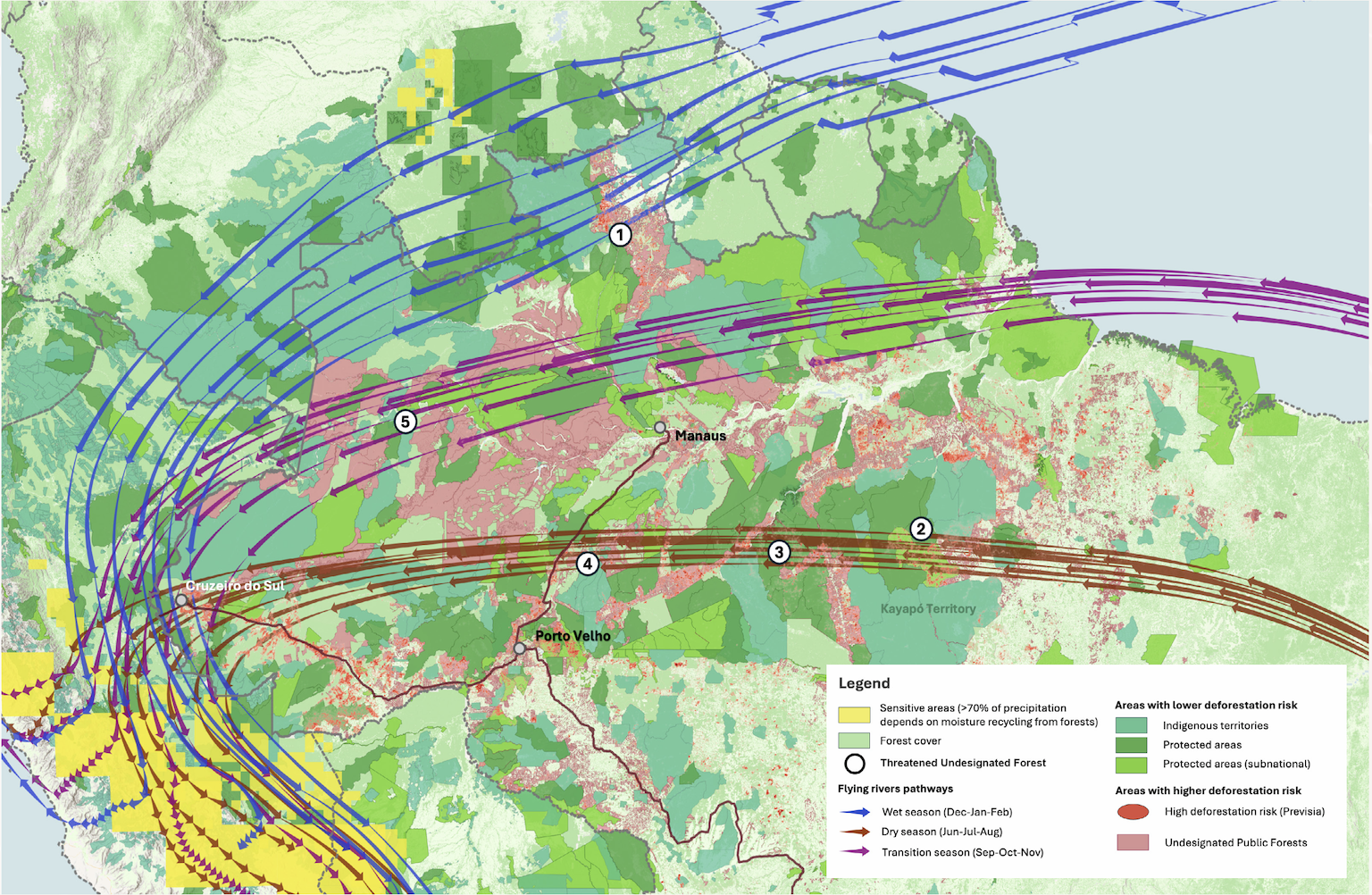
Road development also threatens the flying rivers’ pathway during the dry season. One example is the controversial repaving of the BR-319 highway, which connects the cities of Manaus and Porto Velho. There are also several road projects in the state of Acre, which borders Peru and Bolivia, including the repaving of a highway linking the state capital Rio Branco to Cruzeiro do Sul.
A new road has a multiplying effect on deforestation as it often leads to the clearing of forests for side roads, a phenomenon known as the “fishbone effect.” Concern with the impact of the BR-319 has led it to be dubbed the “tipping point road.”
Forest cover in Acre is particularly important, because the three seasonal pathways of flying rivers converge over the west of the state. Research has also shown that the vegetation in the central-western Amazon, furthest away from the Atlantic Ocean and closest to the areas sensitive to shifts in the flying rivers, plays a more important role in recycling moisture and providing rainfall to the tropical Andes.
“Acre is the last stretch before you get to these critical areas, so if you interrupt forest cover there, it’s very likely it would lead to a drastic reduction in precipitation just downstream of the flying rivers,” Bodin told Mongabay in a video interview.
Disruption from climate change
The onset of a strong El Niño could also lead to a particularly fierce dry season this year. When conditions are dry, the forest has less moisture to pump into the atmosphere and less water evaporates, Bodin explained.
One recent study found that the southwestern Amazon’s dry season is already lasting longer, with more intense water deficit and climate unpredictability. Another study showed that drought during the 2023-2024 El Niño led to increased fires and forest degradation in the Brazilian Amazon.
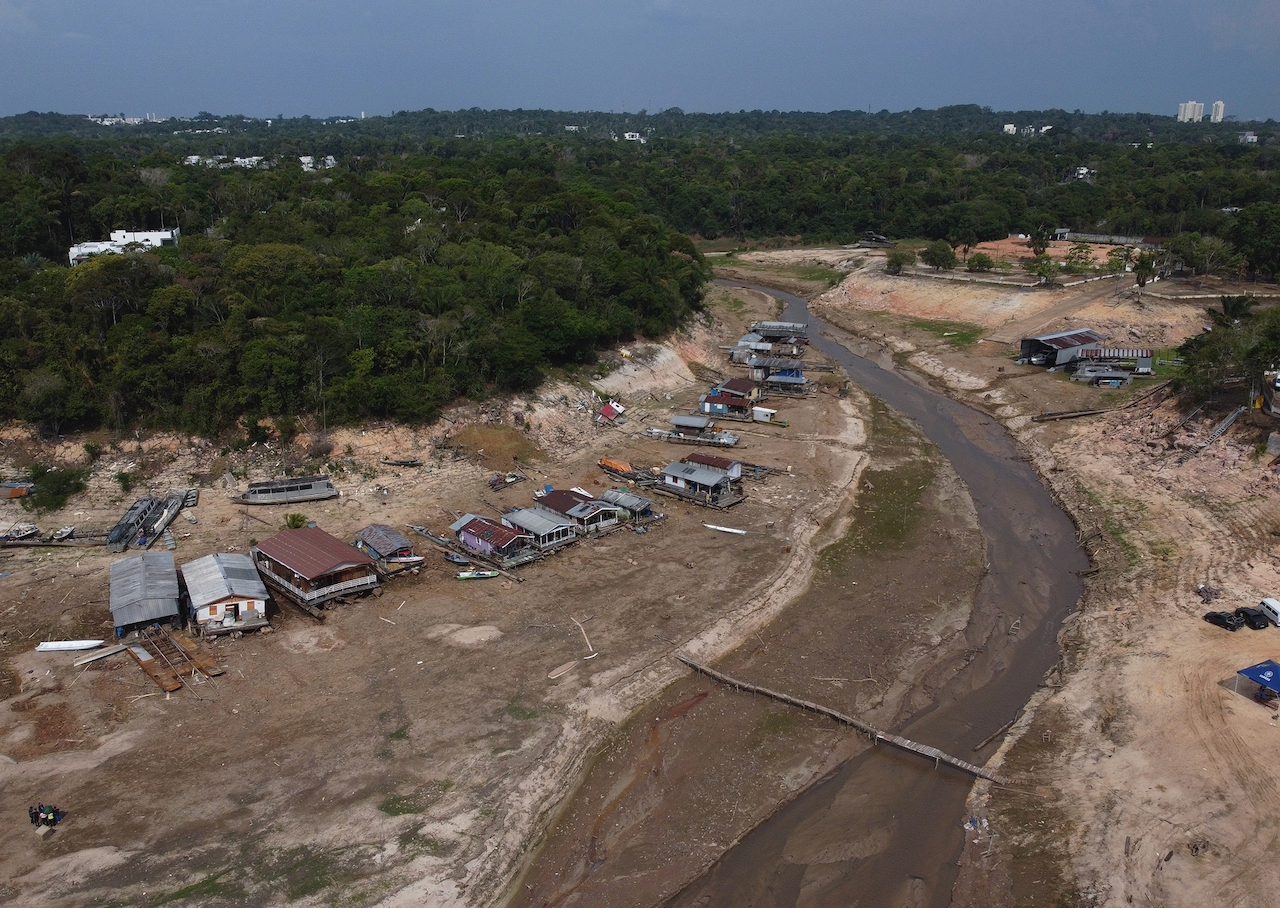
Both deforestation and climate change impact flying rivers in “a sort of reinforcing feedback loop,” Bodin said.
The 2023-2024 drought in the Amazon began with a severe shortage of rainfall in the Peruvian and Bolivian Altiplano, but it is not possible to establish exactly how much deforestation contributed to this, the report noted.
“The models are not yet accurate enough,” Bodin said, but they are being developed. A newly published paper calculated that deforestation between 1982 and 2018 in the Amazon reduced seasonal precipitation by 6% to 30% across seven soybean states in central and southern Brazil.
And it is possible to observe how changes to the climate are already affecting biodiversity and communities in the areas most dependent on the flying rivers, the Amazon Conservation report said.
In recent years, more frequent droughts and unpredictable rainfall have severely affected activities that support rural livelihoods in southern Peru and northern Bolivia, like potato production and Brazil nut collection.
“We used to base ourselves on the seasons, but now everything has changed,” said Magaly Tipuni, an Indigenous leader from the Pilón Lajas Biosphere Reserve and Communal Land in Bolivia’s Beni department. Pilón Lajas is home to 23 Indigenous communities who cultivate rice, yucca, banana and corn for subsistence. They hadn’t experienced fires prior to 2023, Tipuni told Mongabay over the phone.
“First came the drought, and from the drought came the fire. The fire burnt many animals and plants, even parts of our communal crops. And the following year, the floods came,” she said.
Evapotranspiration as a factor for conservation
Putting Brazil’s roughly 50 million hectares (around 123 million acres) of UPFs under formal protection could be an important step to protecting the flying rivers, but the report’s authors defend a more targeted approach.
They recommend that the criteria for designating new protected areas and undertaking infrastructure projects like roads should take into account a forest’s contribution to atmospheric moisture.
“Let’s start incorporating flying rivers into the list of things to consider when you are doing environmental assessments and project planning,” Finer said.
When the first conservation units were created in Brazil, they considered factors like species and ecosystems, said Erika Guimarães, leader for protected areas at WWF-Brazil. “Now we have an understanding that we also create conservation units to promote ecosystem services,” she said.

“The production of rain or moisture in the Amazon is a role that is now crystal-clear, [but] I don’t think it’s something which has been consciously incorporated,” she added. “It would be interesting to develop and perfect models to take this criterion into account.”
These same models could be used by companies to calculate a project’s impact on deforestation and therefore, moisture, Bodin said, while acknowledging that this requirement would need to be included in the Brazilian government’s environmental licensing rules. At the same time, recent law changes in Brazil have led to a simplification of the environmental licensing process for projects like the BR-319.
The countries that depend on the flying rivers also have a role to play, Finer said, citing the example of Manu National Park in Peru. “For an official in Peru, half the [conservation] strategy is avoiding deforestation in Manu, but the other half is diplomacy, perhaps, and making sure that Brazil doesn’t trigger excess deforestation that cuts off the moisture flow,” he said.
Banner image: Soy plantations abut the Amazon rainforest in southern Brazil. Image by Rhett A. Butler/Mongabay.
Citations:
Finer M, Ariñez A, Sierra JP, Espinoza JC,, Weng W, Vriesendorp C, Bodin B, Beavers J (2025) The Amazon Tipping Point – Importance of Flying Rivers Connecting the Amazon. MAAP: 232.
Lovejoy, T. E., & Nobre, C. (2019). Amazon tipping point: Last chance for action. Science Advances, 5(12). doi:10.1126/sciadv.aba2949
Dutra, D. J., Ferreira, I. J. M., Rodrigues, É. T., Braga, D., Izidoro, B., Mataveli, G., Aragão, L. E. O. C. de, & Anderson, L. O. (2026). Intensification of drought-associated wildfires challenges actions for Amazonia’s sustainable development. Perspectives in Ecology and Conservation, 24(2). doi:10.1016/j.pecon.2026.02.013
Dutra, D. J. , C. Jones , R. A. Betts , et al. (2026). Dry-Season Water Deficits in the Southwestern Amazon Under High Emissions. International Journal of Climatology, 46(6). doi:10.1002/joc.70331
Li, H., Lesk, C., Zhu, L., Crowther, T., Chen, M., Ray, D., & Mueller, N. (2026). Amazon deforestation reduces precipitation and soybean yields across Southern Brazil. Proceedings of the National Academy of Sciences, 123. doi:10.1073/pnas.2525378123
FEEDBACK: Use this form to send a message to the author of this post. If you want to post a public comment, you can do that at the bottom of the page.
Cite this article
Constance Malleret (2026). Targeted conservation in Brazil could help protect the Amazon’s flying rivers. Mongabay Conservation news. DOI: https://doi.org/10.66709/news-322348
Credits

This story first appeared on Mongabay
This article is licensed under a Creative Commons Attribution-NoDerivatives 4.0 International License.
You may republish this article, so long as you credit the authors and Mongabay, and do not change the text. Please include a link back to the original article.