



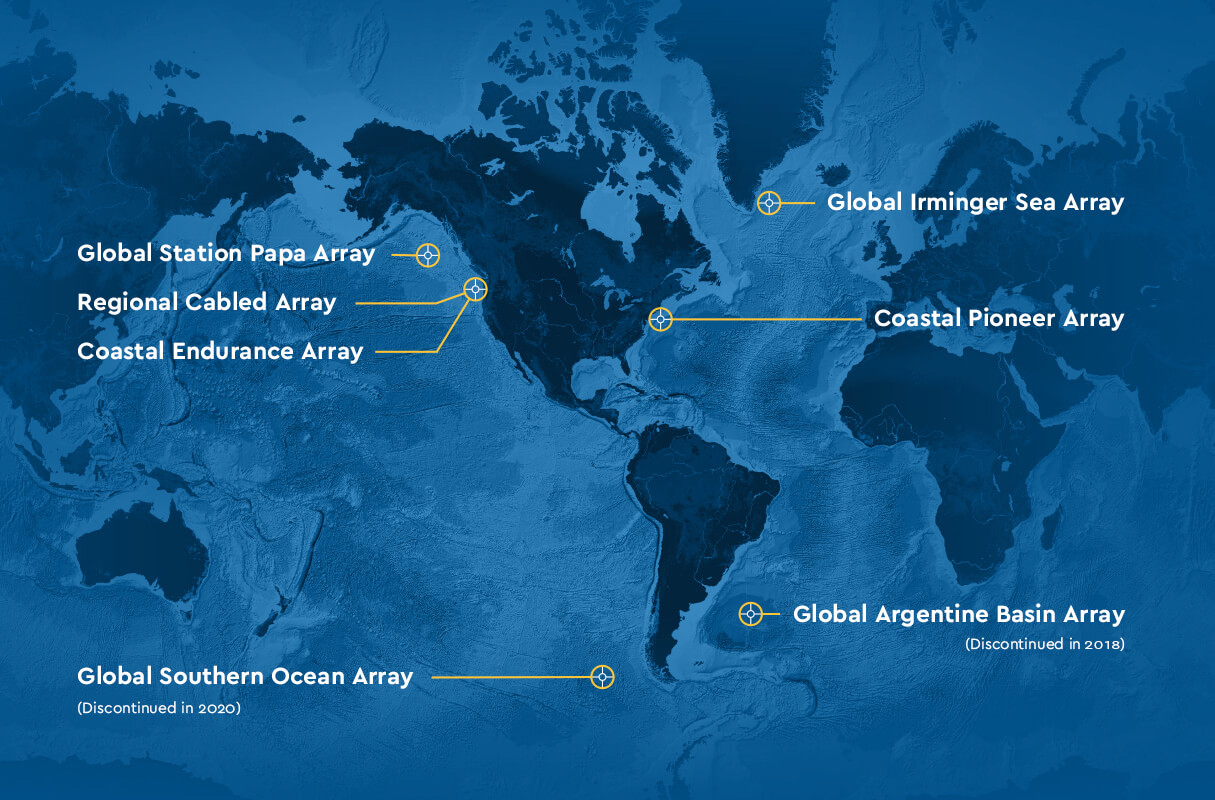
Over the next 15 months, major sensor arrays that have provided crucial, decade-long observations of the ocean, marine ecosystems and climate change will be dismantled.
These sensors are part of the Ocean Observatories Initiative (OOI), a $386 million network of more than 900 instruments funded by the U.S. government’s National Science Foundation (NSF), which has provided real-time data on the world’s oceans for more than a decade. The sensors are distributed across both the Atlantic and Pacific oceans to monitor coastal environments, marine ecosystems, and ocean currents that influence the global climate.
The decision to end OOI, described by the foundation as a “descoping,” will remove nearly all in-water infrastructure located off the states of Alaska, Washington, Oregon and North Carolina, and the Irminger Sea, an area between Iceland and Greenland. As the instruments are recovered, data streams from those areas will go dark, Jim Edson, principal investigator of the initiative, said in a statement. “However, all previously collected OOI data will remain accessible through the OOI Data Center.”
The OOI was designed as a 25-to-30-year project specifically to capture long-term climate signals, which scientists say require at least three decades of continuous data to be meaningfully detected. The network has achieved just 10 years of observations.
While satellites can monitor the ocean’s surface, the OOI arrays provided a rare look into the deep sea, measuring low-oxygen zones, carbon absorption, and currents critical to regulating weather patterns. The Associated Press (AP) reported that the removal comes at a particularly sensitive time, as an El Niño event, marked by unusually warm ocean waters, is predicted to arrive this summer, potentially leaving scientists blind to its subsurface impacts.
Chris Robbins, associate director of scientific initiatives at U.S.-based environmental nonprofit the Ocean Conservancy, called the decision to abandon the observation system “absolutely myopic.”
“This system is a vital scientific asset that quietly protects American lives, communities and the economy through unfettered access to world-class scientific data,” Robbins said in a statement. “Its loss would create an irreparable blind spot for our country in predicting earthquakes, fishery health, storm forecasting, coastal flooding and more. It just doesn’t make sense.”
The dismantling of OOI follows proposed budget cuts to the NSF by the Trump administration, which has repeatedly sought to reduce funding for the project.
The NSF said in a statement to the AP that the descoping is part of a “wider strategy of a nimbler approach to prioritize support for evolving scientific priorities and emerging technologies, as well as smart lifecycle management within its research infrastructure portfolio.”
Craig McLean, former acting chief scientist at the National Oceanic and Atmospheric Administration (NOAA), told The New York Times that the move would “push the United States back yet again into a rear seat in global scientific leadership.”
Banner image: A map of OOI’s arrays. Image by Center for Environmental Visualization, University of Washington via Wikimedia Commons (CC BY 2.0).
This story first appeared on Mongabay
This article is licensed under a Creative Commons Attribution-NoDerivatives 4.0 International License.
You may republish this article, so long as you credit the authors and Mongabay, and do not change the text. Please include a link back to the original article.