



- Ivanhoe Atlantic, a U.S. mining company, plans to mine iron ore in Guinea’s UNESCO-protected Nimba Mountains.
- Mongabay has obtained a copy of the confidential environmental and social impact assessment (ESIA) currently being reviewed by Guinean authorities, which details extensive and irreversible damage to Nimba’s endemic and endangered species and critical habitats.
- The ESIA concludes that the planned mine risks causing “lasting and significant damage” to the adjacent World Heritage Site.
- The document’s findings also indicate the project might be breaching globally recognized environmental and social safeguards that Ivanhoe has publicly committed to.
CONAKRY — Over the next few months, Guinea’s environment ministry will review an environmental and social impact assessment for an iron ore mine in the country’s Nimba Mountains. The project, named Kon Kweni, is to be carved out of Mount Nimba Strict Nature Reserve, a UNESCO World Heritage Site. Comprising a unique combination of tropical forest and high-elevation savanna, the Nimba highlands are a biodiversity hotspot, home to dozens of endemic species. According to the environmental and social impact assessment (ESIA), these highlands would face “direct and major risks,” “irreversible damage,” and “threat to species survival” if the mining operations go ahead.
The impact assessment is an essential step toward securing a mining permit and commencing operations on a project that has been in discussion since 2003, when Guinean mining company SMFG was founded. (The company acquired by U.S. miner Ivanhoe Atlantic in 2019.) Mongabay obtained a copy of the ESIA, a confidential document. The assessment was commissioned by Ivanhoe and carried out by Biotope, a French environmental consultancy, and reveals how Ivanhoe is planning to go about developing the Nimba concession and how the plan is projected to impact Nimba’s ecosystems.
Guinea’s environmental regulator, the AGEE, a branch of the environment ministry, will assess the project’s anticipated environmental impact and the company’s proposed plans to mitigate damage, alongside the precision and comprehensiveness of its assessments.
Seydou Cissé, the AGEE director, said the impact assessment submitted by Ivanhoe would need to compare its plans to alternatives that would do less damage to the environment — including not mining at all. Failure to do so could result in an outright rejection, while methodological shortcomings might require the company to revise the assessment.
In any case, the agency said it would seek an opinion from UNESCO. “Whatever decision we take here, the ESIA won’t be approved before we get approval from them,” he said.
On its website, Ivanhoe presents the project as consisting of two main phases. The first phase would start at a capacity of 2 million metric tons of iron ore per year, scalable to 5 million metric tons. The second phase, work on which would start in 2029, would involve mining on a much larger scale, extracting between 25 million and 30 million metric tons yearly.
The leaked ESIA, which covers only the first phase, reveals that it would require the clearing of a 40-meter corridor for a gravel road leading from an open pit mine on the mountain to a processing site around 6 kilometers (4 miles) away. The road would be plied around the clock by 90-metric-ton trucks. From the processing site, the ore would then be trucked another 20 km (12 mi) to the Liberian border town of Yekepa, which is connected to the Atlantic coast by a heavy-gauge railway.
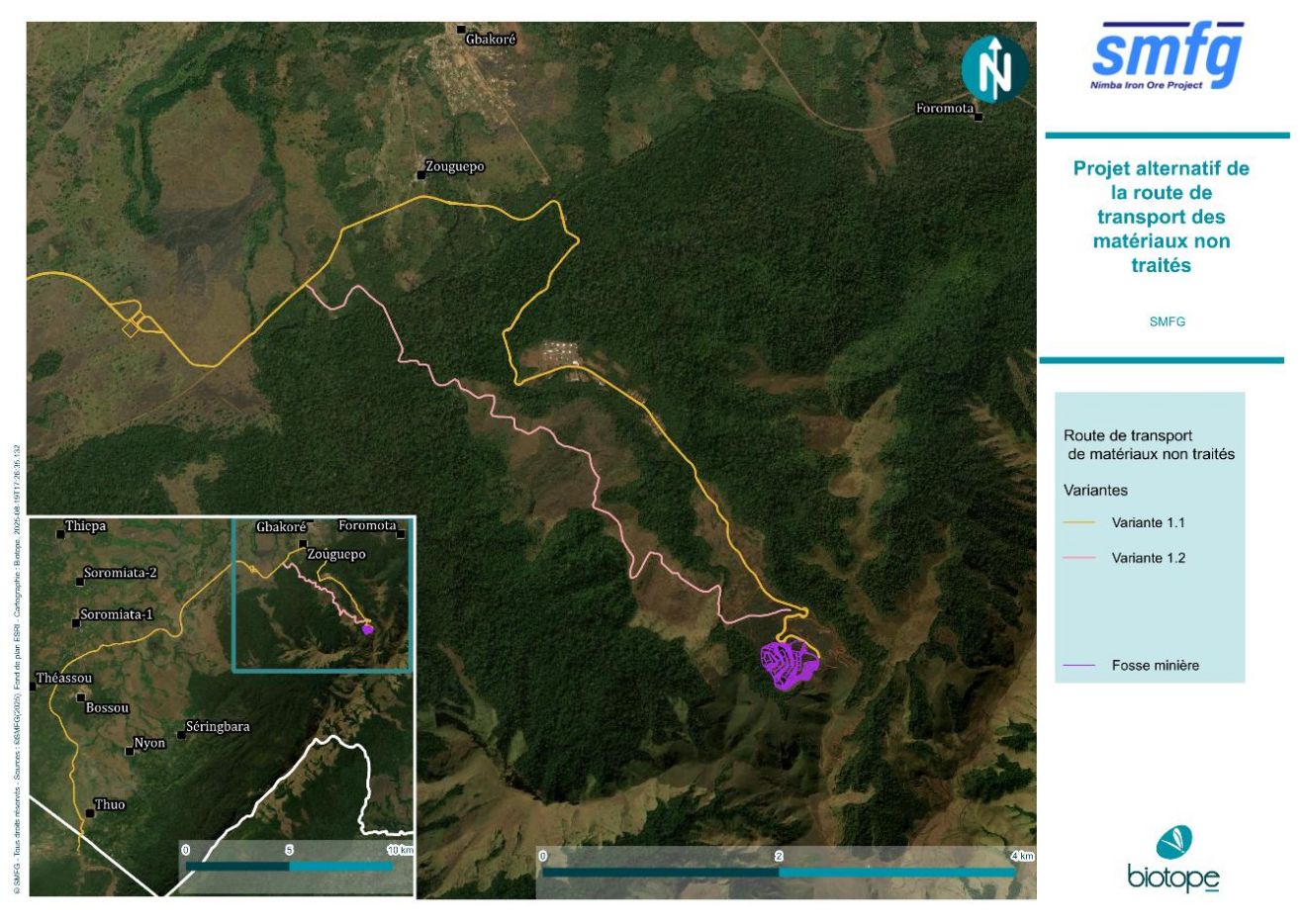

Tearing into an ecosystem
The highlands’ deep ravines and high-altitude savanna retain water year-round. The ESIA anticipates significant disturbance of this environment for excavation, road building, and blasting operations that will strip away vegetation, pollute air and water, alter water flows, damage the ravines, and fragment habitat. The Nimba mountain range has served as a biological refuge for a range of endemic species over millennia.
Among these is the Mount Nimba viviparous toad (Nimbaphrynoides occidentalis), half of whose known population is located in the mining concession. These toads give birth to fully developed live toadlets instead of laying eggs, and rely on the year-round water availability, particularly during the dry season.
According to Mark-Oliver Rödel, a biologist affiliated with Berlin’s Museum of Natural History who has worked in Nimba since 2006, mining the ridge could introduce unpredictable environmental alterations that could prove fatal to the species in the most extreme scenario.
“In such a complex geological environment, it is impossible to predict exactly what is happening. We simply don’t know what removing a particular amount of the ridge would mean for the wind, humidity and, in particular, for the fog, which is essential for the toads to persist,” he said. “As soon as the fog disappears and the sun is burning, the toads are inactive and hidden. They will probably not die [off] instantly, but will have fewer opportunities to feed and mate.”
A total of 135 species depend on habitats threatened by the proposed mine, according to Biotope’s analysis. Alongside the Mount Nimba toad, other species that would be badly affected include western chimpanzees (Pan troglodytes verus), whose Nimba population the ESIA estimates at 193 individuals, and the cave-dwelling Lamotte’s roundleaf bat (Hipposideros lamottei), found only in the highlands.
The bat in particular would face a “direct and major threat to its survival”, the assessment finds, as construction for Kon Kweni is expected to collapse tunnels left behind by previous mining, abandoned decades ago and that now provide a vital refuge for this critically endangered species as well as the Mount Nimba bat (Myotis nimbaensis), only recently described for science after researchers trapped two in the Nimba biosphere. This would be compounded by vibration and noise and light pollution, which could lower the bats’ reproductive success.

In the case of the chimpanzees, road construction would fragment their forest habitat and sever ecological corridors. In addition, the continuous mining activity and noise could trigger flight responses, chronic stress, and changes in territorial behavior, while the population would face the risk of collisions with vehicles operating at all hours, intensified human-wildlife conflict, and increased pathogen transmission.
According to Genevieve Campbell, a primatologist and senior associate at Re:wild, a conservation organization, the combination of direct habitat loss and wider secondary pressures makes mining particularly difficult to reconcile with chimpanzee conservation.
“Chimpanzees possess some degree of resilience to habitat fragmentation and degradation,” she said. “However, the scale and intensity of mining projects make it impossible to mitigate all of their impacts on chimpanzees.”
She added that mining projects generate both direct and indirect impacts that extend beyond the mining concession and are difficult to mitigate.
“Given that chimpanzees have a slow reproductive rate, even small impacts can have significant consequences on their survival,” Campbell said.
Nimba’s chimpanzee population is also uniquely adapted to its environment, and thus difficult to replace or offset, she added: “At the moment it is the only place where crab-fishing behavior has been recorded for chimpanzees.”
The ESIA acknowledges the threat to the great apes: “The magnitude of the impact would be significant, as it would involve individuals of a highly endangered species.”
For many of the affected species, the assessment found, the anticipated damage would be considered irreversible by the standards of the IUCN, the global wildlife conservation authority, which also advises UNESCO. It would also put Nimba’s Outstanding Universal Value, referring to the site’s environmental and human heritage, “at risk of significant and lasting damage.”


The impact assessment is now being studied by AGEE, which can either approve it, thus making way for Ivanhoe to obtain a mining permit, or ask for modifications. These can require adding more details, redoing the study, or altering the mining plan.
AGEE can also reject the project altogether, although this happens rarely. According to Oumar Totiya Barry, a mining expert from Action Mines, a watchdog group based in Guinea, of the more than 200 mining projects assessed by AGEE and its predecessor, only four have ever been rejected.
“In most cases, the assessments are approved subject to modifications,” he said, highlighting that the Guinean government views mining as a means to development and is generally positively predisposed toward mining projects.
AGEE will consider both the quality of the report’s assessment of social and environmental impacts and the company’s proposed mitigation of harm.

Barry and others say that one weakness of the ESIA is its failure to adequately evaluate less damaging options. Ivanhoe had previously considered using tunnels and conveyor belts — more expensive options — to transport ore to the processing facility and then onward for shipment. However, the assessment goes no further than comparing three possible routes for roads.
“The assessment of alternatives is pathetic. It tries to present some minor nuances in a project design where 98% of all decisions were already taken,” said an environmental expert with experience working on mining impact assessments in Guinea, who requested anonymity owing to professional considerations.
Meanwhile, the discussion of a zero-project option — not building the mine — only weighs the benefits of the project against a scenario where the site remains entirely undeveloped. The potential benefits of alternative development in the region, such as ecotourism, are not considered in the ESIA.
“These would certainly outcompete the mining option in terms of benefit for the community,” Barry said. ”They should have been taken into account.”
Barry also pointed out that while local communities are broadly supportive of Ivanhoe’s plans for the mine, the project offers them little in terms of long-term social benefits. The impact assessment makes passing reference to jobs the mine will create, but points out most of these would last only for the 18-month construction phase. And if local communities’ experience around Guinea’s other major new mining is a guide, this phase would be followed by mass layoffs once production begins.

AGEE’s Cissé said the ESIA must take all stages of the project into account, from exploration through construction, operation, closure, and rehabilitation. He specified that if anything considered “a critical phase” has been left out of the ESIA, this could be grounds for rejecting it.
This could signal a major problem for Ivanhoe, as the impact assessment it has submitted only accounts for the first phase of the mine’s development.
“To do a good impact assessment you need to have construction phase, operational phase, closure, post-closure. It’s basic standard impact assessment,” the environmental expert said.
The expert described Ivanhoe’s plans as creating a risk of path dependency. “Once you have an operation up and running in mining, you don’t put a halt to it and say, ‘Now we’re going to invest another 500 million over the next 18 months to upgrade everything’ — you always just tweak and do things on the cheap. Once you’re producing, all the pressures to do things socially and environmentally responsibly take second or third place to budget and schedule. It’s universal in mining.”

Failure to meet IFC standards
Ivanhoe has signed up to the environmental and social safeguards known as the Performance Standards promoted by the International Finance Corporation (IFC), the private-sector lending arm of the World Bank. However, its plans for Nimba seem to fall short of compliance with those standards on many counts.
Under Performance Standard 1, companies are required to assess environmental and social risks over the full life cycle of a project and to meaningfully evaluate reasonable alternatives — including the option of nondevelopment.
Performance Standard 6, which regulates biodiversity conservation and management of natural resources, raises further questions when it comes to the Nimba case. In particular, it requires that “the project does not lead to a net reduction in the global and/or national/regional population of any Critically Endangered or Endangered species over a reasonable period of time.”
With many of Nimba’s endangered species expected to be severely affected by the project — including irreversible losses or even the risk of extinction — it’s unclear how the company squares this with its commitment to the IFC’s environmental standard. The ESIA lists a number of proposed mitigation measures, but in many cases, including for the critically endangered bats, toads and chimpanzees, finds they will not prevent major losses.
With subsequent phases of the project not considered, the company may also be failing to meet the requirement to assess the project’s cumulative impact over its full lifetime. “To be compliant, Ivanhoe should commit explicitly to either closing and walking away from Nimba after mining Château [the proposed first phase], or to reworking the ESIA by including Phase 2,” said the environmental expert familiar with the project.
UNESCO’s World Heritage Committee has not yet commented publicly on Ivanhoe’s ESIA. But the IUCN has: in a November 2025 communique, the IUCN’s ARRC Task Force expressed concern over Ivanhoe’s plans. “The project’s impacts undermine the Outstanding Universal Value (OUV) of the World Heritage site, which could lead to the loss of its status as the only World Heritage site in the Republic of Guinea,” it said.
The task force noted that it’s impossible for the project to comply with the IFC’s Performance Standards and recommended that the ESIA not be accepted.

A 2023 decision by the World Heritage Committee specifically required Ivanhoe’s ESIA to fully identify and quantify the project’s potential effects at each phase, further specifying that the document must be submitted to the IUCN for review before any decision to approve the project is taken — including the issuance of an environmental compliance certificate.
The committee reiterated this in, when it called on Ivanhoe to account for impacts across all phases of the project, and to assess the cumulative potential impacts on the Outstanding Universal Value of the World Heritage-listed site.
According to information published on UNESCO’s website, the ESIA was submitted to the World Heritage Committee in November.
In response to Mongabay’s queries, the IUCN said that alongside the UNESCO World Heritage Committee, it has continued to raise significant concerns regarding the potential negative impacts of mining projects in the vicinity of Mount Nimba Strict Nature Reserve.
Saying its advice on the ESIA would be made publicly available six weeks prior to the July meeting of the World Heritage Committee, it reiterated that the ESIA should be conducted in line with the highest international standards and take into account specific and cumulative impacts across all phases of the project, including construction, operation, closure, and restoration.
In an interview in Conakry in November 2025, Cissé told Mongabay that AGEE would submit the ESIA along with his agency’s own observations and recommendations to UNESCO before making a final decision.
“The state has committed itself to UNESCO and will ensure that the mining of Mount Nimba does not harm Mount Nimba or its World Heritage Site status,” he said.
Banner image: Western chimpanzee (Pan troglodytes verus), Nzérékoré, Guinea. Image by augustofaustino via iNaturalist (CC BY-NC 4.0)
Wildlife and communities bear the cost as Simandou rail corridor advances across Guinea
In the Nimba Mountains, a film examines the paradox of mining-funded conservation
A rush for ‘green’ iron is on in Guinea. Will chimpanzees be a casualty?
Feedback: Use this form to send a message to the author of this post. If you want to post a public comment, you can do that at the bottom of the page.
Cite this article
Josef Skrdlik, OIiver Dunn (2026). Leaked study warns of irreversible damage from iron ore mine in Guinea UNESCO site. Mongabay Conservation news. DOI: https://doi.org/10.66709/news-321728
Credits

This story first appeared on Mongabay
This article is licensed under a Creative Commons Attribution-NoDerivatives 4.0 International License.
You may republish this article, so long as you credit the authors and Mongabay, and do not change the text. Please include a link back to the original article.