


“The future of sustainability is not making claims but being able to prove them,” says Shahzaadee Ballim, CEO of Kwality Holdings, a specialist in international sourcing, consumer products, commercial partnerships and strategic business development.
The company is partnering with Waste2Wear, a global manufacturer of fully traceable sustainable bags and textiles made from post-consumer recycled plastics, to bring some of the first blockchain-verified products to South Africa.
“South Africa already has capable recycling and recycled product suppliers, and we are not positioning ourselves as the first to enter the market. What differentiates Waste2Wear is the ability to provide measurable, traceable and independently verifiable environmental impact through internationally recognised certification, patent-pending verification technology and advanced traceability systems,” she says.
Although many companies have made significant sustainability commitments over the past decade, many have been accused of greenwashing as transparency, traceability or independent verification were lacking.
“South Africa does not yet have this combination of circular manufacturing, traceability and independently verified environmental impact reporting operating together at scale. This is the gap we believe Waste2Wear can address, while creating opportunities for future localisation and circular economy expansion,” Ballim explains.
“I’m excited for the partnership with Kwality Holdings, as it’s a perfect fit to expand into the South African market,” said George Tsogas, CEO of Waste2Wear.
Products with purpose
From mid-2026, Waste2Wear and Kwality Holdings will introduce a wide range of verified recycled products, including reusable retail and shopping bags; hospitality, medical and workwear uniforms; packaging, conference bags, backpacks, business accessories, laptop bags and more.
Ballim admits to being genuinely surprised when encountering Waste2Wear’s products for the first time: “Like many people, we had preconceived ideas about what recycled products would feel like and what level of quality we should expect. When we saw the fabrics, handled the products and experienced the quality of the recycled materials firsthand, we were genuinely blown away. The quality, finish and feel of the products exceeded our expectations.”
This experience reinforced the belief that sustainability does not have to mean compromise. It is possible to create products that are environmentally responsible and commercially viable. Recycled materials are being used to produce products for some of the world’s leading brands, performance apparel manufacturers and international sporting organisations.
A journey to sustainability
Ballim explains that Kwality Holdings’ journey to Waste2Wear began with a customer enquiry for sustainable shopping bags. “As we started researching the market and evaluating the options available internationally, we quickly realised that while there were many products claiming to be recycled or sustainable, it was very difficult to independently verify those claims.”
The search for a solution led to Waste2Wear. “What initially started as a search for a product became a search for proof and ultimately a partnership built on a shared belief that sustainability only has real value when its impact can be measured, validated and trusted. What attracted us was not simply the ability to transform waste into products. Many businesses can do that. What attracted us was the passion behind Waste2Wear and its commitment to helping solve one of the world’s most significant environmental challenges through ongoing innovation.
Depending on the product category and application, Waste2Wear solutions have demonstrated reductions of up to 88% in energy consumption, 71% in carbon emissions and 46% in water usage compared with conventional virgin material production.
Technology for change
Waste2Wear combines circular manufacturing with blockchain-enabled traceability, independent verification and environmental impact reporting, giving organisations sustainability outcomes that can be measured, demonstrated and defended.
Every Waste2Wear product is supported by a unique customer-accessible QR code and digital traceability record, providing access to verified information relating to material origin, processing, manufacturing journey and environmental impact.
Independent partners support this verification process. Wessling, a German testing institute, validates Waste2Wear’s patent-pending RA-3 recycled-content verification technology, while independently validated methodologies are used to measure environmental impact across complex supply chains.
Ballim says Kwality Holdings brought Waste2Wear to South Africa based on the belief that every business has a responsibility to do more than simply generate economic value. “We believe that making a meaningful difference and creating measurable impact should be part of how business is done. Waste2Wear’s philosophy aligns closely with our own belief that commercial success and environmental responsibility should work together, not in opposition.”
“We want to ensure that we create a sustainable future for generations to come and this is one way we believe we can add to this mission and play an active role in our society and communities. We believe sustainability is a global challenge and that every business has a responsibility to create meaningful and measurable impact,” adds Kwality Holdings’ commercial director, Nicole Sykes.
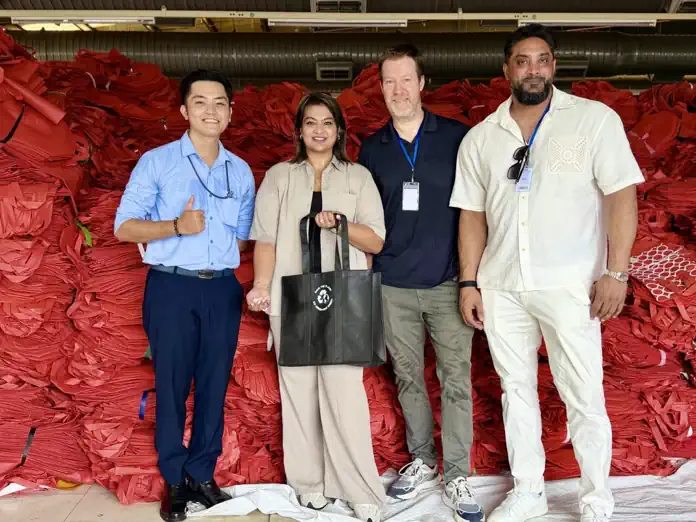
Img 5441: From left to right: Michael Minh, Factory Manager, Waste2Wear; Shaz Ballim, CEO, Kwality Holdings; Stefan Kleijkamp, Merchandising & Quality Manager, Waste2Wear; and Mohamed Mullah, COO of Kwality Holdings, pictured at the Waste2Wear manufacturing facility, with finished Waste2Wear shopping bags, made from post-consumer food containers, ready for distribution in the background.