




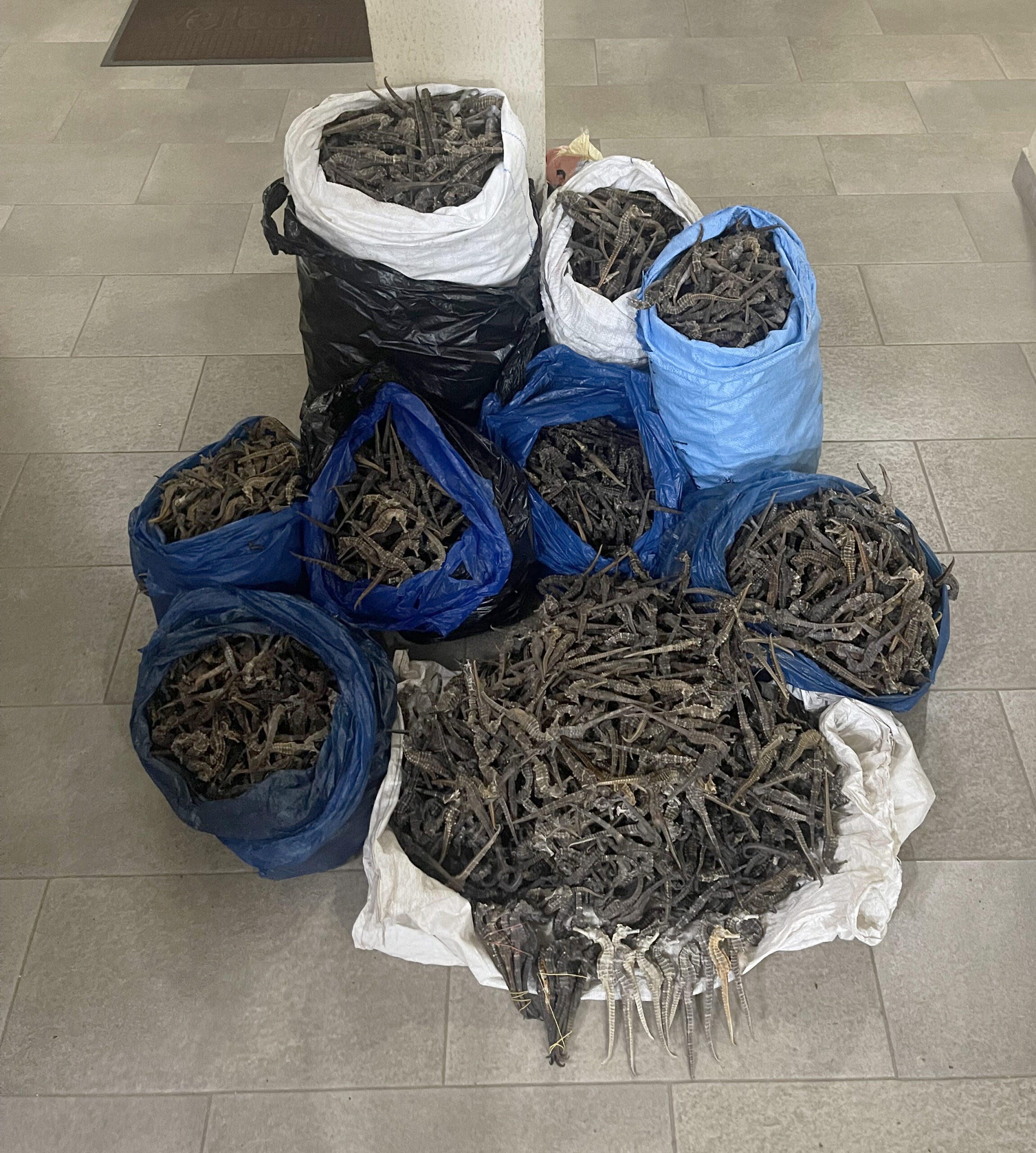
- Guinean authorities arrested four alleged wildlife traffickers and seized 41 kilograms of dried seahorses and 26 kilograms of shark and ray fins.
- The suspects are thought to be part of a transnational criminal network operating in West Africa involved in smuggling protected marine wildlife for more than four decades, and now face 1-5 years in prison and fines.
- The arrests were made when the accused were trying to sell seahorses to Chinese nationals in the country, who would then export them to China.
- The seizure highlights the growing role of West Africa as a source of the illegal global trade in marine species protected under CITES, the international wildlife agreement.
An undercover operation by Guinean authorities in the capital Conakry caught four men in possession of more than 2,000 dried seahorses and 26 kg (57 lbs) of shark and ray fins on May 22, 2026. According to a press release, the seizure was supported by the Guinea branch of the anti-wildlife trafficking NGO Eco Activists for Governance and Law Enforcement (EAGLE).
EAGLE identified the arrested men as Daouda Camara, Thierno Sadou Bah, Sekou Soumah, and Abdoulaye Camara, all Guinean nationals aged between 20 and 55 years old. The NGO told Mongabay they are believed to be part of a transnational criminal network operating across West Africa. The network has been involved in smuggling wildlife for more than four decades, but none of those arrested were previously known to law enforcement authorities.
Antonia Gustafsson, coordinator of EAGLE Guinée, said the alleged traffickers were trying to sell dried seahorses to Chinese nationals in the country, who would then illegally ship them to China. When authorities searched a storage facility linked to the traffickers, they found the stashed shark and ray fins.
Shark and ray fins are key ingredients in shark fin soup, a delicacy in much of China and Southeast Asia. Dried seahorses are in high demand in China as they are used in traditional Chinese medicine preparations. Both products are high-value seafood and a highly lucrative trade: Prices for dried seahorses have peaked as high as $600/kg.
Gustafsson estimated the number of seized seahorses at between 2,000-3,000 dead fish. Most of the seized fins belonged to guitarfish, a group of bottom-feeding rays under increasing pressure from artisanal fishing along West Africa’s coastline. The fins are thought to have come from at least 250 rays.
Authorities are on the lookout for seven other suspects, Gustafsson said.
Catching or selling seahorses, sharks and rays is illegal under Guinean law. International trade of many of these species is permitted and regulated under CITES, the global wildlife trade agreement, and requires import and export permits.
According to EAGLE, the illegal trade of seahorses and other protected marine species is facilitated by organized channels of corruption and bribery. In Senegal, the anti-trafficking organization has found that seahorse traffickers regularly try to get fraudulent CITES permits to launder their illegal catch alongside legal ones. And when there are seizures, authorities don’t always follow up on those cases and catch the traffickers, Gustafsson said.
Gustafsson said the men arrested in Conakry told authorities that Chinese nationals bribe Guinean customs officials to allow the illegal export of seahorses and fins to Southeast Asia.
“The national and international laws protect wildlife, but corruption is a main obstacle in the fight against wildlife trafficking,” Gustafsson told Mongabay.
Seizure highlights West Africa’s role as seahorse trade hotspot
A 2020 analysis of CITES records of seahorse exports from Africa to Hong Kong by wildlife trafficking monitoring NGO TRAFFIC found that Guinea accounted for nearly 79% of all legal exports from Africa between 2008 and 2018, sending more than 400,000 fish. Senegal and Ghana also ranked among the top five.
Alongside legal trade, the illegal trade in dried seahorses is also growing. Reviewing media reports of seizures between 2010 and 2021, conservation scientist Sarah Foster and colleagues calculated that nearly five million dried seahorses — around 13 tons — worth some $21 million, were intercepted from smugglers worldwide in that time span. Africa emerged as a prominent source of the fish, and China a key destination. West African seahorse species were first shipped to Peru and then to Vietnam before they reached China, the study found.
Banner image:A West African seahorse (Hippocampus algiris) is a vulnerable species found in West Africa. Image by remy_dubas via iNaturalist (CC BY-NC 4.0).
Spoorthy Raman is a staff writer at Mongabay, covering all things wild with a special focus on lesser-known wildlife, the wildlife trade, and environmental crime.
Global trade in sea cucumbers ‘alarming’ with many species at risk: Study
Citation:
Foster, S. J., Ascione, S. J., Santaniello, F., & Bondaroff, T. N. P. (2025). Using online reports of seahorse seizures to track their illegal trade. Conservation Biology, 39(5), e70047. doi:10.1111/cobi.70047
FEEDBACK: Use this form to send a message to the author of this post. If you want to post a public comment, you can do that at the bottom of the page.
Credits

This story first appeared on Mongabay
This article is licensed under a Creative Commons Attribution-NoDerivatives 4.0 International License.
You may republish this article, so long as you credit the authors and Mongabay, and do not change the text. Please include a link back to the original article.