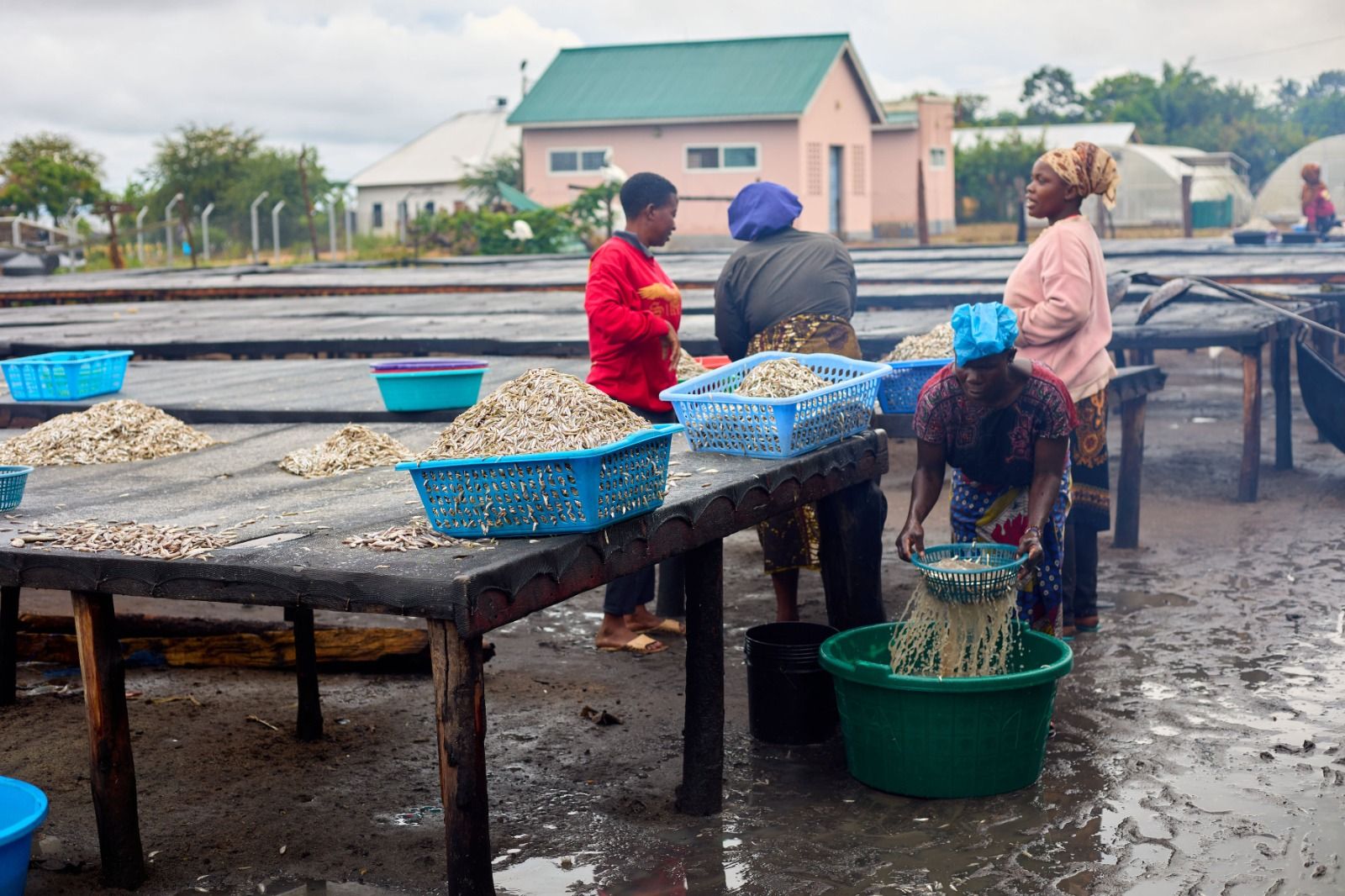
- In fishing communities along Africa’s coast, women are often the backbone of household economies. They process and sell fish, support households and pay school fees, often while facing significant economic and social challenges.
- Hotels, ports and other developments are reshaping many African coastlines. While they can bring jobs and investment, some women working in fisheries say they are also being pushed away from traditional landing sites and areas they have depended on for generations.
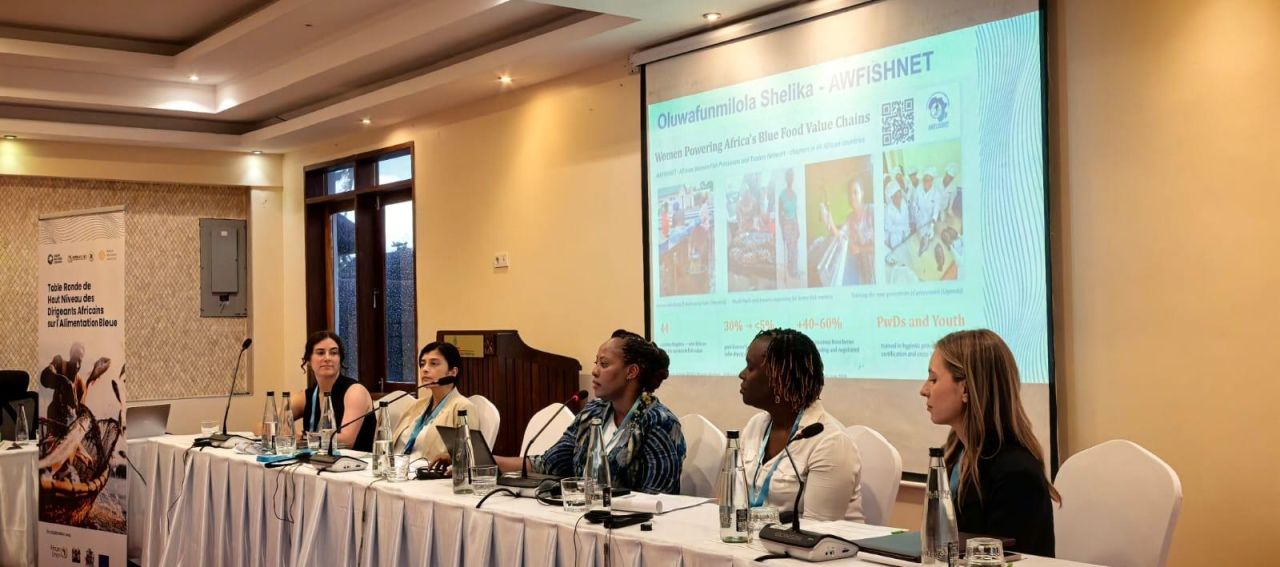
- At a recent gathering of marine organizations in Kenya, one woman stood before the audience to share the realities faced by women fishers, fish traders and others working across the fisheries value chain.
- Uganda’s Lovin Kobusingye knows those realities well. Having overcome numerous obstacles of her own to become a successful entrepreneur, she now advocates on behalf of millions of women working across Africa’s fisheries value chain, many of them women whose contributions to fisheries remain largely unseen and undervalued.
Speaking at a gathering of ocean conservation groups and development practitioners in Watamu, Kenya, Lovin Kobusingye had a simple message: The women who catch, process and sell fish are still largely missing from conversations about Africa’s growing blue economy.
For Kobusingye, the challenges facing women in fisheries are part of her everyday life. “My reality every day is that I wake up to an industrial person taking over my landing place, taking over my fishing zone,” she told the audience, describing how tourism developments and other coastal investments increasingly compete with traditional fishing communities for access to the sea.
Kobusingye said many women face dangers in the fisheries sector, poor working conditions and growing pressure from developments that compete for access to the coast. In some communities, traditional rights are overlooked by the government; while rising seas, erosion and declining fish catches are making an already difficult livelihood even harder, she told the attendees of the meeting organized by the Ocean Resilience Climate Alliance (ORCA).
Despite these challenges, Kobusingye said women remain central to sustaining fisheries and coastal economies. They process fish, trade seafood and support households, including paying school fees, from the income they earn. Yet despite their role in the sector, many women still have little say in how fisheries are managed.
“If you are invisible, you receive invisible budgets. If you are invisible, you receive invisible investments. And if you are invisible, you will also receive invisible policies,” she said, urging governments and donors to ensure women have a seat at the table when decisions about the future of fisheries are made.
But Kobusingye’s own story is much more complicated. When Kobusingye entered Uganda’s fisheries sector it was out of necessity, not design. She was a young mother with a food science degree, a newborn, and few options after her husband left. What began as a struggle to support her children grew into a fish-processing business that now employs dozens of people and supports many more indirectly. Today, she leads the African Women Fish Processors and Traders Network (AWFISHNET), which brings together women involved in fisheries and aquaculture across 44 African countries.
Following the gathering in Watamu, Mongabay sat down with Kobusingye to discuss the personal setbacks that pushed her into business, how a fish-sausage experiment helped launch her company, and why she now spends much of her time advocating for women working in fisheries across the continent.
Mongabay: Your own journey into fisheries began with a personal crisis. What happened?
Lovin Kobusingye: I joined the fisheries sector [as an entrepreneur] in 2012 in Kampala [Uganda]. At the time, I had studied food science and technology, but I did not have a job. I was young, with children, and pregnant with my daughter when my husband left.
That kind of situation can break you. I was vulnerable. But I also knew I had children to feed. You do not negotiate on food, or school fees, or healthcare when children are involved. So, I decided I had to find something to do. What attracted me to fisheries was that it was one of the few sectors where you could start without needing a CV, formal connections or a big title. I did not throw away my degree. Instead, I thought about how to use it differently.
Mongabay: Tell us more about what kept you going during those challenging moments of seeing your husband leave, you as the bread winner and no job.
Lovin Kobusingye: It was painful. I do not want to pretend I was strong every minute. I cried. I felt the pain deeply. But I also felt that no one was going to rebuild my life for me. My father was a big inspiration. He had little formal education, but he was a businessman. He traded across borders, including in Congo and Nairobi, and through that work, he was able to educate us. I was the first graduate in my family. So, I had seen, from home, that enterprise could change a life. I also did not want my children to grow up seeing me as defeated. So instead of sinking into that moment, I focused on work. Work became the thing that kept me moving.
Mongabay: How did that lead to building a business?
Lovin Kobusingye: At first, I started as a fish trader and processor, but it was not easy. Selling fish in the ordinary way was not working for me. So, I began thinking as a food scientist: what could I make that was new, affordable and nutritious? That is how I began developing fish sausages. I wanted a product that would attract curiosity, but also respond to health concerns around processed foods. It took me about eight months of trials to get it right.
Then I got an unexpected opportunity. I had been invited to a fisheries workshop, and I asked the organizers if I could donate 10 kilograms of sausages for participants to try. They agreed, cautiously. The chef tested them first, liked them, and the next day I was given a few minutes to explain the product before the tea break. That was the turning point. Journalists were in the room. The next day, the product was in the newspapers and on television. What I thought was a small tasting became, effectively, my launch.
Mongabay: Where did the business go from there?
Lovin Kobusingye: In 2013, I was starting alone. I registered the company, began selling, and grew step by step. Today, the company employs about 38 Ugandans directly. We have our own fish-processing factory, and we export. The business has also created many indirect opportunities. Through distribution and roadside roasting, hundreds of other people earn income from the products. So, for me, entrepreneurship is not only about one person’s success. It can create livelihoods for many others. That matters to me, because I know what it means to have nothing stable to fall back on.
Mongabay: How did you move from running a company to leading a continent-wide network?
Lovin Kobusingye: The challenges I faced as a businesswoman — access to finance, access to processing facilities, and trying to grow into regional and international markets — made me realize that many women were facing the same barriers. So, I started by organizing in Uganda. In 2016, I helped start the Uganda National Women’s Fish Organization, and I became its president. The idea was simple: Alone, it is very hard; together, you have a better chance.
Later, because Uganda’s chapter was performing well, women from across the continent encouraged me to take on a larger role. During a general assembly in 2025 in Senegal, I was chosen to lead AWFISHNET for the next five years. I had gone there as a country representative and left with a continental responsibility.
Mongabay: What are the main challenges women in fisheries still face?
Lovin Kobusingye: One big issue is policy and legal knowledge. Many women traders do not know the rules that govern cross-border trade, taxes or licenses. Because they do not know their rights, they are easy to exploit. For example, if someone is carrying goods within a certain allowable threshold, they may legally owe no tax. But if they do not know that, they can still be charged money they should not be paying. Many women are working in survival mode. They are praying to pass through the border, not negotiating from a position of knowledge.
There are also cultural barriers, especially in some coastal communities where women face discrimination in access to resources, mobility, or decision-making. And of course, there is the broader issue of finance. Many women are using their own savings, or selling assets, to start businesses.
Mongabay: How is climate change affecting the women you work with?
Lovin Kobusingye: Women feel climate change in very practical ways. Floods damage homes, markets and fish-processing sites. Fish are becoming harder to find in some areas, and people can spend an entire day on the water only to return with little or nothing to sell. For families already living on thin margins, that can be devastating.

Mongabay: What does the future look like for you now?
Lovin Kobusingye: On the business side, I am expanding. I am building a large warehouse near the Kampala port to support trade growth. I am also investing in fish farming — cages in the lake, ponds for hatcheries and nursing [fish] fry — because I want to contribute to production, not just processing and trade.
Personally, I feel grateful. I am not where I was in 2013. But I also feel responsible. There are many women in the situation I once was in; women trying to rebuild after loss, women with children, women with ideas but no capital. If my story means anything, I hope it shows that resilience matters. Women should not have to rely only on personal strength to succeed.
Banner image: According to Lovin Kobusingye, the women who catch, process and sell fish are still largely missing from conversations about Africa’s growing blue economy. Image courtesy of Environmental Justice Foundation.
In Kenya’s Mida Creek, fishers confront a changing ocean with hope
Feedback: Use this form to send a message to the author of this post. If you want to post a public comment, you can do that at the bottom of the page.
Cite this article
David Akana (2026). A trailblazing Ugandan championing women in African fisheries: Q&A with Lovin Kobusingye. Mongabay Conservation news. DOI: https://doi.org/10.66709/news-321885
Credits

This story first appeared on Mongabay
This article is licensed under a Creative Commons Attribution-NoDerivatives 4.0 International License.
You may republish this article, so long as you credit the authors and Mongabay, and do not change the text. Please include a link back to the original article.