Location, location, location! This real estate mantra is considered the key to successful property development. Now, a ground-breaking South African study reveals that the location of housing development is also the key to lowering carbon emissions – significantly so.
A new quantitative study on the impact of the location of housing development in Johannesburg on carbon emissions – by the research partnership of Divercity Urban Property Fund and the Green Building Council South Africa (GBCSA) – shows that where and how housing is built in the city has a massive effect on its residents’ carbon footprints. Against the backdrop of near-universal recognition of the importance of reducing carbon emissions, the findings of this research are particularly significant.
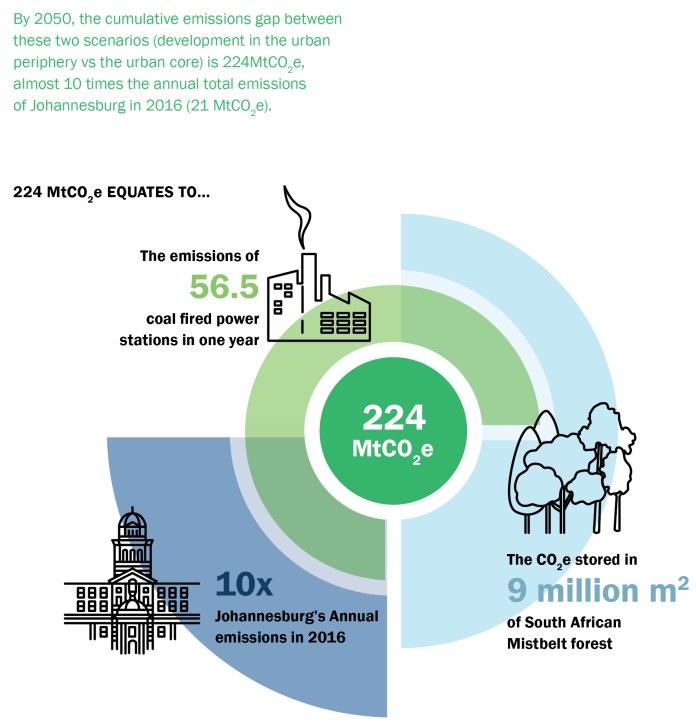
Titled “Does location matter?” and conducted by leading consulting engineering firm Arup, the research highlights a growing gap between the lower carbon emissions generated by living in the well-connected amenity-rich urban core and higher emissions from living on the disconnected amenity-poor urban periphery. This chasm is so vast that, should all new housing be built on the urban periphery, by 2050 it could reach 224MtCO2e – a startling 10-times the total annual carbon emissions of the entire city of Johannesburg in 2016.
South Africa has committed to addressing climate change under the Paris Agreement. Supporting this, Joburg’s new Climate Action Plan aims for the city’s emissions – primarily from transportation and stationary energy – to peak by 2030 and then decline towards net-zero by 2050 and, as a member of the network of C40 Cities addressing climate change, it is developing policies to shift to a lower carbon built environment. But if these pledges are to become a reality, the research shows that we need to act now and change how we develop housing in Johannesburg.
Joburg is urbanising rapidly. It is expected to become a megacity by 2030 and needs more housing to meet current and future demand. Right now, the dominant mode of affordable housing delivery in South Africa confines lower-income households to the urban periphery – far from economic opportunities and essential services such as healthcare, schools, jobs and parks.
The study compared carbon emissions from an urban periphery housing development model to those generated by housing development in the urban core. Researchers also looked at two groups of housing residents – lower and mid-income occupants. They considered the carbon emissions of the housing’s construction and operation over a 60-year design life period, with ongoing operation accounting for 72% of the total carbon a residence will generate. The report also analysed the transport emissions of residents associated with living in each location.
Middle- and lower-income families living on the urban periphery travel similar distances each day, but mid-income families, who rely on private cars, generate three times the emissions of lower-income families, who typically use public or shared transport. This trend was the same in urban core households. But, viewed together, a mid-income family in the urban core still generates fewer transport emissions than a lower-income family living peripherally to the city.
In short, the research proves that the current dominant model of affordable housing delivery in South Africa generates significantly higher carbon emissions and counteracts the aims of Johannesburg’s Climate Action Plan and South Africa’s climate change commitments. In light of this finding, the study shows that urban sprawl, reliance on private car travel and long car trips should be discouraged through spatial planning. In its place, urban densification, access to opportunities, and fewer, shorter private car trips should be encouraged. This approach, notes the research, will help connect people to economic opportunity, break apartheid spatial patterns and retrofit existing settlements.
“The way in which we build housing today will have profound social, environmental and economic impacts on their residents for decades, and the urban form it creates will impact the carbon emissions of their cities into the next century. Divercity is proud to partner with the GBCSA and Arup to produce this new research designed to support the city, property developers and the greater community of built environment professionals to make choices that meet the needs of current and future generations of Joburg citizens. Locally relevant research is an invaluable resource to inform and inspire responsible, sustainable development. We want to collaborate to produce more empirical insights to guide even better developments in future,” says Carel Kleynhans, CEO of Divercity.
“This research highlights the crucial role played by spatial planning and associated transport networks in shaping cities that work for their citizens and the environment. The results correspond with the findings of similar studies in other countries around the globe. To mitigate and adapt to future climate change, we must pay special attention to the broader impacts of urban planning decisions on carbon emissions and look not only at how we can develop greener buildings but also how buildings connect to communities, amenities and opportunities,” says Georgina Smit, GBCSA’s Head of Technical.
So, what can we all do to make sure that we minimise carbon emissions while creating excellent places for people to live and thrive?
- The public sector can implement policies that align property development with climate goals, encourage this with incentives, and manage it with regulations and standards.
- Property developers can take care to build better located housing that minimises lifestyle related carbon emissions.
- Built environment professionals can champion the low-carbon development and operation of urban spaces.
- Town planners can design connected cities, neighbourhoods and spaces that improve equity and access to economic opportunities.
- Urban economists can advocate for integrated thinking, including carbon emissions, air pollution, the cost of lost time during commuting, and other external costs.
The full version of the “Does location matter?” research report by Divercity and the GBCSA, conducted by Arup, is available at https://gbcsa.org.za/wp-content/uploads/2021/09/30.09-Divercity_Carbon-Study_Final.pdf.
About Divercity:
Divercity Urban Property Fund is a for-profit property fund setting a new standard for socially responsible, environmentally sustainable and economically productive urban development while delivering attractive returns for its institutional investors.
Divercity invests in high-density urban precincts. These precincts are well located, rich in amenities, and weighted towards affordable rental housing. They offer low and middle-income households the opportunity to live in sustainable urban environments, close to where they work and with access to the essential amenities required to get ahead in life.
Divercity’s existing portfolio of R3bn comprises 6,500 units and 90,000sqm commercial and retail gross lettable area. Notable assets include Jewel City, a transformative mixed-use housing, education and retail precinct in one of the only pedestrianised nodes of the Johannesburg CBD, and Towers Main, an iconic 30-storey tower comprising 518 apartments and 9,000sqm of ABSA offices. Pipeline developments comprise a further 4,000 apartments and supportive commercial and retail uses of c.10,000sqm.
Further information is available on Divercity’s website: https://www.divercity.co.za/.
About Green Building Council South Africa:
The Green Building Council South Africa (GBCSA) drives sustainability in the property sector by creating tools for rating the design, construction and operation of green buildings and community precincts. Our commercial Green Star rating tools reward projects for building within close (ideally walking) distance of public transport nodes and facilities such as libraries, banks and shops. By building in connected environments, our Green Star tools discourage car trips and prioritise parking and accommodation for non-motorised transport in an effort to reduce transport related emissions. Alongside our tools, the EDGE tool, that focuses on residential developments, sets targets for lowering embodied carbon in materials selected, and rewards energy and water efficiency in homes.
About Arup:
Arup is a multi disciplinary global independent firm of designers, planners, engineers, architects, consultants and technical specialists, working across every aspect of today’s built environment. Together we help our clients solve their most complex challenges – turning exciting ideas into tangible reality as we strive to find a better way and shape a better world.
Released on behalf of:
Divercity Urban Property Fund
Contact person: Carel Kleynhans, CEO
Mobile: +27 84 500 0473
Website: divercity.co.za