



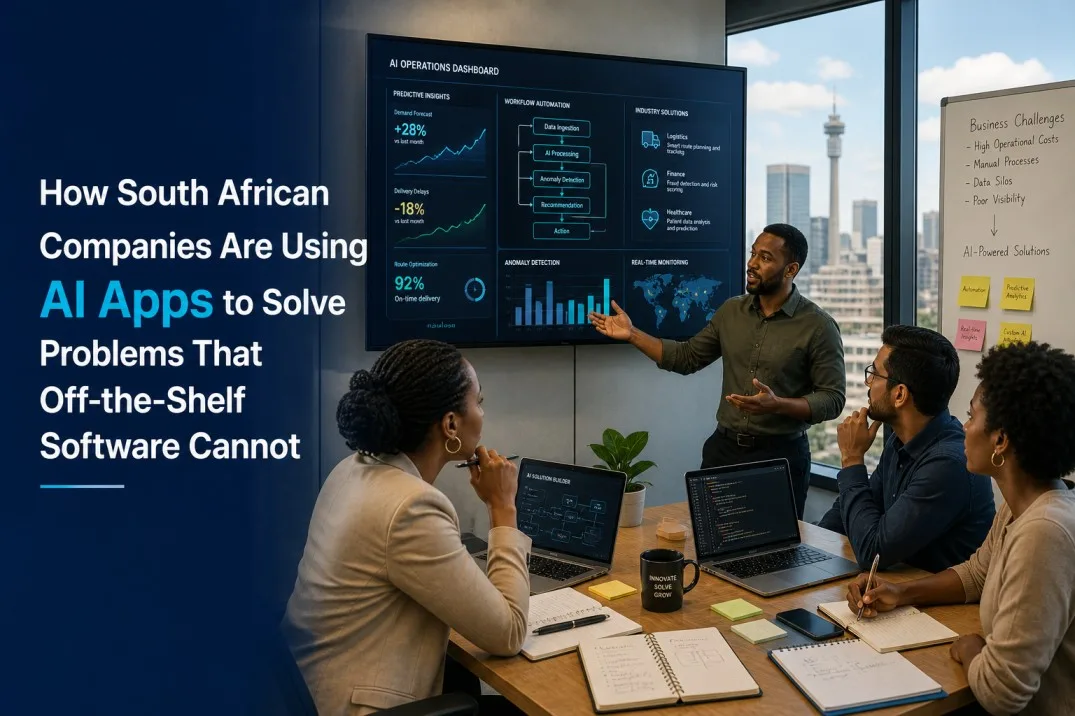
For years, South African businesses operated on a quiet assumption that the software they needed already existed somewhere, built by a company in San Francisco, India, or London, and that the job was simply to adapt their workflows to fit it. That assumption held up well enough when the problems were generic enough. But as businesses grew more complex, more local, and more specific in what they needed, the cracks in that assumption became harder to ignore.
Something has shifted in the last few years. Across various industries (financial services, retail, healthcare, agriculture, and logistics), companies are no longer waiting for global vendors to understand their problems. They are building AI-powered solutions specifically designed for the realities they operate in. That shift is not just a technology trend. It is a fundamental change in how local businesses think about software, capability, and competitive advantage.
Why Generic Software Always Felt Like a Poor Fit
Off-the-shelf software solves for the global average. South Africa is not the global average, and that gap shows up in ways that matter. Consider something as straightforward as a customer communication platform. A tool built for a European or North American market assumes a single-language user base with reliable smartphone access and consistent internet connectivity. In South Africa, a business might need to communicate effectively across eleven official languages, serve customers with varying levels of digital literacy, and do so in environments where connectivity is inconsistent and data costs are a genuine barrier.
The workarounds became the job. Teams built manual processes to compensate for what the software could not handle. They hired people to do what the tool could not automate. They exported data into spreadsheets, manipulated it, and imported it back. Over time, those workarounds became invisible infrastructure, load-bearing habits that nobody questioned because everyone assumed the software was as good as software got.
Load shedding added another layer of complexity that no global vendor was equipped to address. Businesses that depend on predictable power availability simply cannot run operations the way a business in Germany or Japan can. Logistics companies needed routing tools that factored in generator availability at delivery points. Manufacturers needed production scheduling systems that accounted for power outage windows. Retailers needed inventory management that handled the downstream effects of supply chain disruption caused by rolling blackouts. None of those requirements made it onto the feature roadmaps of companies building for global markets.
What Changed to Make Custom AI Accessible
For a long time, building custom software was expensive enough that most South African businesses could not justify it. Custom meant enterprise budgets, long development cycles, and specialist teams that were hard to find and harder to retain. The economics simply did not work for businesses operating below a certain scale.
Three things changed that calculation.
- Falling development costs. AI tooling and frameworks have become far more accessible. What required a team of machine learning specialists three years ago can now be built by a smaller, more specialised development team at a fraction of the cost.
- Maturing local talent. South Africa now has a meaningful pool of developers with real AI and machine learning experience, people who understand both the technology and the local context it needs to operate in.
- Cloud infrastructure. The hardware barrier is gone entirely. A mid-sized South African company can now build, train, and deploy a custom AI application without owning a single server.
The numbers reflect this shift clearly. According to research on AI Software Development, the cost and complexity of building custom AI solutions have dropped significantly over recent years, making what was once a large-enterprise privilege accessible to mid-sized businesses across emerging markets, including South Africa.
Where the Trend Is Showing Up Most Visibly
Financial services have been one of the earliest and most active sectors. South Africa’s banking landscape includes a large unbanked and underbanked population that interacts with money in ways that differ fundamentally from how global fraud detection systems were designed to work. Transactions that look irregular by global standards are entirely normal in local informal economy contexts. Companies in this space are building custom AI models trained on local transaction patterns, models that understand the difference between suspicious behavior and economically normal behavior for their specific customer base. The result is fraud detection that is both more accurate and less likely to flag legitimate activity from customers; the global models were never designed to understand.
Retail and logistics present a different but equally compelling picture. Demand forecasting tools built for European or American supply chains assume a level of infrastructure reliability that simply does not exist in many parts of South Africa. Companies are building AI forecasting systems that factor in variables no global tool would consider, load shedding schedules, seasonal road conditions in rural distribution routes, informal settlement delivery logistics, and the behavioral patterns of consumers who shop differently when economic uncertainty is high. Those inputs produce forecasts that are meaningfully more accurate for local conditions than anything a global platform offers out of the box.
Also Read: AI, Data & Cloud in Focus as South African Business, Technology Leaders Gather
Healthcare is another sector where the gap between global software and local reality is particularly acute. Patient communication in South Africa requires navigating multiple languages, varying levels of health literacy, and a public health system that operates under significant resource constraints. AI tools designed to improve patient engagement in a single-language, well-resourced health system transfer poorly. Local healthcare providers are building AI communication tools that handle multilingual interactions naturally, adapt complexity based on the patient’s demonstrated literacy level, and work effectively in low-bandwidth environments where data costs make rich media impractical.
Agriculture rounds out the picture in an instructive way. South Africa’s farming sector is highly diverse; large commercial operations coexist with smallholder farmers working very different land under very different conditions. Predictive tools built around Northern Hemisphere climate models or large-scale monoculture assumptions are of limited use. What South African agricultural businesses are building instead are AI tools trained on local climate patterns, local soil data, local pest and disease histories, and the specific economic constraints of smallholder farming. The precision those tools deliver is only possible because they were built for this context rather than adapted from one that does not fit.
This Is Bigger Than a Local Story
What is happening in South Africa is an early and clear signal of a pattern that will play out across emerging markets globally. For decades, technology adoption in these markets followed a familiar script: wait for global vendors to build something, adapt local operations to fit it, and accept the compromises that came with software designed for someone else’s context. AI is breaking that script because the economics of building custom solutions have changed enough to make a different approach viable.
South Africa is ahead of this curve in meaningful ways. The combination of a mature local developer community, growing AI literacy among business leaders, accessible cloud infrastructure, and genuinely pressing local problems that global software has consistently failed to solve has created the conditions for this shift to happen faster here than in many comparable markets. The companies moving first are building institutional knowledge and competitive advantages that will be difficult for later movers to replicate quickly.
There is also a broader implication for how global technology companies think about emerging markets. The assumption that businesses in these markets will eventually converge on the same tools as their counterparts in developed economies is looking increasingly shaky. When local companies can build AI solutions that outperform global alternatives on local problems at competitive costs, the incentive to wait for a global vendor to catch up weakens considerably. South Africa is demonstrating that emerging market businesses are not just consumers of technology built elsewhere, they are increasingly capable of building the technology that fits their own reality.