An East London social entrepreneur is driving a solution to rural poverty and economic exclusion of women and youth by tapping into the modern trend for heritage-inspired wellness.
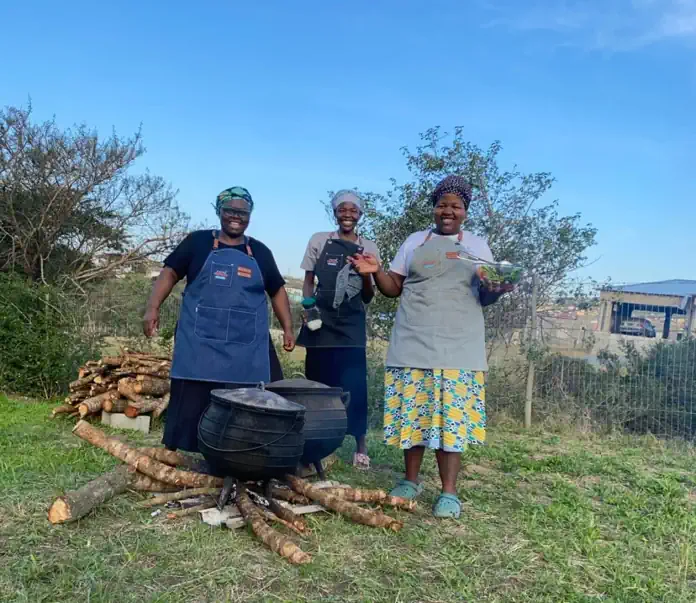
Rural Impaqt Bone Broth founder Phumeza Stuurman and her all-female cooking team in the village of Nxarhuni on the outskirts of East London transform animal bones, an often-discarded agricultural by-product, into nutritious bone broth, made fresh weekly and delivered to a growing list of loyal urban customers in the East London area.
Bone broth has been consumed by diverse cultures over centuries and has resurged in modern times, highly valued by wellness advocates and consumers for being rich in natural collagen, amino acids and minerals that support joint health, gut health and digestion, healthy skin and hair, and boost immunity.
The chicken and beef broths are slow-cooked over open fires in the traditional African way, maximising nutritional value and offering “heritage-inspired wellness”, Stuurman said.
“We are bringing what our grandmothers knew back to the table, in a format that meets modern food safety standards and consumer desires to live well and eat well.”
“In a market dominated by synthetic supplements, we offer a wholefood alternative that is affordable, natural, healing, and deeply rooted in African food tradition,” she said.
It is a circular economy approach, creating a waste-to-nutrition pipeline for a scalable rural manufacturing enterprise that “channels urban consumer demand into rural jobs and wages, creating value where none previously existed,” says Stuurman.
“Inspired by the African term ‘vukuzenzele’, meaning ‘wake up and do it yourself’, I saw untapped potential in the wisdom and resources that we already have in our rural community, rather than focusing on what we lacked.”
Stuurman, 46, is a participant in the second edition of the East London programme of the Stellenbosch Business School‘s Small Business Academy (SBA), a partnership with Standard Bank and the Border-Kei Chamber of Business in East London.
SBA Head Prof Armand Bam said the iconic social impact programme, serving entrepreneurs in low-income, marginalised communities, aims to counter the high failure rate of small businesses in South Africa by “equipping small business owners with the tools they need to defy the odds and succeed”.
“The addition of Standard Bank, as a partner, solidifies our commitment to advance business knowledge and practical capability, enabling small business owners in disadvantaged communities to grow sustainable enterprises that create jobs and strengthen their communities,” Prof Bam said.
Stuurman, who relocated back home to East London for family responsibilities after a 15-year public sector career in financial management and performance monitoring and evaluation in Gauteng, said she saw the SBA as an opportunity to network with like-minded entrepreneurs, learn “from those who have walked the road for a while”, and learn from and be mentored by business experts.
Although she holds an MBA degree, she says this was obtained more than 10 years ago during her career as a public servant.
“My mindset then was of an employee, not a business owner. The knowledge gained through the MBA has come in handy in strategising for the business and most business concepts are not foreign to me.
“However, the SBA is an opportunity to equip myself to think big and scale the business, to learn to work on the business, not just in the business,” she said.
Stuurman had her three part-time employees currently use her home kitchen as a micro-factory for small-batch production, promote the business on social media and take orders on Whatsapp for weekly deliveries to collection points in Beacon Bay and Vincent in East London, as well as selling their wares at local markets.
However, their vision is much bigger – to establish a fully operational small-scale production facility, directly creating 5 to 8 permanent jobs for unemployed rural youth and women in the first year, with economic multiplier effects in local supply chains and strengthened local agricultural ecosystems.
“Our vision is not just to build a food brand but to grow a rural manufacturing ecosystem, based on a commercially viable, scalable business that uses health food as a vehicle for rural economic transformation – creating dignified local employment, activating local supply chains, and demonstrating that high-value health food production can happen outside of urban centres,” says Stuurman.
- While bone broth is a healthy drink on its own, warmed up in a mug as a food supplement or a replacement for commercial packaged soups, Stuurman says it can also be used as a health-giving replacement for water or commercial stock in cooking rice, grains, pasta, vegetables, legumes, soups, stews, gravy or sauces.
- The Small Business Academy has branched out over the last 14 years from low-income Cape Town communities into the wider Western Cape province, the Northern Cape and the Eastern Cape.
Over 460 entrepreneurs have graduated from the programme to date with an accredited post-matric (NQF Level 6 qualification from Stellenbosch University. Ongoing impact research indicates that more than 80% of the participants are still in business and growing in profitability, and over 90% have created new full-time jobs, Dr Bam said.
“The majority of small start-ups fail in their first 12 to 24 months because the entrepreneurs, while having the technical skills in their sector, lack the knowledge of how to plan, run and sustain a business.”
“The SBA is designed to bridge this gap by providing formal business education, practical skills, and ongoing mentorship and business development opportunities. The programme aims to foster a mindset of adaptability and innovation in an ever-changing world to ensure profitable, sustainable enterprises.”
“Unlike many other SME support programmes, we don’t hand over a certificate and walk away – the continued involvement with each business is key to the programme’s demonstrated success,” Prof Bam said.
Follow Rural Impaqt on social media:
Facebook: https://www.facebook.com/people/Rural-Impaqt/61579889492412/
Instagram: https://www.instagram.com/ruralimpaqt/
NOTE TO EDITORS – More about the Small Business Academy
Stellenbosch Business School launched the Small Business Academy (SBA) in 2012 with the aim of empowering small business owners in low-income communities with business education and ongoing mentorship. The programme targets entrepreneurs and small businesses in disadvantaged areas, with classes of about 25 participants each in the Western Cape, Northern Cape and Eastern Cape provinces annually.
The nine-month programme includes training and practical workshops in business essentials, marketing, financial management, IT and presentation skills, and business plan development, with pro bono mentoring by Stellenbosch Business School alumni.
Successful participants obtain an NQF Level 5 certificate from Stellenbosch University.
Participants are admitted after a strict selection process, including an aptitude test and an interview. Apart from a minimal initial commitment fee paid by participants, the programme is fully sponsored.