


Ask employees what they want from an office, and they’ll likely give you a list. Ask them what makes them want to stay, and the answers become harder to articulate.
South Africa’s evolving workspace culture is revealing a compelling truth about what people really need from their workplaces. A need that doesn’t speak the language of metrics at all – because it’s more than a metric – it’s a feeling.
Johannesburg, South Africa, 18 November 2026 – In a human dimension that challenges the conventional economics of office space, an argument is being placed on the table: How does a business assign a monetary value to an unexpected introduction, a meaningful conversation or the reassurance of being seen and heard?
Even more complex – how does a business measure the influence of community on an employee’s willingness to participate, contribute or stay?
In today’s rapidly shifting workplace hierarchy of needs, it seems not everything that makes a workplace valuable can be captured in an employee survey or HR policy.
“Perhaps we’ve been measuring the wrong things all along,” says Stefano Migliore, CEO of South Africa’s flexible workspace, WeWork South Africa.
“The future of work, specifically, is no longer simply about where we work or the ‘perks’ we receive. It’s about who we work alongside; the communities we build; the human connections that make us want to show up,” says Migliore.
Beyond contemporary office design, floating desks, meeting rooms and ‘even the nifty coffee machines presented in an office space,’ there is a new workplace culture evidently taking shape. People aren’t just showing up for work anymore, they’re showing up for each other.
It’s called Community Culture – and South African business owners would be remis to ignore it.
According to the South African Property Owners Association’s (SAPOA) Q3 2026 Office Vacancy Survey, national office occupancy has decreased, having fallen to 11.8% – their lowest level in more than six years. This fuels the debate not only about considerable budget cutbacks, but more-so, about employees’ core needs from the spaces they occupy.
Migliore says: “South African businesses need to reconsider what makes an office worth returning to, day after day, and from what I have witnessed in my own business, ‘Community’ is emerging as a compelling part of the answer.”
It’s a sentiment shared by Lee Loffstadt, HR Manager and Executive Committee Member of Veolia Southern Africa, whose multinational environmental services company chose to transition 65+ members from traditional office infrastructure to a flexible workspace.
“We were reluctant at first, coming from an industrial corporate infrastructure,” says Loffstadt. “We only ever knew one way of working, until we got the chance to witness and embody the spirit of community and human exchange in a broader setting.”
Veolia Southern Africa now occupies one of WeWork South Africa’s larger private office spaces at The Link in Rosebank, Johannesburg.
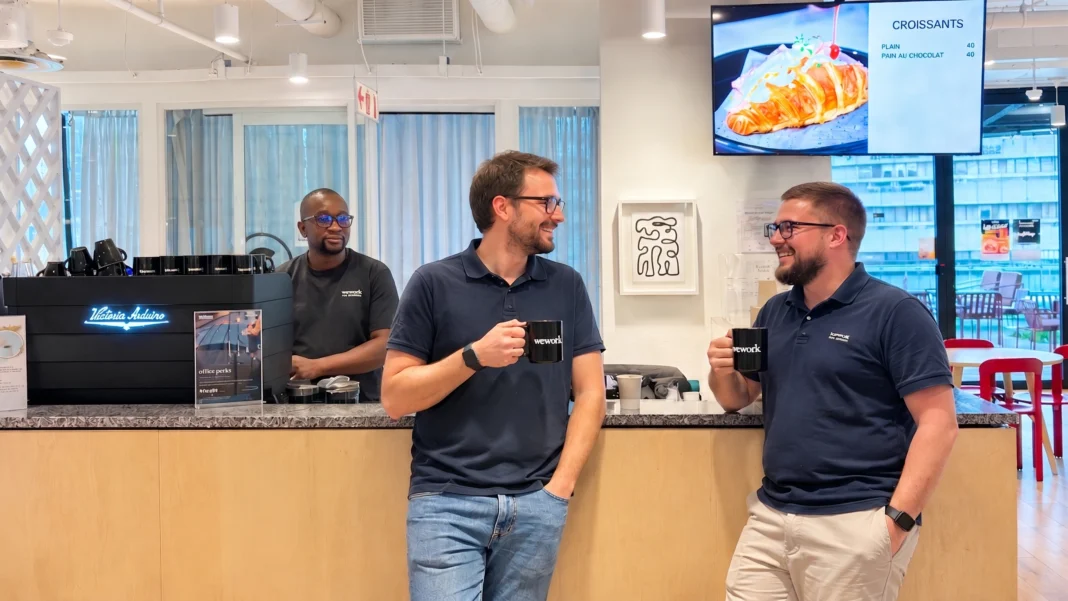
For Loffstadt, the difference is visible in the smallest moments of the working day: A familiar face at the coffee counter or a colleague taking time to connect or simply being part of an environment that invites people out of their offices and into a wider community.
“I often see our teams going down to the pause areas and having coffee together, which is incredible,” says Loffstadt.
For Loffstadt, the workplace is about connecting with others, celebrating differences and understanding the people behind the job descriptions; the very different lives they bring through the office doors.
Migliore believes this is already happening at WeWork, and other flexible workspaces around the globe. Beyond providing infrastructure, the modern office has an opportunity to nurture intergenerational relationships, spontaneous conversations, and diverse cultural backgrounds; the kind of everyday interactions that help people feel they belong.
For Migliore, this is precisely why the future office must be considered through a broader lens than real estate and policy alone. Accordingly, corporates like Veolia, and their transition to a flexible workspace have since encouraged ‘community’ as a work culture – no longer just a personal endeavour.
“Community means diversity in business. We have always celebrated our differences at Veolia because that is what community is truly about – the diversity of a team, or a village, or a friendship,” says Loffstadt.
Migliore takes the sentiment a step further. “In a flexible workspace, for example, the space is shared with many different walks of life: startups, corporates, creatives and entrepreneurs from entirely different sectors, and backstories, all in one building. This kind of cross-pollination in an office – like the unexpected conversation, the referral, the collaboration that nobody planned – is something a monoculture office simply cannot offer; this is why the retention metric needs to change,” says Migliore.
In an era increasingly shaped by artificial intelligence, and work-from-home policies, it feels relevant now more than ever to revise the language of the office culture. Community is a language of connection and belonging unto its own – and it’s apparent that South Africa’s future workplaces need to become fluent in it.
“Community. That’s my word now,” says Loffstadt. “As we progress rapidly in this AI world, generations of today and tomorrow need to make sure they’re building community; that they are surrounded by connected experiences, good listeners, cultural empathy and genuinely supportive individuals ,” says Loffstadt.
For Migliore, the responsibility now rests with South African businesses to rethink what makes an office worth returning to. “If we are going to keep asking people to walk into an office, then as South African businesses, we have a responsibility to make it worth walking into. Let people connecting with people be reason enough,” ends Migliore.
Sources: https://www.baker-street.co.za/blogs/sapoa-q3-2026-office-vacancy-report?utm
About WeWork
WeWork is the leading global flexible space provider, offering businesses of all sizes the solutions they need to thrive in a new world of work. In addition to its flagship South African locations in Sandton, Rosebank and Cape Town, WeWork provides members with a global footprint of 2000 locations across 37 countries, offering beautiful, functional spaces designed to foster productivity and community wherever work happens. Since entering the South African market, WeWork South Africa has played a defining role in reshaping the country’s flexible workspace landscape. The business has helped shift coworking from a niche offering typically found in smaller spaces and lower-grade buildings to a premium workplace solution located in some of the country’s most prestigious commercial developments.
Press Contact:
Mantis Communications
Kerry Simpson
Tel: 079 438 3252
Email: [email protected]