- On a recent visit to Taï National Park, in southwestern Côte d’Ivoire, Mongabay accompanied Ivorian environmental scientist Christine Kouman on a night-time boat trip up the Hana River.
- The river is home to Africa’s rarest crocodile, the critically-endangered West African slender-snouted crocodile.
- For more than a decade Kouman, whose work has been supported by Project Mecistops.
- Now the scientist, who cofounded the conservation NGO EBURCO, is working with others to ensure its rainforest habitat stays well protected.
TAI NATIONAL PARK, Côte d’Ivoire — Environmental scientist Christine Kouman says she has always had a passion to take care of things that are overlooked or neglected. The West African slender-snouted crocodile and its habitat in what remains of the Upper Guinean Forest qualify on both fronts.
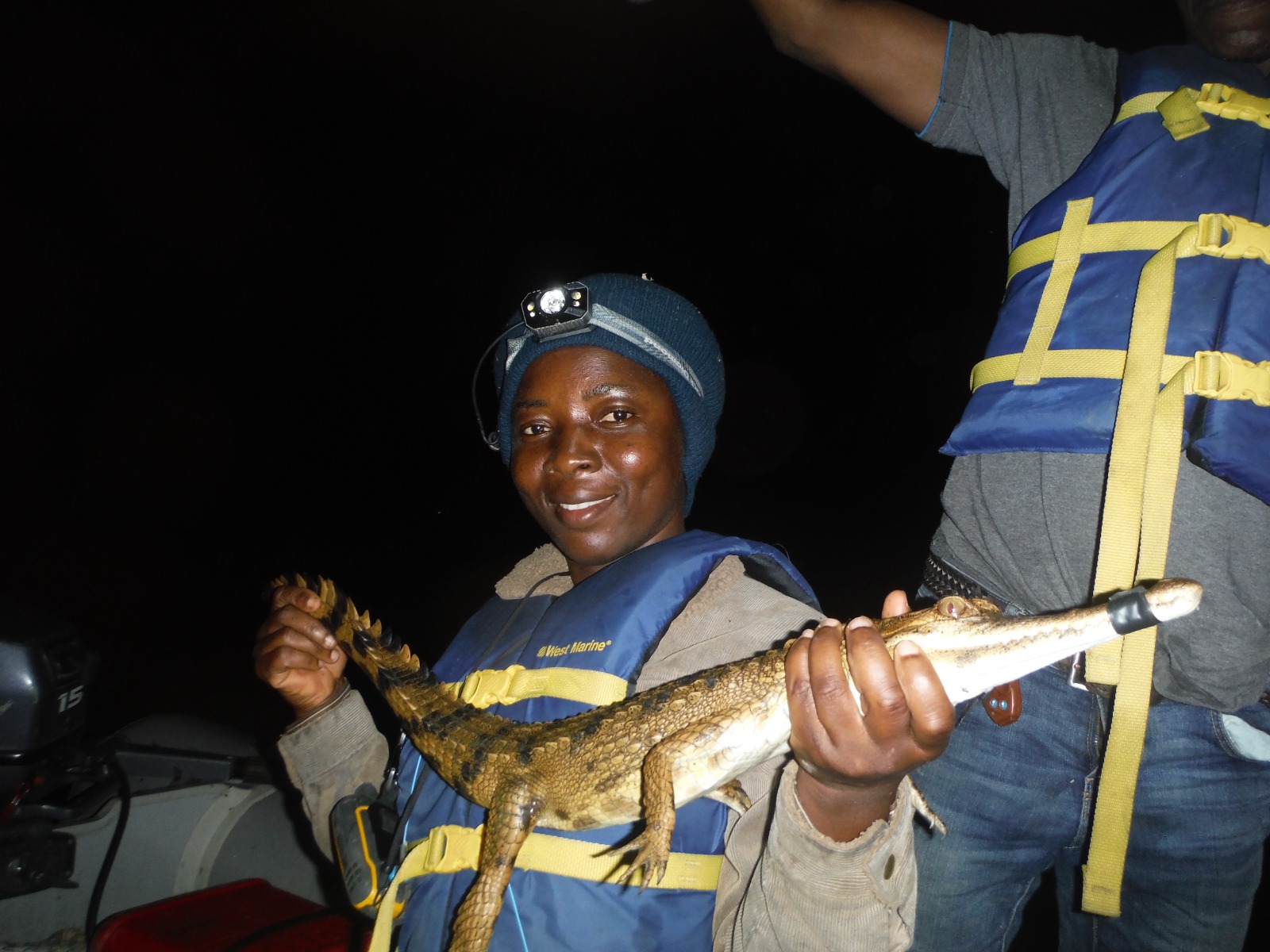
Kouman, co-founder of a conservation NGO called EBURCO that is collaborating with authorities to protect and raise the profile of Taï National Park — a key stronghold of the slender-snouted crocodile (Mecistops cataphractus), — has studied this species in her native Côte d’Ivoire for more than a decade. Her work, which is supported by Project Mecistops, – has produced insights into this little-known species. The project is part of the Tropical Conservation Institute at Florida International University in the U.S.
Mongabay recently accompanied Kouman on a night-time boat trip in Taï National Park, up the Hana River, a place where she has undertaken many hours of grueling fieldwork.
This interview has been lightly edited for clarity.
Mongabay: Tell us something about the slender-snouted crocodile.
Christine Kouman: I can say it’s a gentle crocodile, because it feeds mainly on fish, and I’ve never heard of the species attacking people. I’ve been working on them for more than 10 years now, and during those 10 years, I touched them, handled them, but I still have all my fingers and my toes. I’m still in one piece.
Mongabay: You make it look easy, but how difficult is it to catch a crocodile?
Christine Kouman: Catching this species is not easy. When you catch one, it will fight — but it does tire quickly, then it stops fighting, and you can handle it more easily. The biggest one I’ve caught was 2.85 metres [9 feet in length], and I used a snare pole to catch it.
The difficulties of studying this crocodile are mainly that you have to go to very remote areas and you don’t have supplies, so you have to carry everything with you and set up your own area [of operations, including a field camp].
Working on crocodiles is mainly done at night, so to catch them you need to go along the river at night, staying on the boat for a long time. Before attempting to catch a crocodile, we need to consider the environment and ensure that the team and the animals’ safety are secured to avoid injury to either people or crocodiles as well as incidental drowning of the crocodile.
Mongabay: What were you investigating for your Ph.D.?
Christine Kouman: I studied their spatial ecology — their home ranges, their habitat selection, in terms of micro-habitats used, and also their social interaction between sex and size classes.
[My research found that] this species has a small home range compared to other “true” crocodile species like Crocodylus porosus (the saltwater crocodile) or Crocodylus niloticus (the Nile crocodile), but its home range is bigger than Tomistoma schlegelii (the false gharial of southeast Asia), which is quite similar in terms of its habitat and ecology.
Regarding micro-habitats — the slender-snouted stays near rocks, and they also use fallen trees, which it likes to bask on. That’s because this is a forest-stream species. There are no open areas where they can bask, so they use rocks because they stick out of the water, as do the branches of fallen trees, showing their ability to climb trees.
They also like to stay hidden beneath the vegetation that overhangs the river, because when fruit produced in overhanging trees falls into the water, it attracts fish, which the crocodiles then hunt.
In terms of social behavior, there are few conflicts between individuals within this species. That’s because they are not fully territorial. They share the river with their conspecifics [other slender-snouted crocodiles]. They use the same areas, but most of the time, when one is within the shared area, the other is not. It’s a strategy to use critical resources in a shared area, and by doing this, they avoid conflict with each other.
Mongabay: Did you discover that thanks to the VHF radio tags you put on them? How do they relate with the smaller dwarf crocodiles that are also resident here in Tai?
Christine Kouman: Yes, I tagged 26 individual slender-snouted crocodiles. And, I observed that dwarf crocodiles (Osteolaemus afzelii) use very small streams or swampy areas inside the forest, and the slender-snouted crocodile stays in the main river.

Mongabay: How has the Hana River, which flows through Taï National Park here, changed since you began your Ph.D. research more than 10 years ago?
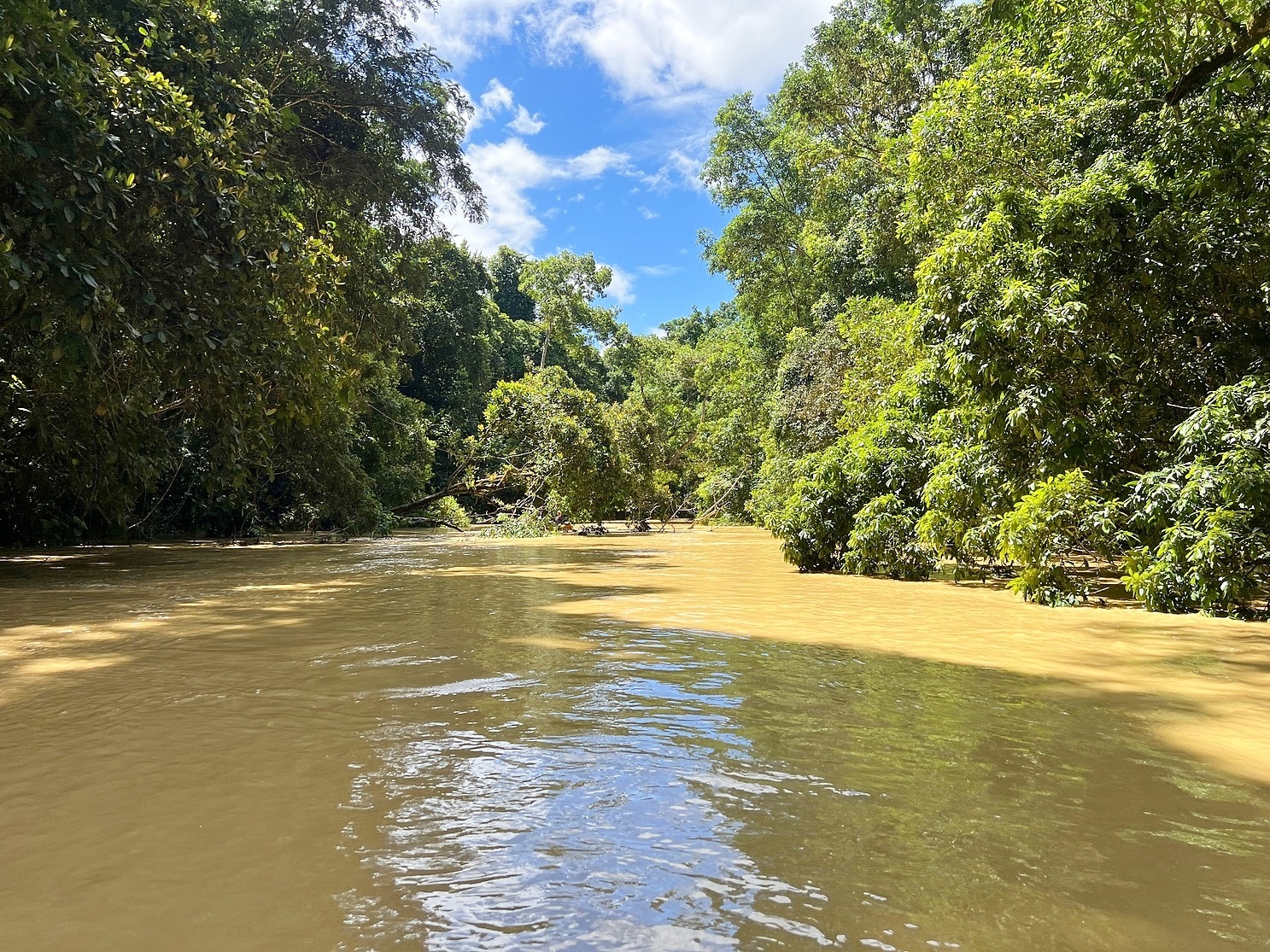
Christine Kouman: One of the most significant changes is the quality of the water. When I started this study, the water was very clear; you could even drink it without needing to filter it.
But since 2019, it has started to get very dirty. It’s very muddy; the color is very different from the original one and there is no way you can drink it now.
[Farmers and fishermen here say] they wish the mining activity [on the eastern boundary of the park, and sometimes inside the park that is responsible for causing sedimentation in the river] would be stopped; so that the environment would recover by itself.
During my Ph.D., I got some funding from the Zoological Society of London, through their EDGE Fellowship, and conducted a social study in the villages around the study area. I interviewed local farmers and fishermen, and fishermen told me that they see the park as a bank for fish, because it’s like when you need money, you go to the bank to withdraw money, and this river also passes through community areas outside the park. When they don’t have fish in their fishing areas, they assume fish move from the park into the community area, and they can get fish again.
Mongabay: Having a clean river is also critical for the wellbeing of the crocodiles, isn’t it?
Christine Kouman: Yes. Although they sometimes feed on other aquatic animals [like frogs], they mainly feed on fish.
The crocodiles don’t move far from the water. As soon as we destroy or change the aquatic ecosystem, it impacts their feeding behavior. So, it’s critical to keep the aquatic environment clean so that the prey species will thrive and the slender-snouted crocodile will have enough food to survive.
Mongabay: And what about the forest that the river flows through? If the tree cover were lost, how would that affect the crocodiles?
Christine Kouman: Yes, it’s a forest-dwelling species. Without forests, the species cannot survive. This crocodile has historically been recorded in many areas in Côte d’Ivoire, and now, because the forest in those areas has been cut down, it has reduced their numbers.
A study of both protected and non-protected areas by one of my colleagues, Dr. Ahizi Michel [who is also a cofounder of EBURCO] found that in places where the slender-snouted crocodile existed in the past, there are no more in non-protected areas.
Where he found some viable populations was in the very well-protected forest areas. So I can confirm that if we lost the forest, we would also lose all of the slender-snouted crocodiles.
Mongabay: How important is a place like Taï to you, who knows and understands this animal and cares for it?
Christine Kouman: I used to say Taï is a paradise for slender-snouted crocodiles, so if you want them to thrive, you need to keep Taï as it is — well protected, and then we’ll have the chance to see the slender-snouted crocodile for a long time.
If not, then we can leave that idea and resign ourselves to losing them forever.
Banner image: Christine Kouman with a slender-snouted crocodile (Mecistops cataphractus). Image courtesy of Agata Staniewicz.
Feedback: Use this form to send a message to the author of this post. If you want to post a public comment, you can do that at the bottom of the page.
Credits

This story first appeared on Mongabay
This article is licensed under a Creative Commons Attribution-NoDerivatives 4.0 International License.
You may republish this article, so long as you credit the authors and Mongabay, and do not change the text. Please include a link back to the original article.