






A new book from Indigenous scholar Tyson Yunkaporta of Australia explores how human narratives dictate how modern society governs itself and, crucially, how it exploits or protects the natural world.
“It’s a terrible thing to … misrepresent things, make false claims, bear false witness in a way that is bending story, the story that everybody follows,” Yunkaporta told Mongabay’s newscast host Mike DiGirolamo. Yunkaporta is a Deakin University senior research fellow and member of the Apalech clan (Wik) whose traditional lands are located in far north Queensland, Australia.
His book, Right Story, Wrong Story: Adventures in Indigenous Thinking, argues that identifying and correcting “wrong stories” is key to stopping environmental exploitation. A wrong story, according to Yunkaporta, is one that acts as a deceptive “curse” by presenting an illusion as if it were real to justify the exploitation of nature and community well-being through narratives that have no connection to the land.
To illustrate the “wrong story” of modern resource exploitation, Yunkaporta told Mongabay the Aboriginal folk tale of Tidalik, a giant frog who hoarded all the world’s water for himself. Yunkaporta compares Tidalik to Wall Street firms and billionaires who gamble on water futures and “park their cash” in housing, exacerbating the affordability crisis while stopping the natural flow of resources.
In the legend, the animal kingdom does not “eat” Tidalik; instead, an eel makes him laugh by tying himself in knots, forcing the frog to “vomit all the water back into the land.”
“A lot of people say, ‘Eat the rich.’ I say, ‘Entertain the rich,’” Yunkaporta said.
The antidote to these destructive patterns lies in “First Law,” an Indigenous explanation of how people relate to each other and the land, Yunkaporta said. “The first relation is between land and people, and the second relation is between people and people. The second is contingent on the first,” Yunkaporta wrote in the book.
By adopting what Yunkaporta calls the “sacred mind,” individuals can see themselves not as isolated actors but as a “collection of relationships, connections, [and] obligations” to the natural world. This Indigenous perspective offers a pathway toward a more sustainable society by shifting the focus from possession to belonging, he elaborated.
Yunkaporta’s upcoming book, Snake Talk, will further detail “S,” foundational narratives shared across many human cultures that he said he believes can bridge global divides and help humans find “leverage points” to heal the planet.
Listen to the full conversation with Tyson Yunkaporta here.
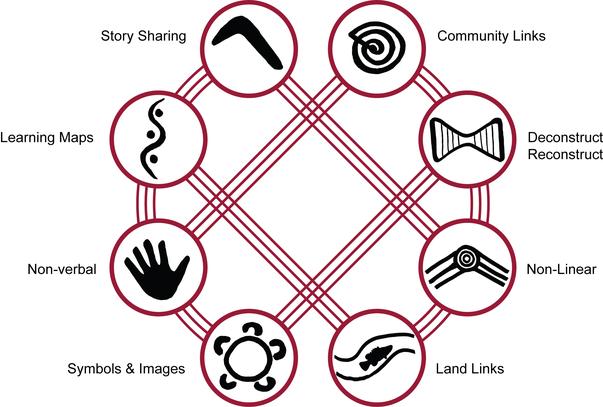
Banner image of eight Australian Indigenous ways of learning, based on Tyson Yungaporta’s 2009 research thesis. Image via Wikimedia Commons (CC0 1.0).
This story first appeared on Mongabay
This article is licensed under a Creative Commons Attribution-NoDerivatives 4.0 International License.
You may republish this article, so long as you credit the authors and Mongabay, and do not change the text. Please include a link back to the original article.



